TokyoHakoneDay tripsMt FujiOnsen
Hakone Day Trip from Tokyo: The 2026 Planning Guide
Plan a Hakone day trip from Tokyo: the Mt Fuji combo vs Hakone on its own, ropeway and lake cruise, bullet train vs bus, and the tours travelers rate highest.
By SimilarTours Editorial · Travel Research · · 13 min read

Hakone is the day trip from Tokyo that quietly out-rewards the famous one. Travelers fixate on Mt Fuji, book a Fuji-only trip, and risk a day staring at cloud. Hakone, the onsen region right next door, gives you a volcanic valley, a ropeway, a lake cruise, and hot springs that are worth the trip whether or not the mountain shows. The best day trips know this and pair the two.
This guide walks the Hakone day trip from Tokyo: when to do Hakone on its own versus combined with Mt Fuji, which transport mix is worth paying for, and what the region's headline stops actually deliver. Every tour referenced is currently bookable through our partner OTAs and ranked on real ratings and review counts, verified June 2026.
Browse all Tokyo and Hakone day trips →The core decision: Hakone-plus-Fuji or Hakone alone
Almost every day trip frames this for you. The combo visits a Mt Fuji viewing area and then loops through Hakone; the Hakone-focused trips skip the Fuji leg for more time in the onsen region. The combo is the more popular first-visit choice precisely because Hakone is the built-in insurance if Fuji hides.
| Format | Best for | Typical length | Fuji included |
|---|---|---|---|
| Mt Fuji + Hakone combo | First visit, breadth | 11 hours | Yes |
| Hakone-focused day | The onsen region, depth | 9-10 hours | View-dependent |
| Private Fuji + Hakone | Control, flexibility | 10 hours | Yes |
| Independent (bullet train) | Budget, own pace | Self-paced | View-dependent |
1. The Mt Fuji and Hakone combo: the popular first-visit pick
The most-booked format, and the most-reviewed single tour in the whole category. The logic is simple: Fuji and Hakone are close together, so one coach day can hit a Fuji viewing platform and then loop through Hakone's valley, ropeway, and lake. If Fuji clouds over, the Hakone half still makes the day.
Top Mt Fuji and Hakone combo day trips

Mt Fuji and Hakone 1-Day Bus Tour Return by Bullet Train
The most-reviewed Fuji-and-Hakone day by a wide margin - coach out, bullet-train back to skip the evening traffic, with the full Hakone loop.
4.8(30,203)11 hoursViewFrom$157Mt Fuji and Hakone 1-Day Bus Tour Return by Bus
The pure-bus version of the top combo - cheaper than the bullet-train return, a longer day, the same Fuji-and-Hakone itinerary.
4.6(955)11 hoursViewFrom$130
Mt Fuji & Hakone Cruise, Drum Show Bullet Train 1 Day from Tokyo
Adds a Lake Ashi cruise and a drum show to the Fuji-and-Hakone day, returning by bullet train - more inclusions packed into the loop.
4.2(7,585)11.8 hoursViewFrom$172
From Hakone: Mt Fuji and Lake Kawaguchiko Area Bus Tour
7 hours - 9 hoursViewFrom$112
Hakone customized private one day tour
5.0(1)7 hoursViewFrom$192
Day Trip to Hakone from Tokyo with National Licensed Guide
9 hoursViewFrom$575
Hakone Full-Day Private Tour
4.8(5)7 hoursViewFrom$261
Mount Fuji Majesty with Hakone Wonders Exclusive Private Day Trip
5.0(2)10 hoursViewFrom$459
Visiting Historical Sites in Hakone with a View of Mount Fuji
7 hoursViewFrom$170
Private Tour - Hakone Day Trip! A Tour to Explore All Must-Sees!
4.9(88)7 hr 30 minViewFrom$182
Insider tip
Why the combo beats Fuji-only. Mt Fuji is visible on roughly a quarter of all days and clouds over fast on summer afternoons. A Fuji-only trip can end in a wall of grey. The Hakone half of a combo tour, the Owakudani valley, the ropeway, the Lake Ashi cruise, and the onsen towns, gives you a full, satisfying day even with zero Fuji. That is the single best reason to pair them.
2. The Hakone highlights: what the region delivers
Whether on a combo or a Hakone-focused trip, these are the stops that rotate through the itineraries. They are worth knowing so you can read what a given tour actually includes.
Owakudani volcanic valley. Sulfurous steam vents and the black eggs cooked in the geothermal water, with the Hakone Ropeway running over the valley. Mt Fuji is a distant cone on the horizon on clear days.
Hakone Ropeway. The cable-car ride over the volcanic zone, with Fuji views on clear days. One of the region's signature experiences.
Lake Ashi cruise. A boat across the lake, with Fuji visible from the deck when the weather cooperates. Lower altitude, more often cloudy, but scenic regardless.
Onsen towns. Hakone Yumoto and the surrounding hot-spring towns are the soul of the region. Some day trips build in time for a soak.
3. Budget and value Hakone-area day trips
If the bullet-train-return combos sit above your budget, the value coach tours cover the Fuji viewing areas and the Hakone region at a lower price, usually trading the train return for an all-bus day.
Budget Mt Fuji and Hakone-area day trips

Mount Fuji Full Day Sightseeing Tour from Tokyo
The most affordable Fuji-and-Hakone-area day in the catalog - coach format, the headline viewing and region stops, return by bus.
4.8(924)10 hoursViewFrom$57
Hakone for Children to Enjoy! Japanese Crafts Experience
5.0(1)6 hoursViewFrom$178
Mount Fuji Highlights Minibus(small group) Tour from Tokyo
5.0(1)10 hoursViewFrom$106Hakone Full-Day Private Tour
4.8(5)7 hoursViewFrom$261From Hakone: Mt Fuji and Lake Kawaguchiko Area Bus Tour
7 hours - 9 hoursViewFrom$112Hakone customized private one day tour
5.0(1)7 hoursViewFrom$192
From Hakone: One Way Bus Transfer to Lake Kawaguchiko
4 hr 30 min - 5 hr 55 minViewFrom$59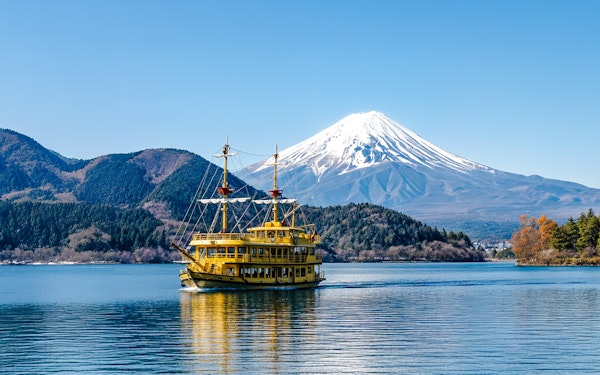
Mount Fuji Tour with Hakone Ropeway, Lake Ashi, Hakone Shrine, & More
4.6(2,779)10 hr 30 minViewFrom$61
Shore Excursion Private Mt Fuji and Hakone Tour from Shimizu Port
4.6(9)4 hours - 8 hoursViewFrom$2,000Visiting Historical Sites in Hakone with a View of Mount Fuji
7 hoursViewFrom$170
4. Private Hakone and Fuji day trips
Private tours buy control: a driver who checks the morning Fuji cameras, flips the order of stops to chase a clearing window, or lingers longer in the onsen region if the mountain stays hidden. They cost two to three times the group price, but for small groups the per-person math can close.
Top private Mt Fuji and Hakone day trips

Private Tour to Mt. Fuji and Hakone (Fully Licensed Operator)
The leading private Fuji-and-Hakone tour by volume - a licensed guide and weather-adaptive routing across the viewing areas and the Hakone loop.
4.9(2,353)10 hoursViewFrom$501Hakone Full-Day Private Tour
4.8(5)7 hoursViewFrom$261
Hakone & Mt Fuji Private Custom Tour with English Driver
4.9(73)10 hoursViewFrom$430Visiting Historical Sites in Hakone with a View of Mount Fuji
7 hoursViewFrom$170Mount Fuji Majesty with Hakone Wonders Exclusive Private Day Trip
5.0(2)10 hoursViewFrom$459Hakone customized private one day tour
5.0(1)7 hoursViewFrom$192Shore Excursion Private Mt Fuji and Hakone Tour from Shimizu Port
4.6(9)4 hours - 8 hoursViewFrom$2,000
Mt.Fuji Full-Day Private Tour By Public Transportation
11 hoursViewFrom$198
Hakone Private Custom Tour: Mt. Fuji View, Nature & Shrine
4.8(50)5 hours - 7 hoursViewFrom$190
The Hakone loop in detail
Part of what makes Hakone special is that getting around is half the experience. The classic circuit chains together a series of distinct transport modes, each a small attraction in itself: a mountain railway that switchbacks up the hillside, a cable car, the ropeway gondola over the steaming Owakudani valley, and a cruise across Lake Ashi on a galleon-style boat. Guided tours run a streamlined version of this loop by coach, hitting the highlights without the connections; independent travelers can ride the full circuit using the region's combination pass.
The reason the loop matters for planning is that it sets the rhythm of the day. You are not standing in one place for hours; you are moving through a volcanic landscape in stages, with the scenery, and on clear days Mt Fuji, opening up differently from each. It also means weather affects different segments differently: the ropeway occasionally pauses in high wind or volcanic activity, in which case a substitute bus runs, so a flexible itinerary helps.
Onsen: what to expect
Hakone is, at its heart, an onsen town, a hot-spring region where the volcanic geology feeds bathhouses and ryokan inns. Some day trips build in time for a soak, and it is one of the most relaxing ways to end the day before the ride back to Tokyo. A few things to know: traditional onsen are bathed in without swimwear, you wash thoroughly at the seated showers before entering the communal bath, and historically many onsen restricted guests with tattoos, though private baths and tattoo-friendly facilities have become easier to find. If a soak appeals, check that your chosen tour or a stop allows the time, as the full bathing ritual is not a five-minute affair.
Doing it independently
Hakone is reachable on your own: the bullet train runs to Odawara in about 35 to 40 minutes, with onward connections into the region. The Hakone area has its own multi-transport pass that links the ropeway, the lake cruise, and the local lines. It is a rewarding self-guided day for confident travelers, though the region's layered transport is exactly what a guided tour exists to smooth over.
Booking lead time and cancellation
Peak season for Hakone day trips tracks the Fuji draw: spring cherry-blossom weeks, the autumn colors of late October to early December, and summer. In those windows the bullet-train-return combos book out 1 to 2 weeks ahead. Off-peak you can often book a few days out. Most coach tours offer free cancellation up to 24 hours before pickup, the policy worth filtering for if Fuji visibility is a factor in your plans.
Quick compare: the best Hakone day trips from Tokyo
| Tour | Format | From | Duration | Rating |
|---|---|---|---|---|
| Fuji & Hakone, Bullet Train Return | Combo (train) | $157 | 11h | ★4.8 (30,203) |
| Fuji & Hakone, Return by Bus | Combo (bus) | $130 | 11h | ★4.6 (955) |
| Fuji & Hakone Cruise + Drum Show | Combo (train) | $172 | 11.8h | ★4.2 (7,585) |
| Mount Fuji Full Day Sightseeing | Budget combo | $57 | 10h | ★4.8 (924) |
| Private Fuji & Hakone (Licensed) | Private | $501 | 10h | ★4.9 (2,353) |
| Private Fuji & Hakone (Driver) | Private | $436 | 10h | ★4.7 (856) |
Hakone or a Fuji-only trip: the honest answer
If you are choosing between a Hakone-inclusive day and a Fuji-only trip, the case for Hakone is reliability. A Fuji-only trip lives or dies on whether the mountain shows, and it hides far more often than the postcards suggest. Hakone gives you a full, rewarding day regardless, the volcanic valley, the ropeway, the lake, the onsen, with Fuji as a bonus when the weather cooperates rather than the whole point. For a first visit, that insurance is worth a lot, which is why the most-booked tours pair the two and why we steer most travelers toward the combo over a Fuji-only gamble.
Practical tips for the day
Dress in layers. The Hakone uplands and the Fuji viewing areas run colder and windier than central Tokyo, especially at altitude.
Carry cash. The Owakudani black-egg stalls, smaller onsen towns, and local stops often prefer it.
Pack motion-sickness tablets if winding mountain roads bother you; the routes into the region are a series of switchbacks.
Check the Fuji cameras the morning of. On combo tours, an early-morning clear window is your best shot at the mountain before the afternoon cloud builds.
Plan your trip
See all Tokyo and Hakone day trips →How far is Hakone from Tokyo?
Hakone is about 80 to 90 km southwest of Tokyo. By bullet train it is roughly 35 to 40 minutes to Odawara, then a short onward connection into the Hakone region. By road it is around 1.5 to 2 hours each way without traffic. Most guided day trips drive down by coach and often return by bullet train to skip the evening traffic back into the city.
Is Hakone worth a day trip from Tokyo?
Yes. Hakone packs an onsen hot-spring region, the Owakudani volcanic valley, a ropeway with Mt Fuji views on clear days, and a lake cruise into a compact area, which makes it one of the most rewarding day trips from Tokyo. It also works as a reliable Plan B for Mt Fuji: even when the mountain hides, Hakone gives you a full day on its own.
Should I combine Hakone with Mt Fuji?
For a first visit, the combo is the most popular choice and for good reason. Mt Fuji and Hakone sit close together, so the standard combo tour visits a Fuji viewing area and then loops through Hakone for the Owakudani valley, the ropeway, and the Lake Ashi cruise. If Fuji clouds over, the Hakone half still delivers, which is why the pairing is the safer bet than a Fuji-only trip.
What is there to do in Hakone?
The headline stops are the Owakudani volcanic valley with its steam vents and black eggs, the Hakone Ropeway over the valley, a pirate-ship cruise on Lake Ashi, the onsen hot-spring towns, and open-air art. On a clear day Mt Fuji is visible from several of these. A guided day trip strings the highlights together so you are not solving the region's famously layered transport on your own.
Bullet train or bus to Hakone?
Most rated day-trip tours drive down by coach and return by bullet train, which is the best of both: the guide narrates and controls the stops on the way out, and the train saves time against Tokyo's evening traffic on the way back. Pure-bus tours are cheaper but a longer day. Independent travelers can take the bullet train both ways via Odawara.
Can you see Mt Fuji from Hakone?
On clear days, yes, from several spots including the Lake Ashi cruise and the ropeway. But Fuji is shy and often hidden, especially on summer afternoons. The advantage of Hakone over a Fuji-only trip is that the region is rewarding regardless: the volcanic valley, the onsen, and the lake stand on their own when the mountain does not show.
How long is a Hakone day trip from Tokyo?
Guided day trips typically run 9 to 12 hours door to door, depending on whether Mt Fuji is included and whether you return by bullet train or bus. The Fuji-and-Hakone combos sit at the longer end, around 11 hours. Independent visits can be shorter or longer depending on how many of the region's stops you link together.
Is Hakone better as a day trip or an overnight stay?
A day trip covers the headline stops comfortably, which is why the combo tours are so popular. But Hakone rewards an overnight if you can spare it: staying in a ryokan with its own onsen, and seeing the region empty out once the day-trippers leave, is a different and more restful experience. For a first visit on limited time, the day trip is the efficient choice; if onsen relaxation is the goal, an overnight is worth it.
When is the best time to visit Hakone?
Autumn (late October to November) is the standout, with vivid foliage across the hills and the clear, dry air that gives the best Mt Fuji odds. Spring brings blossom and fresh green; winter is cold but offers the clearest Fuji views and steaming onsen at their most appealing. Summer is lush but more humid and more prone to the afternoon cloud that hides the mountain. Whatever the season, the onsen and the volcanic valley work year round.
Keep reading
More reads
More guides to help you plan your trip

2 Days in Tokyo: Two Districts, Done Properly
Two days in Tokyo is enough for two districts and nothing else - and that is the right plan. A day-by-day route, what to book, and what to deliberately skip.

5 Days in Tokyo: How to Use a City With No Centre
Five days in Tokyo, organised by district rather than by sight - a day-by-day plan, the day trip worth taking, and why the fifth day should not be booked.

The Best Walking Tours in Tokyo: Which Ones Actually Help
Tokyo is the city where a guide earns their money. A guide to the walking tours worth booking - by neighbourhood, by theme, and by what you need explained.

Tokyo in Summer: How to Enjoy a City That Is Genuinely Hot
Summer in Tokyo is hot, humid, and full of things worth seeing. How to structure days around the heat, what to book, and when the season is actually at its best.

The Best Day Trips from Tokyo: Mt Fuji, Kamakura, Nikko and More
The best day trips from Tokyo ranked by what is worth a full day: Mt Fuji and Hakone, Kamakura, Nikko, Yokohama, and Kawagoe, with the top-rated tours for each.

Tokyo in Winter: Clear Skies, Illuminations, and the Best Fuji Views
Tokyo in winter is the underrated season: crisp clear skies, the year's best Mt Fuji visibility, city-wide illuminations, onsen day trips, and thin crowds.

Things to Do in Tokyo with Kids: A Family Guide That Actually Works
The best things to do in Tokyo with kids: teamLab, the Skytree, a theme park day, animal cafes and parks, plus the transit and hotel logistics that matter.

The Best Time to Visit Tokyo: A Month-by-Month Guide
The best time to visit Tokyo, month by month: the real trade-offs between weather, crowds, and prices, plus the two sweet-spot windows for cherry blossom and autumn colour.