ParisWalking ToursFranceMontmartreLe Marais
The Best Walking Tours in Paris: Highlights, Montmartre, Food and More
Every kind of walking tour of Paris compared: classic highlights, Montmartre, food walks, Le Marais, and night walks, ranked on real ratings and reviews.
Av SimilarTours Editorial · Travel Research · · 21 min läsning

A walking tour of Paris is the single best-value thing you can book in the city, and this is not close. Paris is compact, flat outside Montmartre, and dense with stories that do not announce themselves on plaques; a good guide turns streets you would have crossed obliviously into the reason you came. The market reflects it: walking tours are the best-rated experience category in the entire Paris catalog, and the top ones carry thousands of reviews.
The catch is that "walking tour" covers five very different products, from free tip-based city walks to $150 food crawls. This guide breaks them down by type, classic highlights, Montmartre, food walks, Le Marais, and night walks, with the highest-rated bookable options in each, ranked on real ratings and review counts and verified July 2026.
Browse all Paris tours and experiences →Before you book: how Paris walking tours work
The formats. Tip-based "free" tours are pay-what-you-decide at the end, and the good ones are genuinely excellent. Standard guided walks run 1.5 to 3 hours at a fixed price, mostly $30 to $75. Small-group and private versions cap the numbers and raise the price. Food walks bundle enough tastings to replace a meal and price accordingly. Night walks trade sights for atmosphere and stories.
Pace and footwear. Walking-tour pace is slow, a stroll with stops, so stamina is rarely the issue. Cobbles and, on the Montmartre walks, stairs are, so wear broken-in shoes. Tours generally run rain or shine; bring a layer.
When to book what. Book a highlights walk for your first morning or afternoon, it makes every later day smarter, and book food walks a few days ahead since the small groups fill first. Ordinary neighborhood walks can usually be grabbed a day or two out.
With kids or limited mobility. Standard group walks assume two hours of standing and strolling, which is a lot for young children; the treasure-hunt style family formats exist precisely to fix this, and private versions of most neighborhood walks let the guide set your pace. Travelers with limited mobility should favor the center and Marais routes, which are flat, over Montmartre, which is stairs by design, and message the operator before booking: most Paris guides adapt routes readily when asked, but the cobbles and curbs are easier to plan around than to discover.
Insider tip
Do the big walk first. The single best scheduling trick in Paris is putting a highlights walking tour in your first 24 hours. You leave with the city's layout in your head, a shortlist of places to come back to, and a local's answers to the questions every first-timer has. Every subsequent day runs smarter for it.
Classic highlights walks: the whole city in one go
The classic city-center walk is the default first booking: the river, the islands, the Louvre's surroundings, and the monumental core, stitched together by a guide who explains how it all fits. The range runs from a near-perfect-rated tip-based tour to a five-hour half-day sweep, and includes walks that pair the city center with the interior of Notre-Dame.
Top classic Paris walking tours

Paris Top Sights Half Day Walking Tour with a Fun Guide
The heavyweight of the category - a five-hour half-day sweep of the top sights with a big review base and ratings to match.
4.8(3,136)5 hoursViewFrom$75
Paris City Center Free Walking Tour (Tip-Based)
The best-known tip-based walk in the center - near-perfect ratings across a large review base, pay the guide what it was worth at the end.
5.0(1,715)2.3 hoursViewFrom$3
Paris Notre-Dame Interior or Exterior Walking Tour
A focused ninety-minute walk around, or into, Notre-Dame and its island - the pick if the cathedral quarter is your priority.
4.9(2,292)1.5 hoursViewFrom$35
Paris City Center with Notre Dame interior Exclusive Walking Tour
A small-format city-center walk including the Notre-Dame interior - the highest-rated of the premium center walks.
4.9(219)2.7 hoursViewFrom$61
Old Paris Walking Tour: Explore Saint-Germain and Saint-Michel
5.0(17)2 hoursViewFrom$42
Paris Highlights: Half Day Private Walking Tour
5.0(189)3 hoursViewFrom$411
VIP Paris in a Day: Montmartre, Louvre, Île de la Cité, Cruise
5.0(13)8 hoursViewFrom$469
Paris Top Sights Half Day Walking Tour + Wine Tasting Experience
5.0(16)6 hours - 7 hoursViewFrom$164
Explore Paris Highlights by Bike
5.0(37)4 hoursViewFrom$47
Paris starts here The Tour for first-time visitors
5.0(11)2 hoursViewFrom$18
Walking tours of Montmartre: the hill that needs a storyteller
If you take one neighborhood tour in Paris, make it Montmartre. The walking tours of Montmartre in Paris France consistently outrate everything else in the city, because the neighborhood is all backstory: the artists' studios, the cabarets, the vineyard behind the hill, the village absorbed by the city. Without the stories it is a pretty, steep photo stop; with them it is the best two hours on foot in Paris. There is a strong free walking tour of Montmartre for budget travelers, tip-based with near-perfect scores, alongside the classic paid walks and a pop-culture screen-locations version.
Top Montmartre walking tours

Paris Montmartre Walking Tour Best Art Culture and Food
The most-reviewed Montmartre walk in the catalog - art, culture, and food packed into ninety minutes on the hill.
4.8(2,818)1.5 hoursViewFrom$37
Paris Montmartre Walking Tour: Hidden Gems, Views & Croissant
Two hours through the quieter lanes with a croissant stop and the best viewpoints - a highly rated take on the neighborhood beyond the main square.
4.8(934)2 hoursViewFrom$41
Montmartre District Walking Tour in Paris
A classic two-and-a-half-hour district walk - the straightforward, well-reviewed version of the full Montmartre story.
4.9(814)2.5 hoursViewFrom$30
Emily in Paris Montmartre Walking Tour
The screen-locations take on the hill - a two-hour walk hitting the show's Montmartre spots, for fans who want their Paris with a plot.
4.2(117)2 hoursViewFrom$40
Montmartre Private Walking Tour: Famous Artists and Cabarets
5.0(21)2 hr 15 minViewFrom$341
Montmartre Walking Guided Tour
5.0(111)2 hoursViewFrom$35
Montmartre guided walking tour with local guide in small group
5.0(17)2 hr 20 minViewFrom$41
Montmartre Paris Hidden Gems Small Group Walking Tour
5.0(14)2 hoursViewFrom$235
Montmartre Semi Private Tour: from Moulin Rouge, to Sacré-Cœur
5.0(55)2 hoursViewFrom$110
Paris food walking tours: eat the city
The food walk is the walking tour's best evolution: three to four hours moving between cheesemongers, bakeries, chocolatiers, and wine stops, with tastings that add up to a rolling feast. Review-for-review these are some of the best-rated experiences in all of Paris, and they solve lunch and sightseeing in one booking. Montmartre and the broader center are the classic hunting grounds; go hungry, because the portions are not symbolic.
Top Paris food walking tours

Paris Food Tour: Eat Like a Local with Cheeses, Wines & Secrets
The most-reviewed food walk in Paris - three and a half hours of cheese, wine, and neighborhood secrets with a five-thousand-review track record.
4.8(5,190)3.5 hoursViewFrom$87
Devour Paris Ultimate Food Tour
The flagship three-hour tasting walk from a specialist operator - one of the highest-rated food experiences in the city at scale.
4.9(2,760)3 hoursViewFrom$118
Montmartre Hill French Gourmet Food and Wine Tasting Walking Tour
The gourmet tasting climb up Montmartre - food, wine, and the hill's stories in one heavily reviewed three-and-a-half-hour package.
4.8(2,703)3.5 hoursViewFrom$140
Eating Paris Montmartre Food and Wine Small Group Tour
The small-group Montmartre food option - capped numbers, three hours of tastings, and one of the top ratings in the category.
4.9(821)3 hoursViewFrom$156
Paris: Le Marais Private Guided Food Tour with 10 French Tastings
5.0(128)3 hr 30 minViewFrom$272
Paris Walking Food Tour : Explore Canal Saint-Martin Like a Local
5.0(15)3 hoursViewFrom$112
Paris Small-Group Montmartre Chocolate & Pastry Walking Tour
5.0(54)3 hoursViewFrom$101
Paris: Pastries & Damnations - A Sweet Tour of the Old City
5.0(24)2 hoursViewFrom$81
Paris Food Tour
0.0(0)3 hoursViewFrom$110
The food, wine & tragedies tour of Montmartre
5.0(18)2 hr 40 min - 3 hr 10 minViewFrom$75
Le Marais walking tours: the district history built
The Marais is the other neighborhood where a guide changes everything. A Marais Paris walking tour moves through pre-revolutionary mansions, the arcaded Place des Vosges, and the old Jewish quarter around Rue des Rosiers, layers of the city's story packed into streets you can cross in minutes. The food-walk variant is particularly strong here, with the district's bakeries, falafel institutions, and cheese shops doing the heavy lifting between chapters.
Top Le Marais walking tours

Marais District and Jewish Quarter Guided Walking Tour 12ppl Max
A twelve-person-max walk through the Marais and the Jewish quarter - the highest-rated of the district's history walks.
5.0(403)2.5 hoursViewFrom$61
Paris Le Marais Food Tour With 10+ Tastings, Cheese, Wine & More
The Marais food-walk heavyweight - ten-plus tastings across three and a half hours, from the same stable as the city's most-reviewed food tour.
4.8(1,163)3.5 hoursViewFrom$104
Le Marais Walking Tour: Hidden Stories, History & Local Life
Two hours of the district's hidden stories and local life - the mid-priced pick for the Marais beyond its shopping streets.
4.8(192)2 hoursViewFrom$60
Paris Le Marais Walking Tour: An Incredible History - Small Group
A small-group history walk with a perfect score so far - the intimate option for going deep on the district.
5.0(30)2 hoursViewFrom$64Paris: Le Marais Private Guided Food Tour with 10 French Tastings
5.0(128)3 hr 30 minViewFrom$272
Small Group Marais/Place des Vosges Walking Tour -10 people max
5.0(27)2 hoursViewFrom$59
Jewish History Tour of Le Marais
5.0(21)4 hoursViewFrom$117
Paris History Walk: Medieval Marais, Notre Dame Islands & Stories
5.0(15)2 hoursViewFrom$81
Paris Latin Quarter Walking Tour: History & Culture - Small Group
5.0(16)2 hoursViewFrom$65
Guided Walking Tour of Saint-Germain-Des-Prés
0.0(0)1 hr 30 minViewFrom$38
Latin Quarter and the islands: the oldest Paris on foot
The Latin Quarter and the two river islands are where walking tours earn their keep in a different way from Montmartre: not one big story but hundreds of small ones, layered into lanes that have carried students, printers, and philosophers for centuries. The quarter's walks weave the Sorbonne streets, the Pantheon's hill, and the bookshops by the river into a coherent picture, and the island walks do the same for Notre-Dame's neighborhood, the flower market, and the quieter Ile Saint-Louis a bridge away. This is also the best-served area for app-based audio walks if you want the stories at your own pace, and the "hidden gems" tip-based formats concentrate here too, working the courtyards and passages the big groups skip.
Top Latin Quarter and island walking tours

Paris Latin Quarter Exclusive Guided Walking Tour
The standout Latin Quarter walk - two and a half small-format hours through the student lanes with a near-perfect rating.
5.0(220)2.5 hoursViewFrom$61
The Ultimate Notre-Dame Cathedral & Île de la Cité Walking Tour
The heavyweight island walk - Notre-Dame's quarter and the Ile de la Cite covered in two hours, with the biggest review base in the category.
4.4(1,226)2 hoursViewFrom$69
Paris Time Machine: Hidden Gems Walking Tour (Tips-Based)
A tip-based walk through the passages and courtyards the checklist tours skip - near-perfect scores from travelers who wanted the unobvious city.
5.0(242)1.8 hoursViewFrom$3- tiqets
Paris Latin Quarter: Audio Guide App by TouringBee
A self-paced audio-app walk through the Latin Quarter - the budget self-guided option when you want the stories without the schedule.
4.8(4)1.5 hoursViewFrom$8 
Paris Latin Quarter Private Tour—Roman Ruins, Sorbonne & Pantheon
5.0(25)2 hr 15 minViewFrom$337Paris Latin Quarter Walking Tour: History & Culture - Small Group
5.0(16)2 hoursViewFrom$65
Latin Quarter Private Walking Tour
5.0(14)2 hoursViewFrom$239
Paris Latin Quarter Walking Tour with Pantheon Entry
5.0(1)ViewFrom$68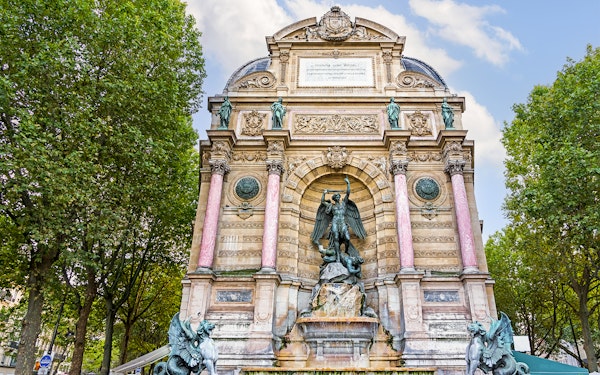
Latin Quarter Guided Walking Tour
5.0(1)1 hr 30 minViewFrom$43
Visits in Italian : Latin Quarter and the Seine ( 2 itineraries)
5.0(21)2 hoursViewFrom$34
The Seine riverside: the walk that needs no ticket
Before booking anything, know that the single best walk in Paris is free. The riverbank through the center, much of it on car-free lower quays, strings together more landmarks per kilometer than any guided route in Europe: the islands and their cathedral, the Louvre's long river facade, the grand bridges one after another, the bookseller boxes on the parapets above, and the Eiffel Tower closing the western end. Walked east to west it is a comfortable afternoon with cafe barges for the breaks; walked at dusk into darkness it becomes the night walk mentioned above, with the illuminations coming on around you.
Guided tours use the riverbank as connective tissue rather than a destination, which is exactly why it makes the perfect self-guided complement to them: do a guided neighborhood walk in the morning, then give the afternoon to the quays with no plan at all. If your legs give out mid-river, the hop-on-hop-off boats run the same corridor and function as a floating shortcut back.
A one-day self-guided walking route
For travelers who want the self-guided version properly organized, here is the route we would put on any Paris walking tour map, a full day, no tickets required, quitting points everywhere.
Morning: the islands and the Latin Quarter. Start at Notre-Dame's square on the Ile de la Cite, loop the island past the flower market, cross to the Ile Saint-Louis for its single perfect high street, then bridge over to the Left Bank and climb gently through the Latin Quarter's lanes toward the Pantheon. Coffee stops present themselves roughly every ninety seconds.
Midday: Luxembourg to Saint-Germain. From the Pantheon it is a short drop to the Luxembourg Gardens, the day's built-in rest, then a drift through Saint-Germain's gallery streets back toward the river. Lunch here, this is some of the best casual-bistro territory in the city.
Afternoon: the river to the Louvre and the Tuileries. Rejoin the Seine and follow it west past the Louvre's facade, detour into its courtyards for the pyramid view (no ticket needed for the courtyards), and finish through the Tuileries to the Place de la Concorde. Total walking distance for the full day sits in comfortable-with-breaks territory for most travelers, and the route passes a Metro station every few hundred meters, so bailing out early is always painless.
Swap the afternoon for Montmartre if you would rather end on the hill; the Metro connects the Tuileries end to the base of the butte directly.
Paris night walking tours: the city after dark
Paris at night is a different product: the monuments are lit, the crowds thin, and the storytelling turns to the city's darker chapters. The standout format is the ghosts-and-legends walk, the most-reviewed of them is the two-hour Paris by Night Walking Tour: Ghosts, Mysteries and Legends, priced around $17 with nearly a thousand reviews, which swaps sightseeing for two hours of the macabre and the mysterious through the old center. Reviewers split predictably: story-lovers rate it a highlight, literalists find it theatrical, so pick it for the tone, not the monuments.
The alternative night move is simpler and free: walk the riverbank. The stretch of the Seine through the center, taken slowly after dark when the bridges and facades are lit, is the best self-guided night walk in Europe, and it needs no ticket at all.
Season changes the night-walk math more than any other category. In winter, darkness arrives by late afternoon, so the illuminated city is available from about 6 p.m. and a night walk fits before dinner rather than after it, the consolation prize of the short days. In high summer the light lingers well into the evening, which pushes the true after-dark experience late; if you are traveling in June or July, take the riverbank walk as a post-dinner digestif rather than an early-evening stroll, or you will be walking a lit route in daylight. The guided ghost walks run year-round and lean into winter atmospherics happily.
Compare all Paris night tours and experiences →Guided or self-guided: an honest comparison
The case for a self guided walking tour of Paris is real: the center is compact, safe, and so dense with landmarks that a simple route, Notre-Dame along the river past the Louvre to the Tuileries, or up through Montmartre's lanes, delivers a great walk with any decent Paris walking tour map or offline map app. You set the pace, it costs nothing, and serendipity does the curating.
What the guided version buys is everything that is not visible: the stories behind the facades, the courtyard doors you would never push open, the answers to your accumulated questions, and the neighborhood knowledge that turns a pretty street into a specific one. The economics favor a hybrid: one or two guided walks early in the trip, a highlights walk plus the neighborhood you care most about, then self-guided wandering after, armed with what the guides gave you.
Browse all guided walking tours in Paris →How many walking tours fit a trip
The right number of booked walks scales with trip length, and over-booking is the classic mistake, walking tours compete with each other for the same legs.
Two days: one. The classic highlights walk on the first morning, self-guided riverbank after. Anything more crowds out the sights themselves.
Three to four days: two. The highlights walk on day one plus one neighborhood, Montmartre for most first-timers, the Marais for history-minded travelers, with a food walk substituting for one of them if eating is the trip's real agenda.
Five days or more: three fits comfortably, highlights, one neighborhood, one food walk, with the night walk as an optional fourth since it occupies an evening rather than a day. Past three booked walks, returns diminish fast; the better use of a long trip's extra days is the self-guided routes above, done with the confidence the guided walks gave you.
Whatever the count, spread them out. Back-to-back walking tours on consecutive mornings feel like commuting; a rest day of parks, museums, or a river cruise between them resets the legs and the attention span.
Practical tips for walking tours in Paris
Book the small-group and food tours a few days ahead. Capped groups fill first, especially in spring and early autumn; the big tip-based walks usually have same-week space.
Wear broken-in shoes and check the weather. Cobbles are universal, Montmartre adds stairs, and most tours run rain or shine.
Tip the tip-based guides properly. The free-tour model works because good guides earn it; showing up with nothing is poor form.
Eat around the food tour. A food walk replaces a meal, so book it for lunch or early evening and plan the day's other eating lightly.
Confirm the meeting point the night before. Paris walking tours start from squares, Metro exits, and cafe corners, not offices; five minutes of checking saves a missed start.
Match the tour to the day. Highlights walk first, neighborhoods mid-trip, night walk whenever the evening is free; the sequencing is half the value.
Quick recap: which walking tour of Paris to book
First visit: a classic highlights walk in your first 24 hours. One neighborhood: Montmartre, guided, with the tip-based version as the budget route. Food lovers: a Montmartre or Marais food walk in place of a lunch. History depth: the Marais with a small group. After dark: the ghosts-and-legends walk for storytelling, or the illuminated riverbank on your own for free. Mix one or two guided walks with self-guided wandering and you have the whole city on foot.
Plan your trip
See all Paris tours and experiences →What is the best walking tour of Paris for a first visit?
For a first visit, a classic highlights walk through the city center is the right opening move: two to five hours covering the river, the islands, and the headline monuments with a guide stitching the story together. The most-reviewed options run from tip-based free tours to half-day guided walks. Do it on day one and the rest of your trip makes more sense, because you will have seen how the pieces of the city fit together.
Are free walking tours in Paris actually free?
They are tip-based: booking is free or close to it, and you pay the guide at the end based on what the tour was worth to you. The quality is often excellent, the top tip-based tours in Paris carry some of the highest ratings in the whole catalog, and guides work hard precisely because they are paid on performance. Budget a reasonable tip per person, book a slot anyway since groups cap out, and treat it as pay-what-it-deserved rather than free.
Is Montmartre worth a guided walking tour?
More than any other Paris neighborhood, yes. Montmartre reads as a pretty hill without context; with a guide it becomes the layered story of artists, cabarets, the vineyard, and the village the city swallowed. The walking tours of Montmartre are among the best-rated in Paris, from short art-and-culture walks to food-tasting versions, and there is a well-reviewed tip-based option if budget is the constraint. Wear real shoes; the hill is steep and cobbled.
What is a Paris food walking tour like?
Typically three to four hours moving between a cheesemonger, a bakery, a chocolatier, a wine stop, and a few neighborhood institutions, with enough tastings along the way to add up to a full meal. Montmartre and Le Marais are the two classic food-walk neighborhoods. The top-rated food walks in Paris carry thousands of reviews and are, review-for-review, some of the best-rated experiences in the city. Go hungry; the portions are real.
Can I do a self guided walking tour of Paris instead?
Absolutely, and central Paris is one of the best cities anywhere for it: compact, dense with landmarks, and safe to wander. The classic self-guided route runs from Notre-Dame along the river past the Louvre to the Tuileries, or up through Montmartre's lanes with a map. What you give up is the storytelling and the doors a guide can open; what you gain is your own pace. Many travelers do one guided walk early in the trip and go self-guided after.
Are night walking tours in Paris safe and worth it?
The guided night walks stick to well-lit, busy central areas and are as safe as the daytime versions; standard city awareness applies either way. Worth it depends on the format: the illuminated riverside is genuinely at its best after dark, and the ghost-and-legends style walks trade sightseeing for storytelling, which reviewers either love or find hokey. Check the recent reviews of the specific tour and pick the tone you want.
How long is a typical walking tour in Paris, and how much walking is it?
Most run 1.5 to 3 hours and cover a modest distance at storytelling pace, with stops every few minutes; half-day highlight walks stretch to five hours with breaks. It is stamina-light compared to a day of solo sightseeing because the pace is slow, but the cobbles and, in Montmartre, the stairs are real, so comfortable broken-in shoes matter more than fitness. Most tours run rain or shine.
How much do walking tours in Paris cost?
Tip-based tours cost whatever you tip, with a small booking fee. Standard guided neighborhood walks mostly sit in the $30 to $75 band, private and small-group versions run higher, and food walks with tastings included span roughly $100 to $160 because they replace a meal. Rating-for-money, the guided neighborhood walks in the $30 to $60 range are the sweet spot of the whole Paris catalog.
How many walking tours should I book for a Paris trip?
One per two days of trip is the reliable ratio. A weekend trip wants just the highlights walk; three to four days fit that plus one neighborhood or food walk; five days or more fit three comfortably, with a night walk as an optional evening extra. Booked walks compete with each other for the same legs and attention, so spread them across the trip and fill the gaps with the free self-guided routes, the riverbank above all.
Keep reading
Fler läsningar
Fler guider för att hjälpa dig planera din resa

1 dag i Paris: Schemat som passar, och det som inte gör det
En dag i Paris, planerad kring verkliga avstånd - vad du bör boka, vad du kan gå, vad du ska hoppa över, och varför tre museer på en dag är klassiska misstaget.

The Best Food Tours in Paris: Which Ones Are Worth the Money
Paris food tours are expensive and the good ones are excellent. How to tell them apart - by neighbourhood, by format, and by what you actually want to learn.

Arc de Triomphe-biljetter 2026: Takåtkomst, Paket och Hur du Hoppar över Kön
En 2026-guide till Arc de Triomphe-biljetter - takterrass med tidsbokad inträde, hoppa över kön, Paris utsiktspunkter och Seine-kryssningspaket, samt guidade promenader på Champs-Élysées.

Musee d'Orsay-biljetter 2026: Typer, hoppa över kön och paket jämfört
En guide 2026 till Musee d'Orsay-biljetter - tidsbokade inträden, hoppa över kö, guidade höjdpunktsturner, Louvre- och Orangerie-paket och passalternativ jämförda.

5 Days in Paris: The Perfect Itinerary at a Relaxed Pace
A 5-day Paris itinerary at a human pace: the icons, Montmartre and Le Marais, a full day at Versailles, and the tours travelers rate highest for each day.

Christmas Markets in Paris: The Best Festive Spots and Tours
The best Christmas markets in Paris, from the Tuileries to La Défense, plus when the season runs, how to plan around crowds, and the top festive experiences.

Summer in Paris: What to Expect and What to Book
What summer in Paris is really like - long evenings, heat waves, August closures, and the Seine cruises, Eiffel Tower visits, and day trips worth booking.

Winter in Paris: What to Expect and What to Book
What winter in Paris is really like - short days, thin crowds, festive lights, and the museum tours, cabaret shows, and food experiences worth booking.