ParisGivernyDay tripsMonetGardens
Giverny Day Trip from Paris: Monet's Garden Tours and Tips
Plan a Giverny day trip from Paris: half-day guided vs full-day and combo tours, the Vernon train option, garden season, and the trips travelers rate highest.
SimilarTours Editorialによる · Travel Research · · 17分間の読むことができます

A Giverny day trip from Paris is one of those rare outings where the reward is exactly what you pictured. This is the small Normandy-border village built around the house, the flower garden, and the water-lily pond with its green Japanese bridge that inspired the Impressionist movement. Seeing them in person, the colour massed along the paths, the reflections on the pond, is the whole point, and it is close enough to the capital to fit comfortably into part of a day.
This guide walks the practical decisions: whether to book a dedicated Paris to Giverny half-day or pair the gardens with Versailles or Auvers-sur-Oise for a full day out, how the coach and minivan tours compare with going independently by the Paris to Giverny train, and what the gardens actually deliver across the season. Every tour referenced is currently bookable through our partner OTAs and ranked on real ratings and review counts, verified July 2026.
Browse all Paris and Giverny day trips →The core decision: Giverny alone or paired with a second stop
Giverny is a half-day sight. The house and the two gardens fill a relaxed couple of hours, and the transfer eats the rest. That single fact shapes every tour format: you either book a dedicated half-day and keep the rest of your time free, or you pair Giverny with Versailles, Auvers-sur-Oise, or a wider Normandy loop to build a full day. Neither is wrong; it depends on your pace and how much you want to see.
| Format | Best for | Typical length | Second stop |
|---|---|---|---|
| Guided half-day | The gardens, a relaxed pace | 4.5-11.5 hours | None |
| Small-group minivan | Smaller groups, hotel pickup | 5 hours | None |
| Combo with Versailles | Two headline sights in a day | 9-11.5 hours | Versailles |
| Combo with Auvers-sur-Oise | Impressionist and Van Gogh trail | 10 hours | Auvers |
| Independent by train | Budget, own pace | Self-paced | Your choice |
1. Guided half-day tours to Monet's garden
The most straightforward way to do Giverny: a guided half-day that picks you up in Paris, drives out to the village, handles entry, and gives you time in the house and gardens before the ride back. These are the trips most travelers book when Giverny is the goal and they want the afternoon or morning free for the city.
Top guided half-day Giverny tours from Paris

Giverny Monet’s Home and Gardens Half Day Tour from Paris
The best-reviewed dedicated Giverny half-day by a wide margin - coach transfer from central Paris, entry handled, and a couple of unhurried hours in the house and gardens.
4.7(2,597)11.5 hoursViewFrom$86
Giverny and Monet's House Half Day Trip from Paris Guide or Audio
A flexible half-day with a choice of live guide or audio commentary - lets you set your own pace through the gardens while keeping the transfers organised.
4.1(1,356)5.3 hoursViewFrom$99
Giverny & Monet's House Audio Guided Half-day Tour from Paris
The audio-guided version - a self-paced walk through the house and water garden with the transfers taken care of, one of the shorter half-day formats.
4.0(385)5 hoursViewFrom$99
Monet's Gardens & House-Private Giverny Tour From Paris
4.7(154)5 hoursViewFrom$508
Audio-guided tour of Monet's house and gardens in Giverny
3.8(6)2 hoursViewFrom$4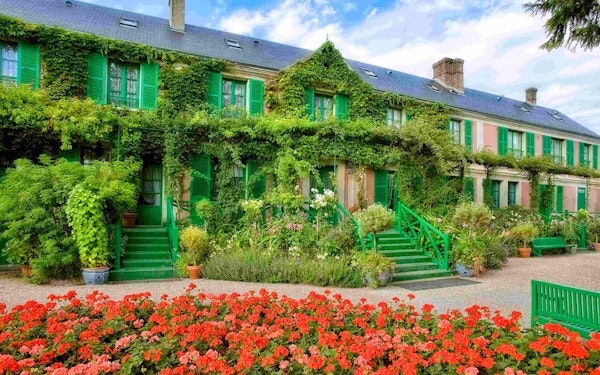
From Paris: Giverny Day Trip with Monet's House & Gardens Entry
4.4(3,971)5 hoursViewFrom$46
From Paris: Giverny Day Trip with Monet's House & Gardens Entry - Small group
5.0(3)ViewFrom$151
Giverny Small-Group Half Day Trip with Monet’s Gardens from Paris
4.8(1,941)4 hr 30 minViewFrom$154
Half-Day Tour to Giverny from Paris with Monet’s House & Gardens
4.0(12)6 hoursViewFrom$74
Giverny Monet's Home & Versailles Palace Day Trip from Paris
4.5(1,012)11 hr 30 minViewFrom$158
Insider tip
Why a half-day is usually enough for Giverny. The house and the two gardens, the flower beds by the house and the water garden with the lily pond and green bridge across the road, are a compact, walkable pair. Most visitors find a couple of hours covers them without rushing. The value of a guided half-day is in the transfer and the entry: you skip the drive planning and, in season, the entrance queue, and you keep the balance of the day for Paris.
2. Small-group and specialty Giverny tours
If a large coach is not your style, small-group minivans run the same route with fewer travelers, hotel or meeting-point pickup, and a more personal pace. There are also specialty formats, a bike tour among them, for travelers who want the countryside as part of the experience rather than just the destination.
Small-group and specialty Giverny tours

Giverny Small-Group Half Day Trip with Monet’s Gardens from Paris
The top-rated small-group half-day - a smaller party through the house and gardens at a gentler pace, one of the most efficient dedicated Giverny formats.
4.8(1,895)4.5 hoursViewFrom$151
From Paris: Monet Gardens & Giverny Bike Tour with Picnic Stop
A different way to see it - cycle the countryside around Giverny with a picnic stop, pairing the gardens with the landscape that shaped the Impressionist eye.
4.7(531)9 hoursViewFrom$139
Giverny Small-Group Minivan with Hotel Pickup or Meeting Point
A small-group minivan with the convenience of hotel pickup or a central meeting point - the shortest, most personal way to reach the gardens.
4.7(730)5 hoursViewFrom$140Monet's Gardens & House-Private Giverny Tour From Paris
4.7(154)5 hoursViewFrom$508Audio-guided tour of Monet's house and gardens in Giverny
3.8(6)2 hoursViewFrom$4From Paris: Giverny Day Trip with Monet's House & Gardens Entry
4.4(3,971)5 hoursViewFrom$46
Giverny Monet’s Home and Gardens Half Day Tour from Paris
4.7(2,965)6 hours - 11 hr 30 minViewFrom$76From Paris: Giverny Day Trip with Monet's House & Gardens Entry - Small group
5.0(3)ViewFrom$151Half-Day Tour to Giverny from Paris with Monet’s House & Gardens
4.0(12)6 hoursViewFrom$74Giverny Monet's Home & Versailles Palace Day Trip from Paris
4.5(1,012)11 hr 30 minViewFrom$158
3. Combo tours: Giverny with Versailles or Auvers-sur-Oise
Because Giverny leaves half the day free, pairing it with a second sight is a popular way to justify the trip out of the city. Versailles is the classic partner, the palace and its gardens on the same day. For a more offbeat pairing, Auvers-sur-Oise, another village steeped in Impressionist and Post-Impressionist history, links naturally with Giverny for an art-focused full day.
Giverny combo tours with Versailles or Auvers

Giverny Monet's Garden & Auvers-sur-Oise with Van Gogh House Full Day From Paris
The highest-rated combo in the set - a full day linking Monet's gardens with the Van Gogh village of Auvers-sur-Oise, an Impressionist-to-Post-Impressionist trail.
4.9(417)10 hoursViewFrom$256
Versailles Timed Entrance Ticket and Giverny Small Group Day Trip from Paris
A small-group full day combining timed Versailles palace entry with Giverny's gardens - two headline sights, the entrance queues handled for both.
4.8(276)9 hoursViewFrom$291
Giverny Monet's Home & Versailles Palace Day Trip from Paris
A well-priced Giverny-and-Versailles full day - the gardens in the morning, the palace and grounds after, both from central Paris.
4.5(901)11.5 hoursViewFrom$156
Versailles Palace and Giverny Monet House Visit with Lunch
The Versailles-and-Giverny pairing with lunch included - a full day covering the palace and the gardens with a meal built into the itinerary.
4.2(1,993)9.5 hoursViewFrom$165From Paris: Giverny Day Trip with Monet's House & Gardens Entry
4.4(3,971)5 hoursViewFrom$46From Paris: Giverny Day Trip with Monet's House & Gardens Entry - Small group
5.0(3)ViewFrom$151Half-Day Tour to Giverny from Paris with Monet’s House & Gardens
4.0(12)6 hoursViewFrom$74
Giverny Half-Day Guided Tour from Paris
5.0(20)4 hr 30 minViewFrom$446
Giverny from Rouen | Private Tour | Guide Optional
8 hoursViewFrom$1,299
Monet’s House & Gardens Giverny Small Group Tour from Paris
4.7(54)5 hours - 7 hoursViewFrom$325
4. Private and premium Giverny day trips
For travelers who want lunch built in, a smaller party, and the palace paired with the gardens without the crowd rhythm of a large coach, the premium combo formats deliver control at a higher price. They cost more per head, but for a couple or a small family who value a slower, more curated day, the trade can be worth it.
Premium Giverny and Versailles day trips

Giverny's House & Gardens plus Versailles Palace Day Trip with Lunch from Paris
A premium full day pairing Giverny's house and gardens with Versailles palace and lunch - the most comprehensive combo in the set for travelers who want it all handled.
4.8(225)9 hoursViewFrom$373From Paris: Giverny Day Trip with Monet's House & Gardens Entry
4.4(3,971)5 hoursViewFrom$46From Paris: Giverny Day Trip with Monet's House & Gardens Entry - Small group
5.0(3)ViewFrom$151Half-Day Tour to Giverny from Paris with Monet’s House & Gardens
4.0(12)6 hoursViewFrom$74Giverny Half-Day Guided Tour from Paris
5.0(20)4 hr 30 minViewFrom$446Giverny from Rouen | Private Tour | Guide Optional
8 hoursViewFrom$1,299Monet’s House & Gardens Giverny Small Group Tour from Paris
4.7(54)5 hours - 7 hoursViewFrom$325
From Paris: Giverny & Versailles Small-Group Guided Day Trip
0.0(0)9 hoursViewFrom$290
Giverny and Impressionism Private Tour
6 hoursViewFrom$602
Private Half-Day Tour to Monet's Garden in Paris
5.0(4)4 hoursViewFrom$756
Getting to Giverny
Giverny sits about 75 km northwest of Paris, in the Normandy borderlands along the Seine, which is why it works so well as a half-day. Guided coach and minivan tours drive out from central Paris in roughly 75 to 90 minutes each way, handle the garden entry, and bring you back, so the only planning you do is choosing the tour.
Going independently, the route is by rail: a mainline train from Paris reaches Vernon, the nearest station, in under an hour. From Vernon it is a short onward hop of a few kilometres into Giverny itself, covered by a seasonal shuttle bus timed to the trains, by taxi, or by a hired bike from near the station. The Paris to Giverny train is the budget option and gives you full control of your timing; the trade-off is that you manage the connections and, in peak season, the entrance queue yourself.
When the gardens are open and the best season
The gardens at Giverny are seasonal. They generally open in spring and stay open through autumn, then close over the winter months, so the first thing to check before you book is that your travel dates fall inside the open season.
Within that window, the gardens shift character as the year moves. Spring brings tulips and blossom and the first fresh green; early summer is the fullest stretch, with the roses and the water lilies on the pond at their peak; and by autumn the palette warms into the reds and golds of the turning season. There is no single best week, it depends on which blooms you most want to see, but a bright day anywhere from late spring to early autumn shows the gardens at their richest. If the water-lily pond and the green bridge are the image in your head, aim for the summer stretch when the lilies are on the water.
Booking lead time and cancellation
Giverny is a compact, popular sight, and the entrance can back up badly at midday in the warm months. That is a large part of why a guided tour earns its price: the timed or bundled entry means you are not standing in the sun in a queue. In peak spring and summer weeks, the best-rated half-day and combo tours book out several days to a couple of weeks ahead, so reserve early if your dates are fixed. Off-peak you can often book a few days out.
Most tours offer free cancellation up to 24 hours before departure, a policy worth filtering for if your plans are still fluid or if you are watching the weather for a bright garden day. If you go independently, booking a timed garden ticket online before you travel saves you the worst of the queue, especially on weekends.
Practical tips for the day
Time your visit early or late. The gardens are busiest around midday when the tour coaches converge. An early arrival or a later slot gives you the paths with more room to breathe.
Dress for a garden, not a museum. You are outdoors on gravel paths for most of the visit, so comfortable shoes and a layer for the shade matter more than anything formal.
Bring a hat and water in summer. There is little deep shade in the flower garden, and the warm-month crowds and sun can wear you down over a couple of hours.
Check the open season before you commit. Because the gardens close over winter, an off-season trip out of Paris means the village and house without the blooms that are the main draw, so confirm your dates land inside the open months.
Give the water garden its time. Across the road from the house, the lily pond and the green bridge are the image most people come for. Leave enough of your visit to walk it slowly rather than rushing across at the end.
Quick compare: the best Giverny day trips from Paris
| Tour | Format | From | Duration | Rating |
|---|---|---|---|---|
| Giverny Monet's Home & Gardens Half Day | Guided half-day | $86 | 11.5h | ★4.7 (2,597) |
| Giverny Small-Group Half Day | Small group | $151 | 4.5h | ★4.8 (1,895) |
| Giverny & Monet's House (Guide or Audio) | Half-day | $99 | 5.3h | ★4.1 (1,356) |
| Giverny Small-Group Minivan (Hotel Pickup) | Small group | $140 | 5h | ★4.7 (730) |
| Giverny & Auvers-sur-Oise Full Day | Combo (Auvers) | $256 | 10h | ★4.9 (417) |
| Giverny & Versailles Palace Day Trip | Combo (Versailles) | $156 | 11.5h | ★4.5 (901) |
| Giverny's House & Versailles with Lunch | Premium combo | $373 | 9h | ★4.8 (225) |
Half-day or full day: the honest answer
If you are torn between a dedicated Giverny half-day and a Versailles or Auvers combo, the deciding question is what you do with the leftover time. Giverny itself is a half-day sight no matter how you slice it, so a dedicated tour gives you the gardens at a relaxed pace and hands you back the rest of the day for Paris. A combo makes fuller use of the drive out of the city by adding a second headline stop, at the cost of a longer, busier day with less lingering at each. For travelers whose main goal is the gardens and the pond, the dedicated half-day wins; for those who want two sights ticked in one outing, the combo earns its longer hours.
Plan your trip
See all Paris and Giverny day trips →How do you get from Paris to Giverny?
Most travelers reach Giverny one of two ways. A guided tour picks you up in central Paris and drives out by coach or minivan, roughly 75 to 90 minutes each way, and handles garden entry for you. Independently, you take a mainline train from Paris to Vernon, the nearest station, then a short shuttle bus, taxi, or bike hire for the last few kilometres into Giverny. The train is cheaper and flexible; the tour removes the transfers and the ticket queue.
Is a Giverny day trip from Paris worth it?
Yes, if the gardens are what you have come for. Giverny is a small village built around the house and the gardens and water-lily pond that inspired the Impressionist movement, and seeing them in person, the colour, the reflections, the famous green bridge, is the whole point. It is a half-day for most visitors, which is why so many pair it with Versailles or a Normandy stop to fill a full day out of Paris.
How long does a Giverny day trip take?
A dedicated Giverny visit is a half-day: guided half-day tours run roughly 4.5 to 6 hours door to door, most of which is transfer time, with a couple of hours in the gardens and village. Combo trips that add Versailles or Auvers-sur-Oise stretch to a full 9 to 12 hour day. Independent visits by train can be as short or long as you like.
Should I combine Giverny with Versailles?
It is the most popular way to turn Giverny into a full day. Giverny alone leaves half the day free, so pairing it with Versailles, the palace and its gardens, gives you two of the region's headline sights in one trip. The trade-off is a longer, busier day with less lingering time at each. If the gardens are your priority, a Giverny-only half-day lets you slow down.
When is the best time to visit Monet's garden at Giverny?
The gardens are seasonal, generally open from spring through autumn and closed over winter. Each stretch of the season looks different: spring brings tulips and blossom, early summer is peak for the roses and the water lilies on the pond, and autumn shifts to warmer tones. There is no single best week, it depends on which blooms you want to see, but a bright day anywhere from late spring to early autumn shows the gardens at their fullest.
Do I need to book Giverny tickets in advance?
In peak season, yes. Giverny is compact and popular, and midday queues at the entrance can be long. A guided tour bundles skip-the-line or timed entry, which is a large part of its value. If you go independently, booking a timed garden ticket online before you travel saves you the worst of the wait, especially on spring and summer weekends.
Can you visit Giverny independently by train?
Yes. Take a mainline train from Paris to Vernon, then cover the last few kilometres to Giverny by the seasonal shuttle bus timed to the trains, by taxi, or by bike hired near the station. It is a rewarding self-guided day for confident travelers and the cheapest option. The trade-off is managing the connections and the ticket queue yourself, which is exactly what a guided tour smooths over.
How far is Giverny from Paris?
Giverny sits about 75 km northwest of Paris, in the Normandy borderlands along the Seine. By road it is roughly 75 to 90 minutes each way without traffic, which is why guided coach and minivan tours run comfortably as a half-day. By train, Vernon is the nearest station, reached in under an hour, with a short onward transfer into the village itself.
Is Giverny better as a half-day or full-day trip?
The gardens and village themselves are a half-day, and a dedicated half-day tour covers them at a relaxed pace. Whether to make it a full day comes down to how you feel about the leftover time: many travelers add Versailles, Auvers-sur-Oise, or a Normandy stop to justify the trip out of Paris, while others prefer a shorter, calmer visit and keep the afternoon free in the city. Both are valid; it depends on your pace.
What is there to see at Giverny?
The two draws are Monet's house, with its distinctive rooms and colour, and the gardens: the flower garden by the house and, across the road, the water garden with the lily pond and the green Japanese bridge that became the subject of the famous water-lily paintings. The village around them is small and walkable, with a handful of cafes and the church, and makes for an unhurried couple of hours.
Keep reading
その他の読み物
あなたの旅行計画に役立つガイド

パリ1日観光:実現可能なプランと失敗するプラン
実際の距離に基づくパリ1日観光計画 - 何を予約するべきか、何を歩くべきか、何をスキップすべきか、そして1日で3つの美術館は典型的な過ちである理由

The Best Food Tours in Paris: Which Ones Are Worth the Money
Paris food tours are expensive and the good ones are excellent. How to tell them apart - by neighbourhood, by format, and by what you actually want to learn.

2026年凱旋門チケット: 屋上アクセス、コンボ、行列スキップ方法
2026年凱旋門チケットガイド - 屋上テラス時間指定入場、スキップザライン、パリ展望地点とクルーズコンボ、シャンゼリゼガイド付きツアー。

2026年オルセー美術館チケット: チケット種別、スキップザラインと組み合わせチケット比較
2026年のオルセー美術館チケットガイド - 時間指定入場、スキップザライン、ガイド付きハイライトツアー、ルーヴルとオランジュリー組み合わせと各種パスを比較。

5 Days in Paris: The Perfect Itinerary at a Relaxed Pace
A 5-day Paris itinerary at a human pace: the icons, Montmartre and Le Marais, a full day at Versailles, and the tours travelers rate highest for each day.

The Best Walking Tours in Paris: Highlights, Montmartre, Food and More
Every kind of walking tour of Paris compared: classic highlights, Montmartre, food walks, Le Marais, and night walks, ranked on real ratings and reviews.

Christmas Markets in Paris: The Best Festive Spots and Tours
The best Christmas markets in Paris, from the Tuileries to La Défense, plus when the season runs, how to plan around crowds, and the top festive experiences.

Summer in Paris: What to Expect and What to Book
What summer in Paris is really like - long evenings, heat waves, August closures, and the Seine cruises, Eiffel Tower visits, and day trips worth booking.