
Old Tbilisi
ძველი თბილისი
The historic core of Tbilisi on both banks of the Mtkvari, from Kala and the baths to Avlabari and Metekhi
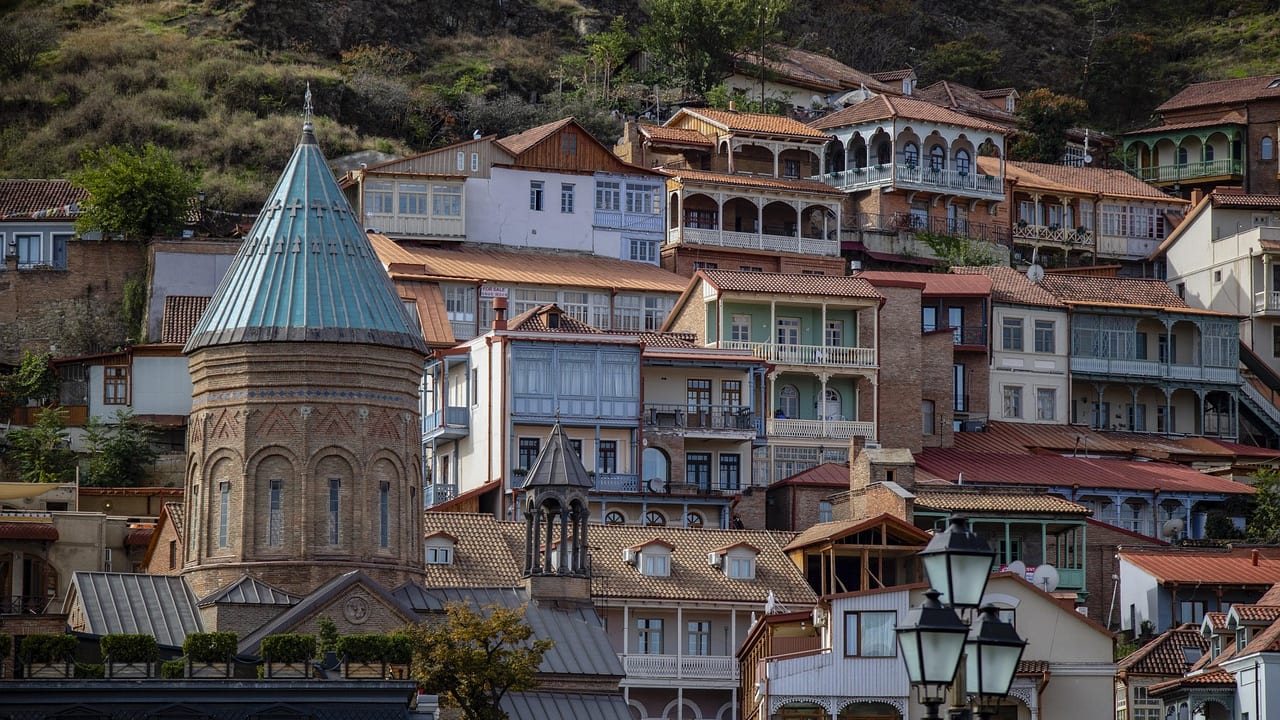
Tbilisi Old Town is the historic core of Georgia's capital, about two square kilometres on both banks of the Mtkvari, first built up in the early Middle Ages. Here are its quarters, the streets still named after old trades, the sights, and one walking route from Baratashvili Bridge to the baths and across the river.
Old town Tbilisi: Kala, Avlabari and the riverbanks
Tbilisi grew from three early settlements, Tpilisi, Kala and Isani, and the Mtkvari splits the city into a right and a left bank.2 The old town spreads over both: about two square kilometres at the heart of the city, first built up in the early Middle Ages.1 Until 1936 this part of the city was still called Tpilisi.2
On the right bank, the centre of the 5th-century town was Klidisubani, above what is now Gorgasali Square, the Meidani.2 Inside the wall of Narikala Fortress lies Kala, once a town of its own with a royal residence, palaces, churches and baths.2 Much of Tbilisi was destroyed in an invasion in 1795, though not all of it: the tourism board dates what stands in Kala today to the 19th century or earlier.2
Across the river is Avlabari. Under Arab rule the settlement on this bank was walled and called Hisni, which became Isani; the name Avlabari came later.2 Metekhi church stands here, with the statue of King Vakhtang Gorgasali that has looked over the city since 1965, and Queen Darejan Palace, Sameba Cathedral and Rike Park are all close by.2
Streets named after the old trades
The old town has been a market since the 5th century, and the merchants and craftsmen who worked here left their trades on the street map.2 The names are still in use: Silver Street (Vertskhli), Iron Row (Rkinis Rigi), Bread Square (Puri), Wine Rise (Ghvinis Aghmarti) and Cotton Row (Bambis Rigi).2
Other quarters take their names from a building, as Anchiskhati and Sioni do, or from people who lived there, as Orbeliani does.2
The French traveller Jean Chardin, writing in the 17th century, said you could meet more kinds of foreigners in this market than anywhere else in the world, and counted Armenians, Greeks, Jews, Persians, Indians, Tatars and Europeans among them.2 Shardeni Street carries his name, and today it is known for its bars, restaurants and nightclubs.2
Old Tbilisi sights
The sights of Old Tbilisi sit close together on both banks, so most of them fit into one long walk. Start with the fortress on the hill and the domed baths below it, then cross to Metekhi for the statue and the view, and leave time for the bridges, the puppet theatre's clock tower and the churches, mosque and synagogues that share the same few streets.
Narikala Fortress
The citadel on the hill, named in written sources from the 4th century onward.7 St Nicholas church stands inside its walls, looking over the historic centre.6 The Rike cable car runs 500 metres up to it from Rike Park.4
Abanotubani and the sulfur baths
The domed bathhouses date from the 17th century and are fed by naturally hot sulfur water; the tourism board calls them the main attraction of Old Tbilisi.1 Abano Street ends at the Orbeliani Bath, the Colourful Bath, with its tiled front.3
Metekhi church and the Gorgasali statue
The statue of King Vakhtang Gorgasali has stood here since 1965.2 He is remembered as the founder of Tbilisi, and from the church courtyard the whole of the old town lies in front of you.1
Peace Bridge and Metekhi Bridge
The Peace Bridge is a glass footbridge by the Italian architect Michele De Lucchi, between the Baratashvili and Metekhi bridges.2 Metekhi Bridge is a reinforced concrete bridge of 1951, built where earlier bridges had collapsed.2
Gabriadze theatre and its clock tower
Rezo Gabriadze's marionette theatre and its fairy-tale clock tower stand on Shavteli Street, a few steps from Baratashvili Street.2
Porakishvili Hall
A 17th-century house in Avlabari, one of the few Georgian folk houses of its kind still standing.2
The cell of St Dodo Garejeli
The cell of St Dodo Garejeli is cut into the rock by the right-bank end of Metekhi Bridge.2
Churches, a mosque and two synagogues
Within the old town you pass Georgian Orthodox, Armenian and Catholic churches, a mosque and two synagogues.1
A walking route through Old Tbilisi
Start at Baratashvili Bridge, which the tourism board names as a good place to begin, and walk into the old town along Baratashvili Street, where an old horse-tram carriage, the Konka, shows what the city's first trams looked like.2 A few steps on, turn into Shavteli Street for the Gabriadze theatre and its clock tower.2
Carry on through the old streets to Gorgasali Square, the Meidani, which lies below Klidisubani, the centre of the 5th-century town.2 Abano Street runs from the Forty Sebastian Martyrs monastery to the Orbeliani Bath, so the baths make the last stop on this bank.3
Then cross Metekhi Bridge, passing the rock-cut cell of St Dodo Garejeli at its right-bank end, and go on to Metekhi church for the statue and the view back over the old town.2 Rike Park is close by on the same bank, and the cable car from there takes you up to Narikala.4 The stops are listed in walking order without times.
Book or do it yourself
Old Tbilisi is easy to do on your own. Every stop on the route above is a street, a square, a bridge or a church you can walk to, and the Rike cable car is a public ride from Rike Park.4
What a booking adds is someone to explain or something to taste. Guided walking tours bring a guide's stories to the trade streets and the churches, food and drink experiences add the tasting that a self-guided walk leaves out, and cultural and historical tours tie the old town to the rest of the city's past.
Questions about Tbilisi Old Town
What is Old Tbilisi?
The historic core of the city, about two square kilometres first built up in the early Middle Ages.1 It takes in Kala inside the Narikala wall and the bath quarter on the right bank, and Avlabari with Metekhi on the left.2
Where is Tbilisi old town?
At the heart of the city, on both banks of the Mtkvari: the right bank under the fortress hill, and the left bank around Metekhi church and Rike Park.2
How old is Tbilisi old town?
Finds in the city go back to the Eneolithic, and King Vakhtang Gorgasali chose the site for his capital in the second half of the 5th century.2 The 1795 invasion left large parts of Tbilisi in ruins, and what stands in Kala today dates to the 19th century or earlier; the domed baths go back to the 17th century.21
What to see in Old Tbilisi?
Narikala, the domed sulfur baths, Metekhi church with the Gorgasali statue, the Peace Bridge and the Gabriadze clock tower on Shavteli Street. The sights section above has a few lines on each, and the walking route links them.
Where to stay in Old Tbilisi?
Our Tbilisi travel guide covers the city's neighbourhoods and where to stay, the old town included. This page keeps to what to see and how to walk it.