
Narikala Fortress
ნარიყალა
The fortress above Old Tbilisi, recorded since the 4th century and reached by cable car from Rike Park
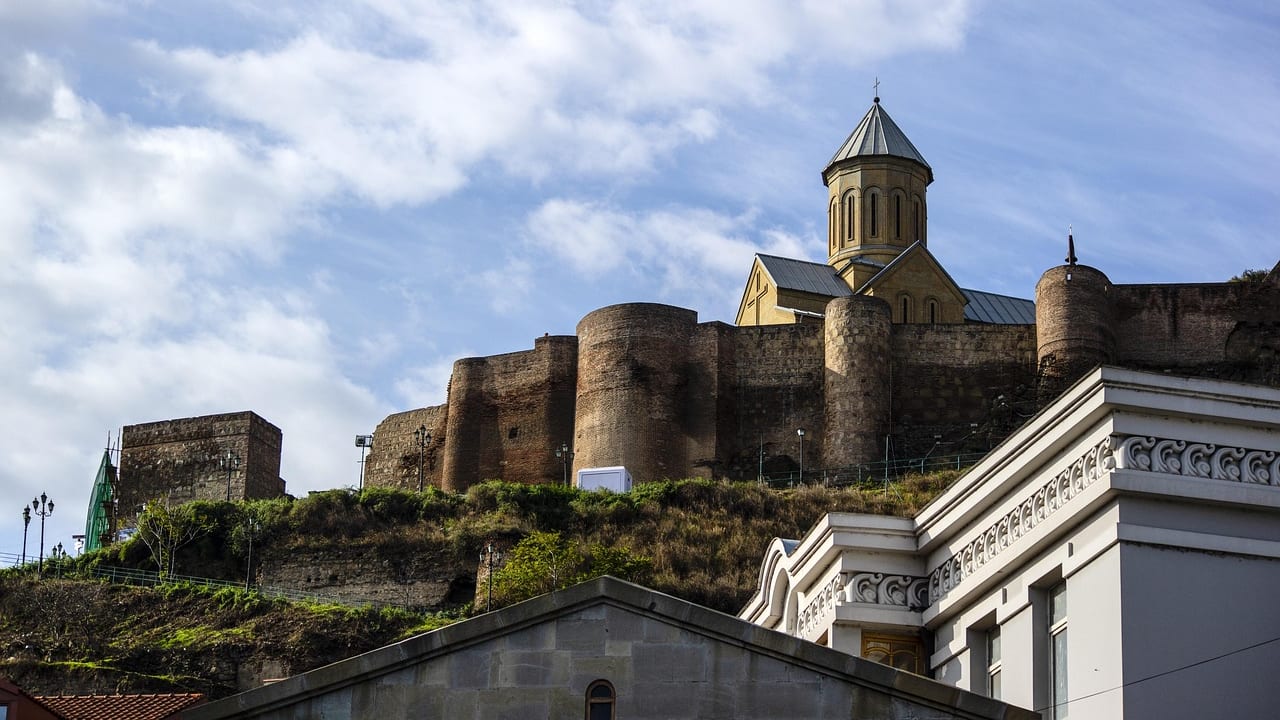
Narikala Fortress is the medieval citadel on the ridge above Old Tbilisi, a ruin that Georgian and foreign records name from the 4th century onward. Read on for its sieges and names, St Nicholas church inside the walls, the cable car up from Rike Park, and what is known about visiting today.
Narikala fort above Old Tbilisi
Narikala is the old citadel of Tbilisi, the walls on the hilltop over the historic centre with the cone of St Nicholas church showing above them.2 The Georgian Encyclopedia puts it in the southeast of the city, on the left bank of the Tsavkisistskali.1 Its wall also closes around Kala, a quarter of Old Tbilisi on the right bank of the Mtkvari that was once a town in its own right.3
It is really two forts in one. The site divides into a lower and an upper fortification.5 The names of the two parts go back to King Rostom, who ruled from 1632 to 1658 and had a wall built from Khidisquri to the fortress to cut the town off from the citadel, which gave the place the names Dabla Tsikhe, the Lower Fortress, and Maghla Tsikhe, the Upper Fortress.1
The name came late. Georgian and foreign sources from the 4th to the 18th century call the place Kala, Shuristsikhe, Tsikhe, Maghlatsikhe or simply the Citadel of Tbilisi, and the word Narikala first turns up in 17th-century records.1 In those two centuries Gori, Sighnaghi, Dmanisi and other strongholds each had a narikala of their own, an inner citadel, but only the one in Tbilisi kept the word as its name.1
Below the walls on the same bank is Abanotubani, the bath quarter, which the tourism board ties to the founding of the city: Vakhtang Gorgasali began building Tbilisi near the fortress in the 5th century.6
Narikala fortress history
The written story begins with a chronicle. Leonti Mroveli credits the founding to Khram Khuar Borzard, an official of the Persian king who came to Kartli in 368, and a bronze dagger of the 13th to 12th century BCE found on the hill suggests people lived here long before that.1 After that comes a long run of sieges and changes of hand; the main ones are below.1
Very little of that past stands. Only some structures of the 12th to 13th and the 17th centuries survive, and water once came up through a system of channels and aqueducts.1 Digs from the 1960s to the 1980s turned up medieval ruins, ceramics, glass and coins, and the walls were restored in the 1970s and 1980s.1
627 and 628: Heraclius and the Khazars
In 627 Heraclius, emperor of Byzantium, and Jibghu, khagan of the Khazars, laid siege to the fortress, and the defenders, with a Persian detachment, held out. The allies came back in 628 and took and destroyed it.1
1045 and 1122: Georgian kings take it back
Bagrat IV, invited in by the city's elders, seized the main citadel in 1045. In 1122 David the Builder secured the fortress together with the city.1
1226 and 1386: Jalal ad-Din and Tamerlane
Jalal ad-Din captured the fortress in 1226 after a massive assault. On 21 November 1386 Tamerlane took the city and its fortress after a siege.1
1578 to 1748: Ottomans and Qizilbash
Lala Mustafa Pasha seized Narikala in 1578 and an Ottoman garrison held it until 1606; the Qizilbash then kept it for more than a century. In 1747 and 1748 Erekle II took Tabori, Metekhi and the Lower Fortress, then Narikala itself, and ended their presence.1
1795 to 1827: the end of the citadel
The last devastating invasion came in 1795 with Agha Mohammad Khan. After the Russian Empire annexed the kingdom of Kartl-Kakheti in 1801 the fortress lost its purpose, and in the first half of the 19th century a gunpowder explosion destroyed almost every building inside.1 An earthquake in 1827 brought down the inner part and badly damaged the outer walls.5
St Nicholas church inside the walls
The church inside the walls is St Nicholas, and the building you see dates from 1997. The first church went up in the 13th century, in the reign of Demetrius II the Self-Sacrificer; in 1818 the Russian general Yermolov turned it into a munitions store, and when the store blew up the church was almost entirely destroyed.2
Archaeologists found what was left of it during digs at Narikala in 1966. The new church stands on the old base and walls, keeps the old proportions and reuses 13th-century remains, together with Georgian brick and tufa stone from Bolnisi.2 Inside, most of the icons are recent, but a few date from the 17th to the 19th century, and four tombs have been found around the church.2 Part of the king's palace is in the same area.2
How to get to Narikala fortress
From the river, take the Rike cable car, which runs 500 metres from Rike Park up to the fortress, with seven gondolas that each hold up to eight people.4 Rike Park is on the left bank of the Mtkvari, close to Metekhi Bridge and the Peace Bridge.3 The line was built in 2012 and has doubled the number of people who reach the site.5
Before the cable car, the tourism board notes, the only way up was a long climb on foot.2 This page gives no cable car hours or fares and names no current footpath, because no operator or official page states them; check at the lower station in Rike Park on the day.
The fortress today
Narikala today is a partly restored ruin with a long conservation programme behind it. The Tbilisi Development Fund put a conservation project for the fortress into its 2015 urban rehabilitation plan for the historic district.5 For 2021 the fund, with City Hall's consent, nominated Narikala to Europa Nostra's 7 Most Endangered Programme, whose advisory panel named unstable seismic ground and the pressure of visitor numbers as the main threats.5
This guide states no opening hours and no access or closure status for the fortress or its upper part. No notice from the city, the Tbilisi Development Fund or the national heritage agency saying which parts are open could be found when this page was checked on 18 November 2026, so ask locally before you plan your visit around the upper walls.
Book or do it yourself
You can reach Narikala without a booking: the Rike cable car runs up to it from Rike Park by the river, and the old town below the walls, including Kala inside the fortress wall, is yours to walk at any pace on the way back down.43
What a booked experience adds is the history on site. Guided walking tours of the old town and cultural and historical tours of Tbilisi can put the sieges, the many names of the fortress and the story of St Nicholas church in front of you as you walk. If you would rather read that here and go alone, the sections above give the dates.
Questions about Narikala Fortress
When was Narikala fortress built?
There is no single building date. The chronicler Leonti Mroveli links the founding to a Persian official who came to Kartli in 368, the name Narikala appears in the 17th century, and the church of St Nicholas inside the walls was rebuilt in 1997.12
Is Narikala fortress open?
No official notice on opening hours or on which parts are open could be found when this page was checked on 18 November 2026, so this guide gives neither. The fortress has been under a conservation programme of the Tbilisi Development Fund; ask locally before you go.5
How do you reach Narikala fortress?
Take the Rike cable car from Rike Park on the left bank of the Mtkvari: the line is 500 metres long and its gondolas hold up to eight people.4
Do you pay to visit Narikala fortress?
This guide quotes no prices, and no official price page for the fortress or the cable car was found to link. Ask at the cable car station in Rike Park before you ride.
What is Narikala fortress?
It is Tbilisi's medieval citadel, on the left bank of the Tsavkisistskali in the southeast of the city, fought over by Byzantines, Georgian kings, Tamerlane, Ottomans and the Qizilbash before it lost its military role after 1801.1
Sources
- Georgian Encyclopedia (I. Abashidze Main Scientific Editorial Office)
- Georgian National Tourism Administration
- Georgian National Tourism Administration
- Georgian National Tourism Administration
- Europa Nostra, 7 Most Endangered Programme
- Georgian National Tourism Administration
- GeoNames (CC BY 4.0)
- Wikidata (CC0)