
Abanotubani
აბანოთუბანი
The bath quarter of Old Tbilisi, where hot sulfur springs gave the city its name
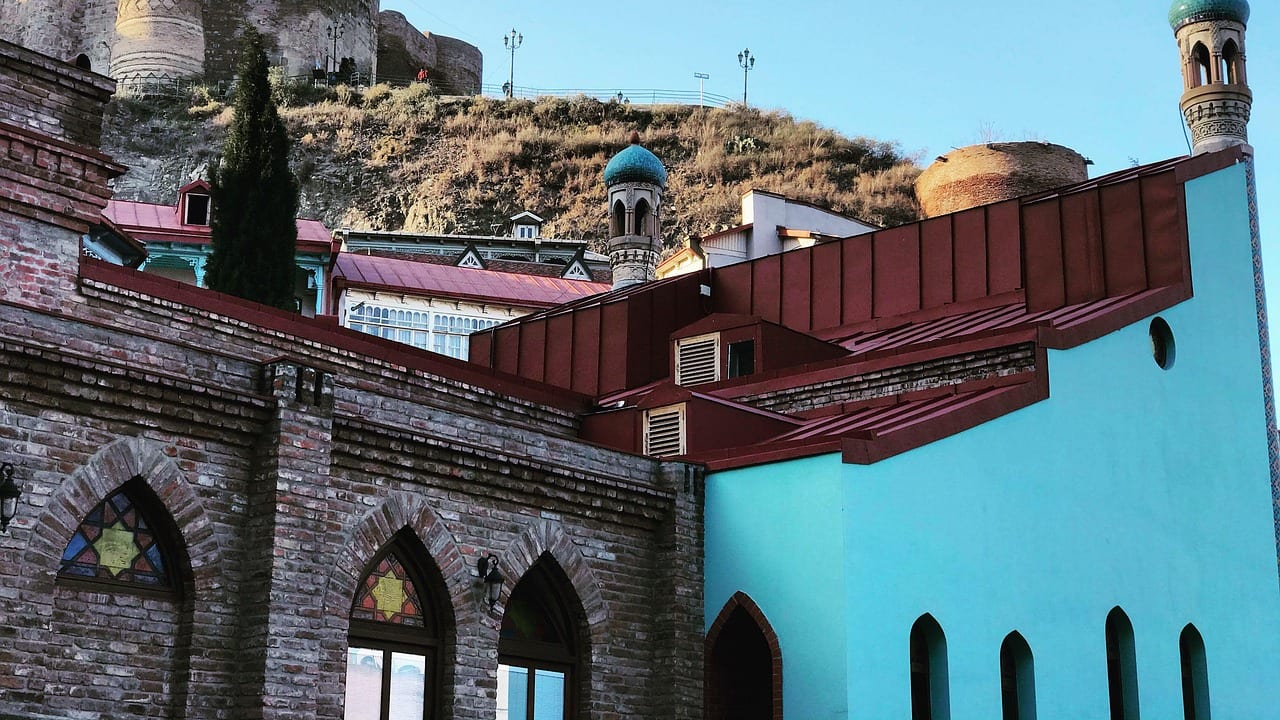
The Tbilisi sulfur baths are in Abanotubani, the bath quarter of Old Tbilisi below Narikala, where low brick domes roof baths fed by naturally hot water. Also spelled sulphur baths, they sit where the city's founding legend is set, and this page covers that story, the tiled Orbeliani bath (Chreli Abano), how to choose a bathhouse and the walk to the waterfall.
Abanotubani, the bath quarter below Narikala
Abanotubani means "the area of baths", and by legend and by scholarship alike it is where Tbilisi began: the first settled ground of the city was the land around these hot springs, under Narikala Fortress on the Mtkvari's right bank.1 It is part of Old Tbilisi, and in the 17th century it went by another name, Seidabad, after the Sayyids who lived there.1
The number of baths has fallen a long way. The tourism board counts 65 baths in the 12th century, six by the 19th and more than 10 in use today.1 Alexandre Dumas, who spent over a month in Tbilisi in 1858, went often and left worried that Paris had nothing to match them.1
The baths are easiest to spot by their roofs: low brick domes on the right bank of the Tsavkisistskali.1 Each bath once carried its owner's name, and only Gulo's still does.1 Abano Street runs through the quarter, from the Forty Sebastian Martyrs monastery, a 21st-century church with an open-air display of archaeological finds outside, past balconied houses, cafes and statues of a sparrowhawk and a pheasant.1
The hot springs and the founding of Tbilisi
The founding legend is set right here. A king's sparrowhawk chased a wounded pheasant, both birds were later found in a boiling spring, and that, the story goes, is how the city's thermal water was discovered.1 The name carries the same idea: "tbili", or "tpili" in its older form, means hot.1
The dated history is close behind. King Vakhtang Gorgasali began building the city near Narikala in the 5th century, and his son Dachi finished the work at the end of the 6th and moved the capital here from Mtskheta.1 The water still comes up naturally hot and sulfurous, and it still fills the domed 17th-century baths.3
The springs also gave Tbilisi a medical resort. Niko Nikoladze proposed one in the 19th century, and in 1938 the resort specialist Mikheil Zandukeli built the Tbilisi Balneological Resort at 9 Vakhtang Gorgasali Street, which has since been completely renovated.1
Orbeliani Baths and Chreli Abano
The Orbeliani bath and Chreli Abano are the same building: the 17th-century bath at the end of Abano Street, called the Colourful Bath because its facade is covered in ceramic tiles with motifs close to Islamic decoration.1 Wikidata records it as a cultural heritage monument of Georgia.5
It is run today by the Abanotubani Group, which also runs King Erekle's Bath. The operator says the building was restored to its original form under the supervision of specialists and has taken guests since 2017, and it describes the architecture as Persian in influence, with multicoloured tiles and a dome shaped like a minaret.6
Inside, Chreli Abano offers hot and cold sulfur baths, massages and spa treatments, and kisa, the traditional exfoliation that belongs to the old Tbilisi bath routine.6 It has 12 private rooms, booked by date on its own site, and its address is 2 Abano Street.6
How to choose a bathhouse
The tourism board names five baths as the best known in Abanotubani: Chreli Abano, Bath No. 5, Gulo's Bath, King Erekle's Bath and the Bohema Bath, plus several public baths.2 Choose by what you want beyond the hot water, a pool, a mosaic room or a tiled landmark, and book with the bathhouse itself. These are the differences the sources record:
Chreli Abano
The tiled 17th-century bath at the end of Abano Street, with private rooms, massages and kisa, booked on its own site.6
Bath No. 5
The one to pick for its interior, which is decorated with colourful mosaics.2
King Erekle's Bath
The bath with a pool guests can use, and walls set with decorative stones.2 It belongs to the same group as Chreli Abano.6
Gulo's Bath
The last bath in the quarter that still keeps its owner's name,1 with its own jam and tea served alongside the hot water; Sting has been a guest.2
The public baths
Several public baths run alongside the private ones, for a shared soak instead of a booked room.2
Around the baths: the waterfall and the mosque
Two paths start at the end of Abano Street, right beside Chreli Abano, so either can follow a bath without retracing your steps through the quarter: one leads to the Leghvtakhevi waterfall, and the other climbs to Botanical Garden Street and the Juma Mosque.1
The Juma Mosque was built in the 18th century, and the tourism board calls it the only Muslim shrine in Tbilisi.1 Its tall minaret, added in the 19th century, is wrapped in an openwork metal grille.1 Since the Shiite mosque near the Metekhi bridge was destroyed in 1952, Shiite and Sunni Muslims of the city have prayed here together.1
For the quarter's past in local words, the library museum of the poet Ioseb Grishashvili, who wrote down the traditions of old Tbilisi, is at 1 Algeti Street.1
Book or do it yourself
For Abanotubani, the experiences our providers sell that fit best are guided walking tours and cultural and historical experiences. A guide earns its place if you want the founding legend, the Dumas visit, the mosque and the baths tied into one route with someone to answer questions on the way.
The bath itself needs no middleman: each bathhouse is run by its own operator, and you deal with it directly. The walk along Abano Street to the waterfall path and up to the mosque is easy to follow on your own with this page in hand, since both paths start at the street's end.
Questions about the Tbilisi sulfur baths
What is the history of Abanotubani?
By legend and by scholarship, it is the first settled part of Tbilisi, built around the hot springs of the founding story.1 Its 17th-century name was Seidabad, and the tourism board counts 65 baths in the 12th century, six by the 19th and more than 10 in use today.1
Are the Abanotubani baths open at night?
Hours are set by each bathhouse, and this guide does not list them. Chreli Abano publishes its working hours and a booking hotline on its own site, so check there, or with the bath you have in mind, before planning a late visit.6
How much does a sulfur bath in Abanotubani cost?
Each bathhouse sets its own prices for rooms, public baths and extras such as kisa, and this guide does not quote them. Chreli Abano shows its rooms and services on its own site, chreliabano.ge, where you book by date.6