RomeWalking toursGuided toursPlanning
The Best Walking Tours in Rome: Which Ones Are Worth Booking
Rome is a walking city with more guided tours than any visitor can sort through. Which types actually help, when to do them, and what the free tours really cover.
Di SimilarTours Editorial · Travel Research · · Lettura di 19 minuti

Rome is the best walking city on this list and also the one where guided walks are hardest to choose between, because there are hundreds of them and the descriptions all sound alike. Two hours, central squares, expert guide, small group.
The useful way to sort them is not by rating but by what problem each one solves. Some are orientation. Some are interpretation at sites that genuinely need it. Some are food. Some are simply a good evening. They are not interchangeable, and booking three of the same type is the most common way visitors waste money here.
Compare Rome walking tours →Where a guide genuinely changes the experience
Worth being specific, because "a guide adds context" is true everywhere and unhelpfully vague.
At the ancient sites, a guide is close to essential. These are ruins. Without interpretation, a large proportion of what you are walking through reads as broken stone in an attractive setting. With it, the layout, the function, and the scale become legible. This is the single highest-return guided purchase in Rome and the one to book first.
In the historic centre, a guide is a bonus. The squares, fountains, and streets are immediately enjoyable whether or not you know anything about them. A guide adds depth and connects things you would otherwise experience as unrelated stops, which is worthwhile - but you will have a good time without one.
At the major museums, a guide solves logistics as much as interpretation. The collections are enormous, and someone who walks you purposefully to the things worth seeing saves you an hour of wandering and a great deal of decision fatigue.
On the food tours, the guide is the access. Same as anywhere: you are paying to be taken into places you would not have found and to have the ordering handled.
Insider tip
Book the site guide, walk the centre yourself. If your budget only stretches to one guided thing, put it inside the archaeological sites rather than on a centre walk. The ruins need explaining; the fountains do not. This one decision gets the most out of a limited tour budget in Rome.
The four types worth considering
1. Ancient-site guided visits - book this one first
A guided entry into the major archaeological areas, usually two to three hours, with the ticket bundled into the price. It solves interpretation and queueing at once.
Do it early in the day and early in the trip. Early in the day because these sites are largely unshaded and get uncomfortable by midday. Early in the trip because understanding what ancient Rome actually was makes everything you subsequently walk past more interesting.
Guided visits to Rome's ancient sites
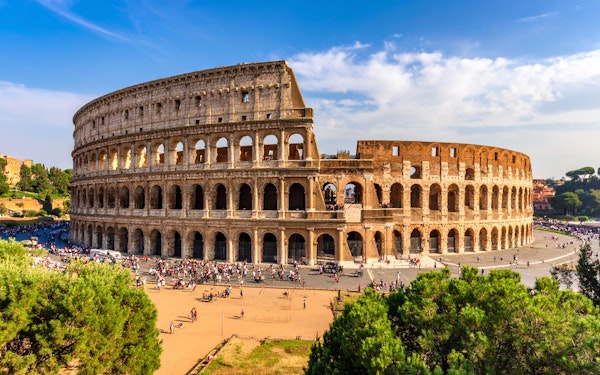
Combo: Colosseum, Roman Forum & Palatine Hill + Vatican Museums + Pantheon
A multi-site bundle covering the ancient core and the Vatican side.
4.4(45,107)ViewFrom$75.39
Ultimate Rome: Colosseum, Vatican Museums & Walking Tour
A guided full day across both major sites plus a centre walk.
4.6(2,650)7 hoursViewFrom$265.00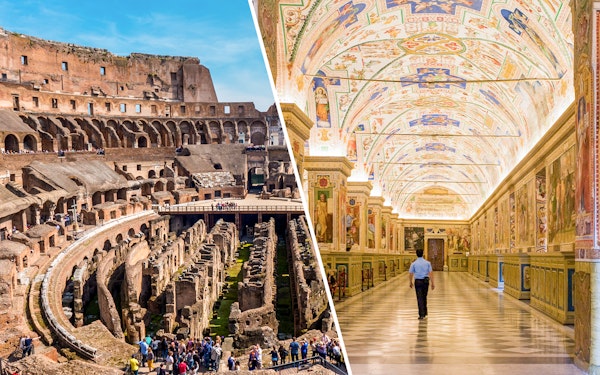
Combo: Colosseum + Vatican Museums Pass
Entry to both headline sites, bookable as a pair.
4.5(47,081)ViewFrom$62.73
Vatican Museums, Sistine Chapel & St Peter's Basilica Guided Tour
A guided route through the three linked Vatican sites.
4.4(40,497)3 hoursViewFrom$81.05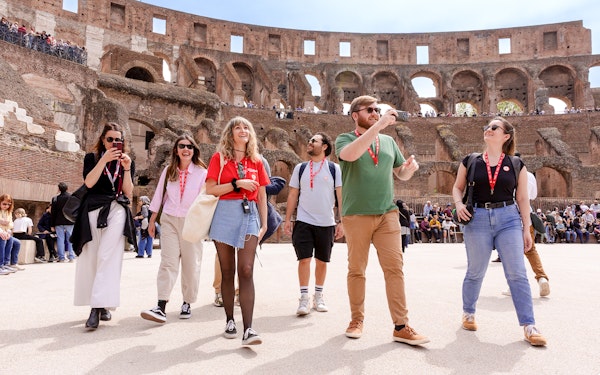
Colosseum, Palatine Hill & Roman Forum with Exclusive Arena Floor Guided Tour
4.5(12,332)2 hr 30 minViewFrom$75
Colosseum Guided Tour in Rome
4.4(86)2 hr 15 minViewFrom$90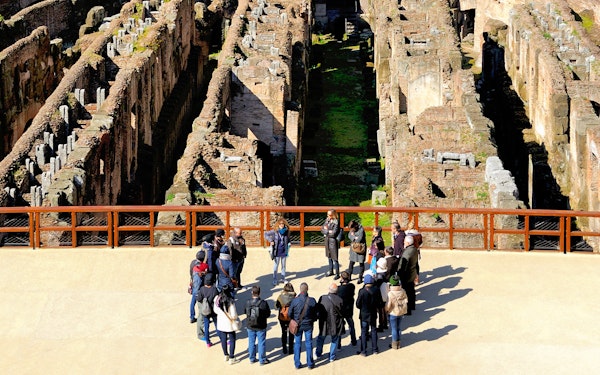
Colosseum Express Guided Tour
4.4(3,236)1 hourViewFrom$61
Rome: Colosseum, Roman Forum and Palatine Hill Guided Tour
4.6(25,795)1 hr 30 min - 3 hoursViewFrom$39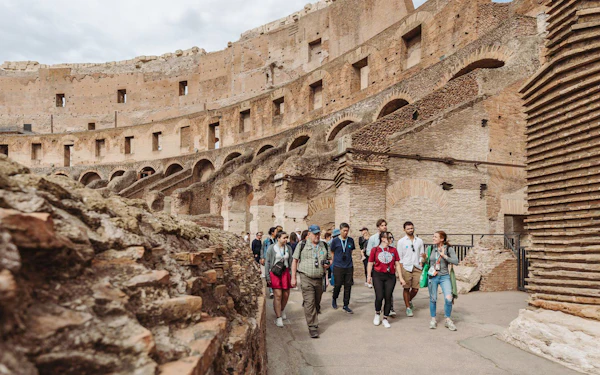
Colosseum Underground & Arena Floor Guided Tour
4.6(4,380)3 hoursViewFrom$156
Colosseum, Roman Forum & Palatine Hill Guided Tour
4.6(11,295)2 hr 30 minViewFrom$56
2. Centre walks - orientation, best on day one
Two hours through the squares, fountains, and bridges of the historic core. Cheap, widely available, and genuinely useful on arrival because it connects landmarks you will otherwise encounter as isolated stops.
The timing advice is simple: if you are doing one, do it on your first full day. Its value is almost entirely in how it changes the days that follow.
Rome historic centre walking tours
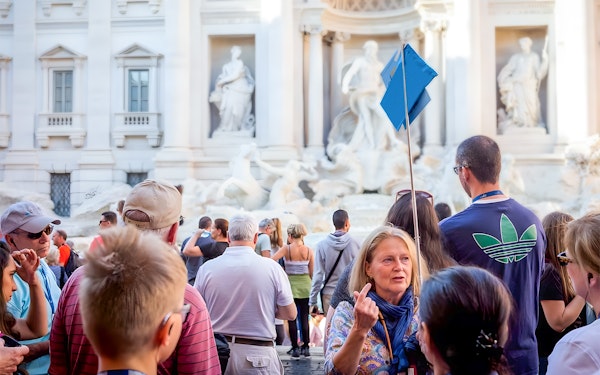
Trevi Fountain & Piazza Navona Guided Walking Tour
Two hours through the central squares with guided context.
4.5(1,568)2 hoursViewFrom$24.20
Rome: Guided Small Group Walking Tour of City Highlights
A small-group version covering the same ground.
4.8(706)2 hoursViewFrom$29.37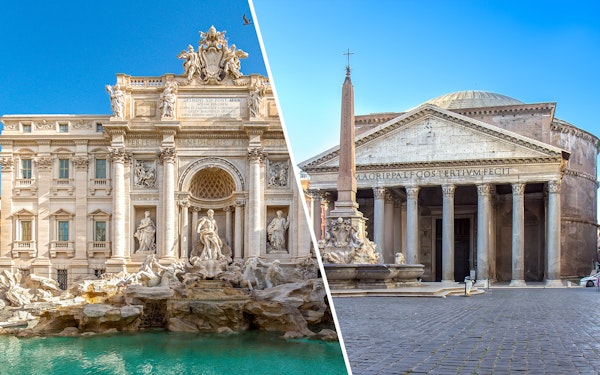
Combo: Rome Walking Tour + Pantheon Fast-Track Tickets
A centre walk with one major interior included.
4.5(6,169)ViewFrom$33.57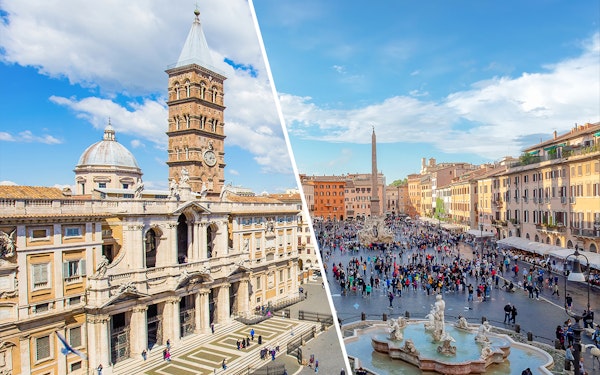
Combo: Santa Maria Maggiore Entry + Trevi Fountain & Piazza Navona Walking Tour
A church interior paired with the central squares walk.
4.5(1,595)ViewFrom$35.03
Rome: Pantheon, Spanish Steps, Navona and Trevi Private Tour
5.0(80)2 hours - 3 hoursViewFrom$290
Rome Walking Tour: Pantheon, Trevi, Navona & Hidden Gems
4.9(136)2 hoursViewFrom$28
Private Tour - City Center
5.0(165)2 hr 30 minViewFrom$136
Rome Walking Tour with Pantheon, Trevi Fountain & Spanish Steps
4.4(753)1 hour - 2 hr 30 minViewFrom$23
Rome City, Pantheon, and Trevi Fountain Walking Tour
4.9(480)2 hoursViewFrom$19
Private Walking Tour of the Squares and Fountains in Rome
5.0(130)3 hours - 4 hoursViewFrom$225
3. Food walks - the best of the evening options
A tasting walk through one or two neighbourhoods, typically three to four hours, usually substantial enough to replace dinner.
In Rome specifically these work well because the neighbourhoods they cover - the ones across the river and around the old market areas - are places most visitors would enjoy walking anyway. You are getting a neighbourhood tour with food attached rather than a food tour that happens to move.
Book these earlier than any other type. They cap low and fill first.
Rome food and neighbourhood tasting walks

Rome Food & Wine Tour: 15 Tastings in Trastevere & the Jewish Ghetto
Two neighbourhoods on foot with fifteen tastings - dinner, effectively.
4.8(3,558)2 hours 45 minutesViewFrom$85.83
Rome Twilight Trastevere Food Tour
An evening walk through the neighbourhood across the river.
4.9(6,124)4 hoursViewFrom$120.78
Rome: Award Winning Trastevere Group Food Tour with Wine
A three-hour group tasting tour with wine included.
4.9(2,743)3 hoursViewFrom$89.19
Rome: Trastevere Luxury Food Tour with Free-Flowing Fine Wine
A higher-end version of the same neighbourhood route.
4.9(3,407)4 hoursViewFrom$147.13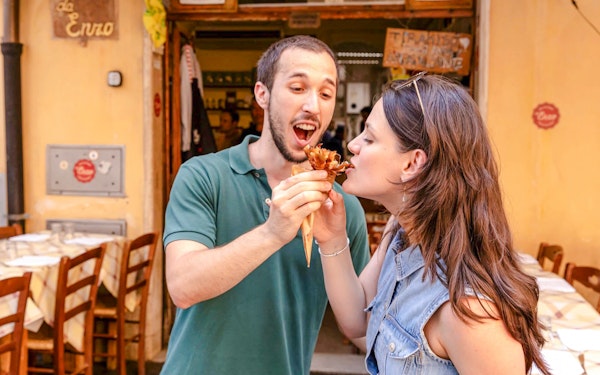
Twilight Food Tour in Trastevere
4.9(105)4 hoursViewFrom$121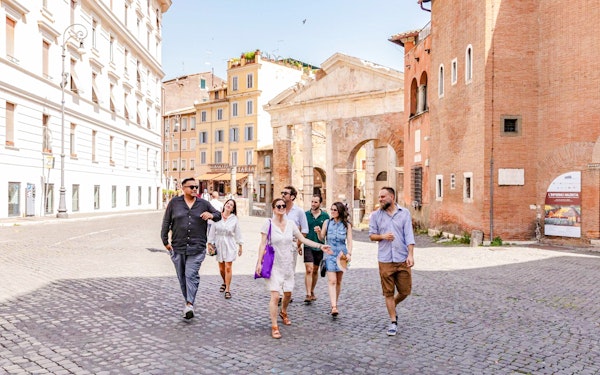
Trastevere and Campo De' Fiori Food Tour With Jewish Ghetto
4.9(123)4 hoursViewFrom$51
Rome Trastevere Food Walking Tour with Pasta and Wine
5.0(124)3 hoursViewFrom$87
Trastevere Food Tour
4.9(142)2 hr 30 minViewFrom$92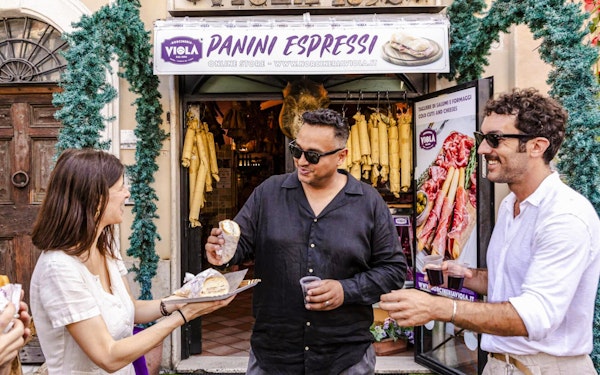
Eternal Rome: Trastevere Food Tour & Jewish Ghetto
4.9(119)4 hoursViewFrom$138
Rome Trastevere Walking Food Tour
4.7(67)2 hr 15 minViewFrom$113
4. Evening and themed walks - the atmosphere option
Night walks, ghost-and-legend tours, and themed routes through the lit centre. These are entertainment rather than education, and judged as entertainment they are good value.
Their strongest case is summer, when daytime walking is genuinely unpleasant and the streets only become comfortable after dark. They are also the cheapest way to fill an evening that would otherwise be a long dinner.
Rome evening and themed walks

Legends & Ghosts of Rome: Night Walking Tour
A ninety-minute evening walk through the lit centre.
4.4(1,452)1 hour 30 minutesViewFrom$10.28
Rome Night Walking Tour: Ghosts, Legends & Haunted Rome
A two-hour themed evening route.
4.9(616)2 hoursViewFrom$30.24
Rome by Night Walking Tour - Legends & Criminal Stories
The cheapest of the evening options, at ninety minutes.
4.3(1,007)1 hour 30 minutesViewFrom$14.10
Pasta Making & Wine Tasting with Dinner in Frascati from Rome
An evening outside the city - the alternative to another centre walk.
4.9(1,380)2 hours 30 minutesViewFrom$39.94
Rome by Night Tour with Top E-bike and optional Italian Dinner
5.0(85)2 hours - 4 hoursViewFrom$77
Under the Moonlight Rome Walking Tour with Secret Backstreets
0.0(0)2 hr 30 minViewFrom$64
Rome at Night: Small Group Guided City Walking Tour
4.9(416)2 hr 30 minViewFrom$34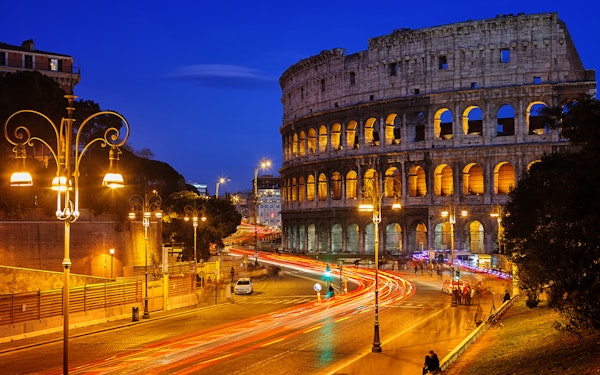
City Sightseeing: Rome Night Bus Tour
4.1(18)1 hourViewFrom$24
Moonlight Rome: Night Walking Tour of Roman Highlights
4.9(285)2 hr 30 minViewFrom$27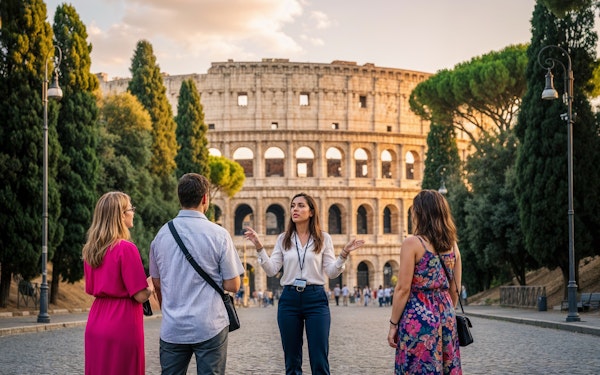
Evening Rome Walking Tour: Colossuem, Trevi Fountain & Roman Forum
3.8(5)2 hr 30 minViewFrom$81
What the free tours actually cover
Rome's tip-based walking tours are numerous and generally competent. They concentrate on the outdoor centre - the squares, the fountains, the bridges, the exteriors - and many guides are good at it.
What they cannot do is take you inside ticketed sites. That is not a shortcoming of the format, it is the format: entry costs money, and a tip-based tour cannot include it.
Which produces a clean division of labour. Use a free tour for the outdoor centre if you want guided orientation cheaply. Pay for a guide where a ticket is involved. Treating the free tour as a budget substitute for the paid archaeological visit is the mistake, because they are not covering the same ground.
Two practical notes: tips are expected and are how the guides are paid, and popular free tours can be large. If group size matters to you, the paid small-group version of the same route is a different experience.
Reading a tour description properly
Rome has more near-identical listings than any city on this site, and the differences that matter are rarely in the title. Five things to check before booking.
Is entry included, and to what? The biggest single source of disappointment. A tour of the ancient centre may walk the perimeter, enter one site, or enter three. The price is a rough signal and the inclusions list is the actual answer.
What is the group cap? Not a regulated term. Eight people and twenty-five people are different products at similar prices, and the cheaper one is usually the larger.
How long, really? Advertised durations sometimes exclude the queue to get in, which at the major sites can be substantial even with a booked slot. If the tour includes entry to a high-demand site, assume the real commitment is longer than the headline number.
Where does it start and end? A tour that finishes on the far side of the city from your accommodation costs you a journey you had not planned. On a short trip that matters.
Is it headset-guided? In large groups this is the difference between hearing the guide and following someone's raised umbrella. For any group above about fifteen it is close to essential.
Self-guided routes: what works without a guide
Plenty of visitors would rather walk alone, and in Rome that is a perfectly good decision for most of the city.
The historic centre is the natural self-guided territory. It is compact, almost entirely free, and organised around a sequence of squares and bridges that connect naturally on foot. A route that strings the major squares together with detours down whichever side streets look interesting is genuinely one of the best things to do in the city, and it needs no more preparation than a rough sense of direction.
The riverside and the neighbourhoods across the water are similarly self-guided-friendly - the appeal is the atmosphere rather than information, and you lose nothing by not having someone explain it.
Where self-guided struggles is inside the archaeological sites. Audio guides help and are cheap, but they cannot answer questions or adapt to what you are actually curious about. If you are going to be strict about budget, the honest ranking is: self-guide the centre, audio-guide the museums, and pay a person for the ruins.
One further note in favour of walking alone: Rome is a city where the good accidents happen off the route. Every guided walk, by definition, follows the route. Leaving several unguided days in a trip is not a compromise here, it is the point.
Seasonal timing for walking tours
The season should decide your departure time more than your tour choice.
Summer makes midday tours at the unshaded ancient sites genuinely punishing. Book the earliest morning departure available, or move to the evening walks entirely. The night tours are at their best in July and August for exactly this reason.
Spring and autumn are ideal walking conditions and the busiest booking months. Small-group tours sell out furthest ahead in these windows; book earlier than feels necessary.
Winter is underrated for walking here. Cool, frequently bright, and dramatically less crowded at the sites. The one adjustment is daylight: schedule the outdoor archaeological tours for the middle of the day rather than late afternoon, because the light goes earlier than you expect.
Rain is the variable that most affects Rome walking tours, because the historic surfaces become genuinely slippery. Most tours run regardless. Check the cancellation terms at the point of booking, not on the morning.
How many tours, and in what order
On two or three days: one guided site visit, and optionally one centre walk. That is it. Rome's outdoor centre is the thing you came to walk, and a schedule of guided departures removes the wandering.
On four or five days: two or three. The site visit, a food walk, and possibly an evening tour. Spread them out; two guided walks on consecutive days blur together.
On a repeat visit: skip the centre walk entirely. Go straight to a specialist guided visit, an underground or below-street-level tour, or a private guide with a specific brief. This is where the interesting value is for anyone who has already done the obvious.
With children: shorter is better and food is better than history. Ninety minutes is the realistic ceiling, and the evening themed walks generally land better than the archaeological ones.
Insider tip
Do not book two tours of the same type. The most common waste in Rome. Two centre walks cover the same squares with different jokes; two archaeological tours cover overlapping ground. Vary the type, not just the operator, and check the route description rather than the title before booking the second one.
What a good Rome guide is actually doing
The gap between an adequate guide and a good one is wider here than in most cities, and it is worth knowing what you are paying for.
An adequate guide recites. Dates, names, dimensions, the sequence of emperors. It is accurate and it slides straight out of your head, because a list of facts about a ruin is not a way of understanding the ruin.
A good guide builds a picture. They tell you where the street level used to be, so the sunken buildings make sense. They explain what a space was for before they tell you what it is called. They point out the join between one century's work and another's, which you cannot unsee afterwards. By the end you are reading the city rather than being told about it, and you carry that into every subsequent day of the trip.
That is why the ancient sites are where guiding pays. The historic centre is enjoyable at face value. The ruins are not - they require someone to restore the missing information before they become anything more than picturesque.
The practical implication for booking: reviews that mention the guide by name are the useful signal. Generic five-star reviews of an operator tell you the logistics worked. Reviews that describe what someone explained tell you the guiding was good.
Combining tours with the rest of a trip
Guided walks slot into a Rome itinerary badly if you treat them as items and well if you treat them as anchors.
A site visit anchors a morning. Book it early, let it run, and plan nothing else demanding for that day - the archaeological sites are large, hot in season, and more tiring than their duration suggests.
A centre walk anchors an arrival afternoon. It gives an otherwise shapeless first day a purpose and hands you the mental map you will use for the rest of the trip.
A food walk anchors an evening and replaces dinner. Nothing goes after it.
A night walk fills the gap between an early dinner and bed, and is the one type that genuinely works as a bolt-on rather than an anchor.
What does not work is scheduling two anchors in one day. Two guided experiences in a single Roman day - a site visit in the morning and a food tour in the evening - looks efficient on paper and produces a day with no room in it. On a short trip, one guided thing per day is the ceiling, and most days should have none.
The practical details
Site-bundled tours sell out with the sites. Where the guide comes with the entry ticket, availability is governed by the site's capacity, and that goes early in high season. Book these as far ahead as you would book the tickets alone.
Check whether entry is included. Some "tours" of the archaeological areas walk the outside and do not go in. The price usually gives it away, but read the inclusions.
Group size is unregulated. "Small group" can mean eight or twenty-five. If it matters, find the number in the description.
Meeting points are frequently squares, not addresses. Central Rome's squares are large and have several entrances. Give yourself ten minutes more than you think you need.
Summer means morning or evening. Midday walking tours in July and August are genuinely hard work at the unshaded sites. Pick the departure time deliberately rather than by convenience.
Comfortable shoes, not new ones. Rome's surfaces are uneven stone. This matters more here than in cities with flat modern paving.
The short version
Put your guiding budget where the ruins are. The archaeological sites are the place in Rome where an unguided visit most often disappoints and a guided one most often surprises, and they are also where the queues justify a bundled ticket.
Walk the historic centre yourself, or with a cheap two-hour tour on day one if you want the orientation. Add a food walk in the evening if you have four days or more. And do not book three tours of the same kind - vary the type, spread them out, and leave most of the walking unguided, because that is what Rome is actually for.
Compare Rome walking tours, guided visits, and food tours →Are walking tours worth it in Rome?
For the ancient sites, yes, emphatically - they are ruins, and without someone explaining what you are looking at a great deal of it is rubble with a good view. For the historic centre, a walking tour is useful but optional, because the squares and fountains work on you whether or not you know their history. The best value is a guide at the archaeological sites and your own feet everywhere else.
When should I do a walking tour in Rome?
An orientation walk works best on day one, when it can still change how you spend the rest of the trip. Site-specific guided visits should be scheduled for the earliest slot on whichever day you have allocated to that site. Evening and food walks work at any point and are best late in a trip, when you already recognise where you are being taken.
Are the free walking tours in Rome any good?
The tip-based tours are generally decent and cover the central squares and monuments competently. What they cannot do is take you inside ticketed sites, which is where guiding adds the most value in this city. Use a free tour for the outdoor centre and a paid guide for the archaeological areas, rather than treating one as a cheaper version of the other.
Is a self-guided walking tour of Rome practical?
Very - the historic centre is compact, walkable, and largely free, and a self-guided route through the squares and bridges is one of the best things you can do here. Where self-guided falls down is inside the ancient sites, where the interpretation genuinely matters. Walk the centre yourself; take a guide into the ruins.
How long are Rome walking tours?
Most run between ninety minutes and three hours. Centre walks tend to be around two hours, site-specific guided visits two to three, and food tours three to four. Anything advertised as covering both the ancient sites and the Vatican in one day will run six hours or more and is a serious commitment rather than a morning activity.
Should I do a night walking tour in Rome?
It is one of the better-value evening activities in the city, particularly in summer when daytime walking is unpleasant and the streets only become comfortable after dark. The lit centre is genuinely different from the daytime version, and the crowds are gone. As an experience it is strong; as an information source it is weaker than a daytime tour.
Do I need to book Rome walking tours in advance?
For small-group and food tours, yes - they cap at low numbers and fill well ahead in the busy months. For general centre walks, a few days is usually enough. Site-specific guided visits to the major archaeological areas should be booked as early as the sites themselves, because the guide and the entry slot are bundled.
What is the best walking tour in Rome for first-time visitors?
A guided visit to the ancient sites, booked for the earliest slot of the day. It is where guiding adds the most, where the queues are worst, and where an unguided visit most often disappoints. Add a two-hour centre walk if you want orientation, and leave the rest of the walking to yourself.
Keep reading
Tours
The best walking tours in London
The same question answered for a very different walking city.
Read more
Listicle
Things to do in Rome: the experiences worth booking
The Rome shortlist, ranked by what is actually worth your time.
Read more
Rome pillar
Rome travel guide: first-time visitor essentials
Where to stay, getting around, and ticket strategy for the big sights.
Read more
Itinerary
3 days in Rome: a walkable itinerary
Where the guided walks fit into a short trip.
Read more
Altre letture
Altre guide per aiutarti a pianificare il tuo viaggio

5 Days in Rome: The Itinerary Where the City Finally Opens Up
Five days in Rome is where the checklist ends and the city begins. A day-by-day route with the two day trips worth taking and the mistakes that waste the extra time.

Christmas Markets in Rome: What the Season Is Actually Like
Rome at Christmas is not a northern market city, and that is the point. What the season actually offers, when it runs, and how to plan a December trip around it.

Biglietti Pantheon 2026: Prezzi, Tipologie e Come Saltare la Coda
Una guida pratica 2026 ai biglietti del Pantheon a Roma - ora che l'ingresso è a pagamento, le tipologie di biglietto confrontate, quando prenotare e come saltare la coda.

Biglietti Cappella Sistina 2026: Prezzi, Tipologie e Come Saltare la Fila
Una guida pratica 2026 ai biglietti della Cappella Sistina - come funziona l'accesso attraverso i Musei Vaticani, confronto tra le tipologie di biglietti, e quando saltare la fila vale la pena.

Biglietti Galleria Borghese: Guida 2026 agli ingressi con orario, visite guidate e come evitare l'esaurimento
Guida pratica 2026 alla Galleria Borghese - confronto tra tutti i tipi di biglietto, come funziona il rigido sistema di slot di 2 ore, e cosa fare quando i biglietti ufficiali sono esauriti.

1 Day in Rome: The Itinerary and the Best Rome in One Day Tours
How to spend 1 day in Rome without losing it to queues: Colosseum morning, Vatican or historic center afternoon, and the full-day tours that solve it all.

Rome in Winter: Why November to February Is the Connoisseur's Season
Rome in winter means short queues at the Colosseum and Vatican, mild days, Christmas in the piazzas, and the city at its most local - here is how to plan it.

Rome with Kids: A Family Guide That Actually Works
A practical guide to Rome with kids: the Colosseum and Vatican with children, gladiator school, pizza and gelato classes, and Villa Borghese downtime.