RomeChristmasSeasonalWinter
Christmas Markets in Rome: What the Season Is Actually Like
Rome at Christmas is not a northern market city, and that is the point. What the season actually offers, when it runs, and how to plan a December trip around it.
By SimilarTours Editorial · Travel Research · · 20 min read

Rome at Christmas confuses people who arrive with a northern European template in their heads. This is not a city built around a single enormous market square with mulled wine and wooden huts, and visitors who come expecting that version leave slightly puzzled.
What Rome actually offers in December is different and, for a certain kind of traveller, better: the city's great sights in cool walking weather with a fraction of the summer crowds, a season that runs long and ends at Epiphany rather than Boxing Day, and evenings where the ordinary streets are the attraction. The markets are part of that. They are not the whole of it.
Compare Rome tours and tickets →What the season actually looks like
Set expectations first, because this is where most December trips go right or wrong.
Rome's seasonal markets are concentrated rather than citywide. You will find them in specific squares rather than spread through every neighbourhood, and they are smaller in scale than the equivalent in Germany, Austria, or the Alpine regions. Stalls lean towards sweets, decorations, toys, and seasonal crafts rather than a food-hall model.
The season is longer at the back end. Where many countries wind down immediately after 25 December, the Italian calendar keeps going to Epiphany on 6 January, which is a genuine event rather than an afterthought. The first week of January is still fully seasonal here, and it is one of the more interesting stretches to visit precisely because most foreign visitors have gone home.
And the atmosphere is distributed rather than contained. The lit streets, the nativity displays in churches, the shop windows, and the general evening life of the city do more for the seasonal feeling than any single market does. If you go looking only for stalls you will underrate the season badly.
Insider tip
Come for Rome, not for the markets. The single best piece of advice for a December trip here. If the markets are the reason you booked, you have chosen the wrong city and there are half a dozen better options a short flight away. If Rome is the reason and the season is a bonus, December is one of the best months of the year to be here.
Why December is a genuinely good time to visit Rome
Strip away the seasonal framing and December still stands up on its own merits.
The weather is better for sightseeing than summer. Rome in July is hot enough that the middle of the day becomes a problem to be managed. In December it is a jacket-and-walking climate, and the whole day is usable.
The crowds drop sharply. Outside the holiday fortnight, the major sites operate at a fraction of their summer load. The difference at the biggest attractions is not marginal - it changes the experience from queueing and shuffling to actually looking.
Prices fall. Accommodation in early December and mid-to-late January is at its annual low. The holiday fortnight is the exception, and a sharp one.
The light is better. Low winter sun on Roman stone is genuinely different from the flat overhead glare of summer, and the golden hour arrives at a civilised time rather than at nine at night.
Rome's headline sights, easier in December
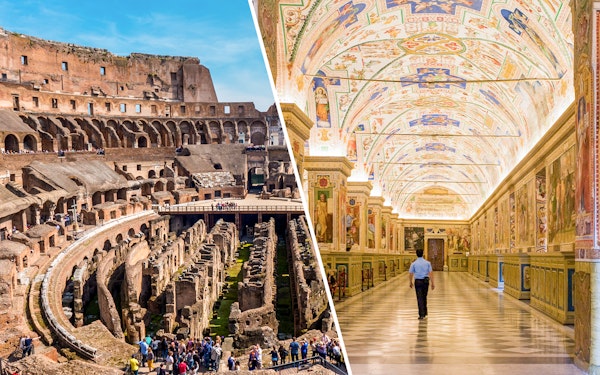
Combo: Colosseum + Vatican Museums Pass
The two biggest sites on one pass - far easier to schedule outside high season.
4.5(47,081)ViewFrom$62.73- tiqets
Vatican Museums & Sistine Chapel: Fast Track Ticket
Timed fast-track entry, without a guide.
4.4(47,898)ViewFrom$66.02 
Vatican Museums, Sistine Chapel & St Peter's Basilica Guided Tour
A guided route through the three linked sites in one visit.
4.4(40,497)3 hoursViewFrom$81.05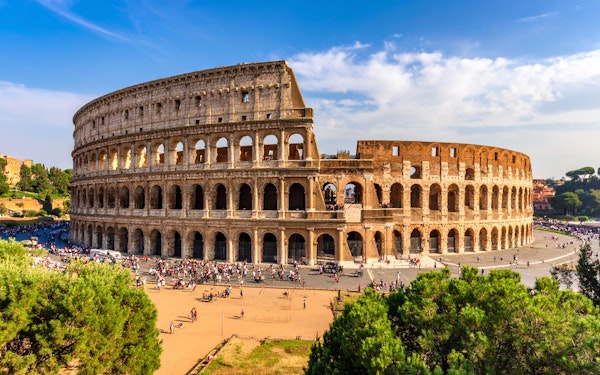
Combo: Colosseum, Roman Forum & Palatine Hill + Vatican Museums + Pantheon
A multi-site bundle - practical when winter hours compress the day.
4.4(45,107)ViewFrom$75.39
Best of Rome: Vatican & Colosseum Guided Tour
4.7(44)9 hr 30 minViewFrom$189
VATICAN: Vatican Museum and Sistine Chapel Skip The Line Tickets
4.1(415)1 hour - 3 hoursViewFrom$23
Combo: Mamertine Prison + Colosseum + Roman Forum + Palatine Hill Tickets
4.3(2,908)4 hoursViewFrom$45
Rome Vatican Museum and Sistine Chapel Skip the Line Tickets
3.2(174)2 hr 30 min - 3 hoursViewFrom$45
From Civitavecchia port with Vatican Museums & Tour Guide
5.0(10)9 hoursViewFrom$1,051
Rome: Colosseum, Vatican Museums, Sistine Chapel & Walking Tour
4.6(2,727)7 hoursViewFrom$138
Building a December day in Rome
The shape of a good winter day here is different from a summer one, and the reason is daylight rather than temperature.
Start earlier than the short days encourage. The usable outdoor light is limited, and it is the resource you cannot buy back. Get the outdoor sights - the squares, the forum, the walking - into the first half of the day.
Use the middle of the day for the biggest ticketed site. Winter opening hours are shorter than summer ones, which compresses when you can visit. Check them for your specific dates; a site that opens until seven in August may close at four in December.
Move to the markets and the streets as the light goes. This is when the season actually shows itself. Lit squares in the early evening are the December experience, and they cost nothing.
Eat late and long. Rome's evenings in December are cold enough that a two-hour dinner is a pleasure rather than a delay, and the restaurants are far more accessible than in high season.
Evening walking tours through the lit centre
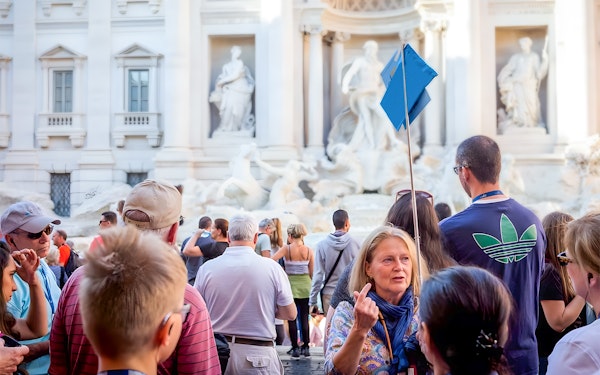
Trevi Fountain & Piazza Navona Guided Walking Tour
A two-hour guided walk through the squares that carry the season's atmosphere.
4.5(1,568)2 hoursViewFrom$24.20
Rome: Guided Small Group Walking Tour of City Highlights
A small-group walk covering the central sights on foot.
4.8(706)2 hoursViewFrom$29.37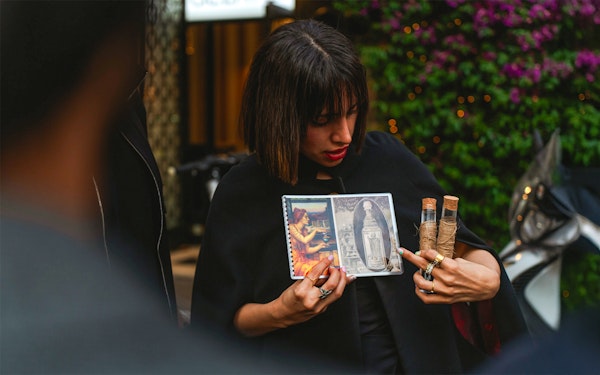
Legends & Ghosts of Rome: Night Walking Tour
An evening walk - the early winter darkness starts it at a sociable hour.
4.4(1,452)1 hour 30 minutesViewFrom$10.28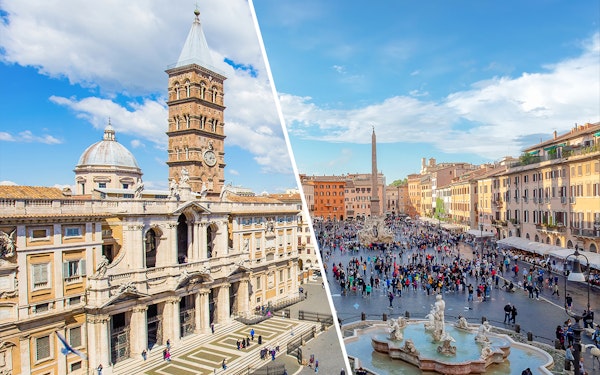
Combo: Santa Maria Maggiore Entry + Trevi Fountain & Piazza Navona Walking Tour
A major church interior paired with the evening square walk.
4.5(1,595)ViewFrom$35.03
Rome by Night Tour with Top E-bike and optional Italian Dinner
5.0(85)2 hours - 4 hoursViewFrom$77
Rome Evening Panoramic Walking Tour Including Trevi Fountain and Spanish Steps
4.3(249)3 hoursViewFrom$40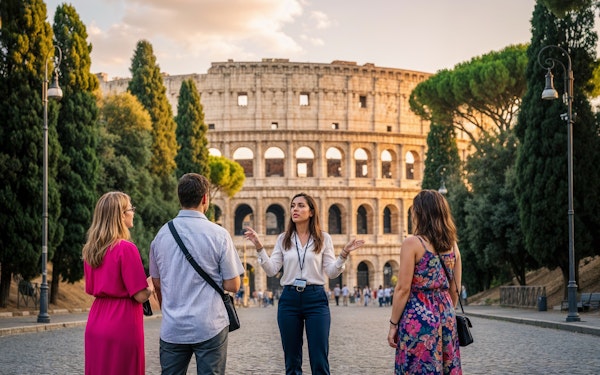
Evening Rome Walking Tour: Colossuem, Trevi Fountain & Roman Forum
3.8(5)2 hr 30 minViewFrom$81
Rome by Night Walking Tour - Legends & Criminal Stories
4.3(1,028)1 hr 30 minViewFrom$14
Rome Walking Tour with Pantheon, Trevi Fountain & Spanish Steps
4.4(754)1 hour - 2 hr 30 minViewFrom$23
Under the Moonlight Rome Walking Tour with Secret Backstreets
0.0(0)2 hr 30 minViewFrom$64
The food is the real seasonal event
If you want the part of a Roman December that most resembles what northern visitors imagine a Christmas market delivers, it is the eating rather than the stalls.
Seasonal baking appears in bakeries and shop windows through the month. Restaurants shift towards winter cooking. And the whole rhythm of eating out relaxes, because the summer pressure of full rooms and turned tables is gone.
A food-focused tour is worth more in December than in July for exactly that reason: the places you are taken to are operating at a normal pace, and the seasonal specialities are actually on.
Rome food tours and tastings

Rome Food & Wine Tour: 15 Tastings in Trastevere & the Jewish Ghetto
A tasting walk through two neighbourhoods - substantial enough to replace dinner.
4.8(3,558)2 hours 45 minutesViewFrom$85.83
Rome Twilight Trastevere Food Tour
An evening food walk - the early winter dark makes twilight departures easy.
4.9(6,124)4 hoursViewFrom$120.78
Pasta Making & Wine Tasting with Dinner in Frascati from Rome
A cooking session outside the city - indoors, seated, and weather-proof.
4.9(1,380)2 hours 30 minutesViewFrom$39.94
Rome Gourmet Food Tour with Free-Flowing Wine
A longer, seated-heavy tasting tour for a cold evening.
4.9(3,687)4 hoursViewFrom$81.05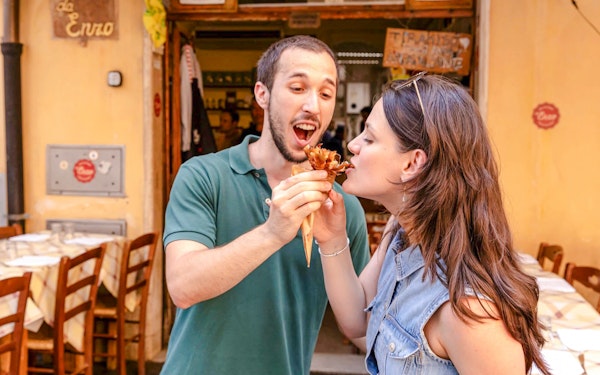
Twilight Food Tour in Trastevere
4.9(105)4 hoursViewFrom$121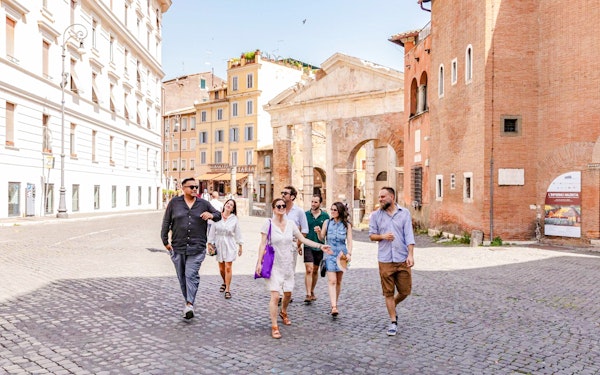
Trastevere and Campo De' Fiori Food Tour With Jewish Ghetto
4.9(123)4 hoursViewFrom$51
Trastevere Food Tour
4.9(142)2 hr 30 minViewFrom$92
Winner 2026: Rome Trastevere Luxury Food Tour with Fine Wine
5.0(3,630)4 hoursViewFrom$143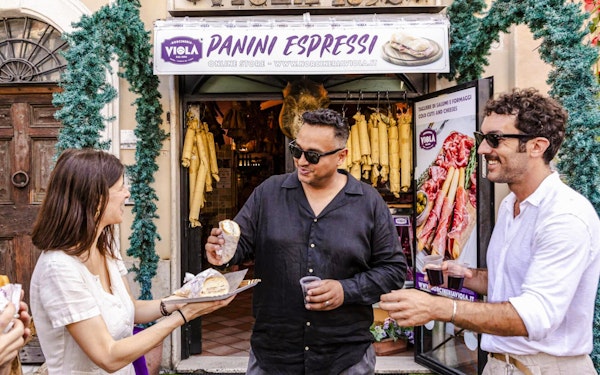
Eternal Rome: Trastevere Food Tour & Jewish Ghetto
4.9(119)4 hoursViewFrom$138
Rome: Award Winning Trastevere Group Food Tour with Wine
4.9(3,062)3 hoursViewFrom$97
When to go within the season
The month splits into three distinct periods, and they are not interchangeable.
Early December, roughly the first two weeks. The quiet, good-value window. Decorations are up, the seasonal atmosphere has arrived, and the crowds and prices have not. If you want December Rome at its most comfortable, this is it.
Roughly 20 December to 6 January. The busy, expensive, atmospheric stretch. Domestic travel adds to international visitors, accommodation prices climb steeply, and the major sites get genuinely busy again. It is also when the season is most fully itself, which is the trade you are making.
Mid-January onwards. Technically past the season, and one of the emptiest, cheapest times to visit Rome all year. The decorations come down after Epiphany and the city returns to normal, but the weather has not changed and neither have the sights.
Insider tip
Watch the holiday closures. The major sites operate on reduced winter hours through December and several close entirely on specific holiday dates. Those dates differ by site, and a closure on the one day you allocated to your must-see attraction is the classic December trip-wrecker. Check each site's hours for 25 December, 26 December, and 1 January before you fix your itinerary.
What to wear, specifically
Rome in December is a mild winter, not a harsh one, but the way it is mild catches people out.
Bring a warm jacket rather than a heavy coat - you will be indoors and outdoors repeatedly, and something you can carry matters more than maximum insulation. Add two light layers underneath so you can adjust between a sunny square and a shaded alley, which is a bigger swing here than the forecast implies.
Shoes with grip are worth thinking about. Rome's historic surfaces are worn stone and cobble, and they get genuinely slippery in the rain. This is not a city for new leather soles.
A scarf does more for the evening temperature drop than another jumper, and a compact umbrella covers the rain that December brings more often than summer without ever dominating the month.
What you can leave behind: heavy winter gear, and any assumption that you will want to sit outside at length after dark.
Day trips in December
Getting out of Rome works in this season with one filter: pick destinations whose appeal is not weather-dependent.
Archaeological sites, hill towns with covered centres, wineries, and food-focused excursions all hold up in December. Coastal trips and anything whose selling point is a view from an exposed hilltop are a gamble.
The practical advantage is the same as in the city - these trips run at a fraction of their summer occupancy, so a "small group" departure in December is actually small.
Day trips from Rome that work in winter

Pompeii from Rome with Optional Mt. Vesuvius & Pizza Lunch
A long day to a major archaeological site - quieter and cooler than in summer.
4.6(6,313)12 hoursViewFrom$81.05
Rome to Pompeii Guided Tour with Wine & Lunch by High Speed Train
The same site by fast train, with a seated lunch built in.
4.8(1,512)9 hoursViewFrom$239.00
Pompeii, Amalfi Coast and Positano Day Trip from Rome
A longer coastal day - better in clear weather, so keep this one flexible.
4.5(6,721)13 hoursViewFrom$128.04
Ultimate Rome: Colosseum, Vatican Museums & Walking Tour
A full guided day inside the city if the weather rules out leaving it.
4.6(2,650)7 hoursViewFrom$265.00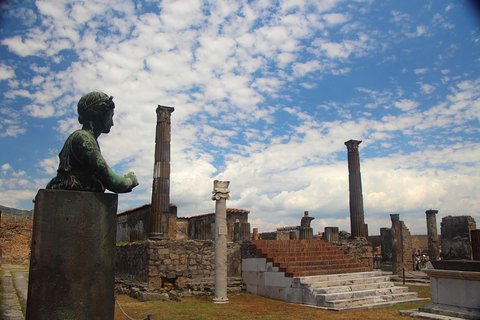
Day Trip to Pompeii Ruins from Rome
4.9(14)8 hoursViewFrom$692
From Rome: AC Coach Transfers to Pompeii with Pompeii Guided Tour
0.0(0)12 hoursViewFrom$194
Pompeii, Sorrento & Amalfi Coast Day Trip from Rome
4.7(2,186)12 hoursViewFrom$82
Private Transfer from Amalfi Coast to Rome or vice versa
5.0(10)5 hours - 7 hoursViewFrom$402
Day Trip from Rome: Explore Pompeii & Sorrento Amalfi Coast
4.8(611)12 hoursViewFrom$87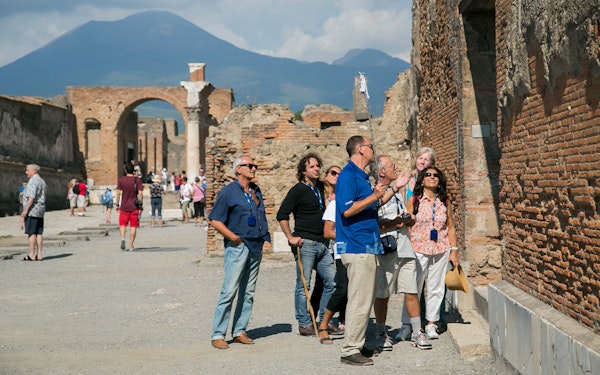
From Rome: Pompeii Guided Tour and Amalfi Coast Day Trip
4.7(313)13 hoursViewFrom$103
How Rome compares to the northern market cities
Worth being explicit, because the comparison is what shapes expectations.
The classic market cities of Germany, Austria, and the Alpine belt are built around a specific format: a dense cluster of wooden stalls in a central square, hot drinks, a strong smell of food, and an evening crowd that treats the market itself as the destination. You go to the market. The market is the evening.
Rome does not work that way, and the reason is that it does not need to. The city's public spaces are already the attraction for eleven months of the year, and the seasonal layer sits on top of them rather than replacing them. The squares are lit, the churches put out displays, the shop windows change - but the thing you are walking around is Rome, with a seasonal overlay, not a purpose-built village.
The practical consequence for planning: do not build an evening around finding a market. Build it around walking the centre after dark and letting the seasonal parts appear as you go. Visitors who navigate stall-to-stall have a thinner trip than visitors who simply walk.
And if the market format itself is what you want, be honest about that at the booking stage. It is a short flight from Rome to several cities that do it properly, and a December trip that combines both is a better answer than expecting one city to be two things.
What December costs, honestly
The financial picture in December is sharply split, and knowing where the line falls is worth real money.
Early December is one of the cheapest windows of the year for accommodation, comparable to the deep low season in late January and February. Flights are similarly soft in the first ten days or so.
The holiday fortnight reverses this completely. Accommodation prices climb steeply from around the third week of December through the first days of January, and the increase is not gradual - it steps up. Flights over the same window follow, with the days immediately before Christmas and immediately after New Year being the worst.
Attraction pricing does not move much either way. Tickets cost broadly what they cost in June. What changes is the practical cost of the trip: in the quiet weeks you spend less on sleeping, and you waste less on priority-access products you do not need because there is no queue to skip.
The arbitrage, if you want it plainly: a trip in the first two weeks of December gets you the decorated city at low-season prices. A trip over the holidays gets you a fuller experience at close to peak cost. Both are defensible; only one is good value.
Getting around in December
Rome is a walking city and December is a good walking month, which simplifies most of this.
The main adjustment is daylight. The usable outdoor light window is short, and it is worth treating as the scarce resource around which everything else schedules. Outdoor sights in the middle of the day, indoor and evening things at either end.
Rain changes the surfaces more than it changes the plan. Rome's historic paving becomes genuinely slick when wet, and the risk is underrated by visitors in smooth-soled shoes. Slow down rather than rerouting.
Public transport runs a reduced service on the main holiday dates, and taxis are harder to find at exactly the moments you want them - late on the big evenings. If you have a fixed commitment on 24 or 31 December, plan to walk to it or leave far more margin than usual.
The holiday dates themselves are the one time the city genuinely changes shape. Many businesses close, some areas go quiet, and the rhythm shifts towards family and church rather than hospitality. That is atmospheric if you expected it and disorienting if you did not.
If it is your first time in Rome and it happens to be December
A common situation, and it changes the priority order slightly.
Do the headline sites anyway. December is a better month for them than most, and a first visit that skips the major sights because it is the season would be a strange trade. Book two or three of the big ones and treat them as the spine of the trip.
Then use the season for the parts a first-time summer visitor usually misses. The evening walking, the neighbourhood streets away from the centre, the long dinners, the churches - all of these are more accessible in December simply because there is room and time for them.
The one thing to guard against is over-indexing on the seasonal layer at the expense of the permanent one. The decorations come down in January. The Forum does not.
A note on New Year
New Year's Eve in Rome is a large, loud, public event, and it deserves a decision rather than a default.
If you want it, book accommodation early and centrally, expect the historic centre to be extremely busy, and accept that transport home late will be difficult. It is a genuine experience and people who want it are usually glad they did it.
If you do not want it, the answer is not to avoid Rome, it is to avoid the centre on that one night. Book a long dinner somewhere residential, walk back before the peak, and the rest of the trip is unaffected. 1 January itself is one of the quietest, oddest, and most pleasant days of the year to walk the city, because a large share of it is asleep.
Who should book a December trip here
Book it if you want the great Roman sights without the summer crush, you value walking weather over beach weather, you like a season that shows itself in ordinary streets rather than in a designated market zone, or you have been to Rome in summer and found it hard work.
Do not book it if a large traditional Christmas market is the main thing you want, you need long evenings outdoors, or your dates fall in the holiday fortnight and you were hoping for the quiet, cheap version of the city.
Compare Rome attractions, tours, and winter tickets →The short version
Rome does not do Christmas markets the way northern Europe does, and measuring it against that standard is the only way to be disappointed by a December trip here.
What it does instead is give you the city at its most comfortable for walking, its least crowded at the major sights, and its most atmospheric in the evenings, with a season that runs a fortnight longer than most and a food culture that shifts noticeably in your favour.
Come in the first two weeks of December for value and quiet, or over the holidays for the full seasonal experience at full seasonal prices. Book the two or three big sites, check the holiday closures, and leave the evenings unplanned. The streets will handle those.
Does Rome have Christmas markets?
Yes, though they work differently from the northern European model. Rome's seasonal markets are smaller, more concentrated in specific squares, and run alongside a broader set of seasonal traditions rather than being the main event themselves. Visitors arriving expecting a German-style market city are usually surprised; visitors who come for Rome and treat the markets as one part of a December trip generally find the season excellent.
When do Christmas markets in Rome start and finish?
The seasonal period broadly runs from early December through to Epiphany on 6 January, which is a more significant date in the Italian calendar than in many other countries. That gives the season a longer tail than in cities where everything winds down on 26 December - the first week of January is still very much part of the celebration here, and it is one of the more atmospheric stretches.
Is Rome worth visiting at Christmas?
For a certain kind of trip, very much so. You get the city's major sights in cool, walkable weather with far fewer people than in summer, a genuine seasonal atmosphere, and long evenings of lit streets. What you do not get is a compact market experience of the sort northern Europe does better. Come for Rome in December and the markets are a bonus; come specifically for markets and you may be disappointed.
How busy is Rome at Christmas?
Considerably quieter than summer, but not empty - the two weeks either side of Christmas draw both visitors and Italians travelling domestically. The pattern is that the first half of December is genuinely quiet and good value, the period from roughly 20 December to 6 January is busy and priced accordingly, and the rest of January drops away sharply.
What is the weather like in Rome in December?
Cool rather than cold, and often bright. Days are comfortable for walking with a jacket, evenings are chilly once the sun goes, and rain is more frequent than in summer without dominating the month. It is a good walking climate - noticeably more pleasant than the July heat that makes midday sightseeing difficult.
Do I need to book Rome attractions in advance in December?
Less urgently than in high season, but yes for the biggest sites, especially over the holiday fortnight. Outside that window, December is one of the easier months to get the slot you want at short notice. The general rule: book the two or three headline sites, and improvise everything else.
Are Rome's main sights open at Christmas?
The major sites run through the season, generally on shortened winter hours, with specific closures on the main holiday dates themselves. Those dates vary by site, so check individual opening hours for 25 December, 26 December, and 1 January before building a day around any one attraction. The outdoor city - the squares, the streets, the fountains - is unaffected.
What should I wear in Rome in December?
A warm jacket rather than a heavy winter coat, layers underneath, and comfortable shoes with decent grip - Rome's older streets are uneven stone that gets slippery when wet. Add a scarf for the evening drop and something waterproof. The temperature swing between a sunny afternoon square and a shaded street is larger than the daily forecast suggests.
Keep reading
Seasonal
Christmas markets in London: what is worth the trip
The London version of the season, and how it compares.
Read more
Rome pillar
Rome travel guide: first-time visitor essentials
Where to stay, getting around, and ticket strategy for the big sights.
Read more
Listicle
Things to do in Rome: the experiences worth booking
The Rome shortlist, ranked by what is actually worth your time.
Read more
Itinerary
3 days in Rome: a walkable itinerary
A field-tested route built around real booking constraints.
Read more
More reads
More guides to help you plan your trip

5 Days in Rome: The Itinerary Where the City Finally Opens Up
Five days in Rome is where the checklist ends and the city begins. A day-by-day route with the two day trips worth taking and the mistakes that waste the extra time.

The Best Walking Tours in Rome: Which Ones Are Worth Booking
Rome is a walking city with more guided tours than any visitor can sort through. Which types actually help, when to do them, and what the free tours really cover.

Pantheon Tickets in 2026: Prices, Types and How to Skip the Line
A practical 2026 guide to Pantheon tickets in Rome - now that entry is paid, the ticket types compared, when to reserve, and how to skip the line.

Sistine Chapel Tickets in 2026: Prices, Types and How to Skip the Line
A practical 2026 guide to Sistine Chapel tickets - how entry works through the Vatican Museums, the ticket types compared, and when skip-the-line is worth it.

Galleria Borghese Tickets: 2026 Guide to Timed Entry, Guided Tours, and Beating the Sell-Outs
A practical 2026 Borghese Gallery guide - every ticket type compared, how the strict 2-hour slot system works, and what to do when official tickets are gone.

1 Day in Rome: The Itinerary and the Best Rome in One Day Tours
How to spend 1 day in Rome without losing it to queues: Colosseum morning, Vatican or historic center afternoon, and the full-day tours that solve it all.

Rome in Winter: Why November to February Is the Connoisseur's Season
Rome in winter means short queues at the Colosseum and Vatican, mild days, Christmas in the piazzas, and the city at its most local - here is how to plan it.

Rome with Kids: A Family Guide That Actually Works
A practical guide to Rome with kids: the Colosseum and Vatican with children, gladiator school, pizza and gelato classes, and Villa Borghese downtime.