TokyoWalking toursGuided toursPlanning
The Best Walking Tours in Tokyo: Which Ones Actually Help
Tokyo is the city where a guide earns their money. A guide to the walking tours worth booking - by neighbourhood, by theme, and by what you need explained.
Af SimilarTours Editorial - Travel Research · · 20 min læsning

Tokyo is the city where a guide earns their fee. Not because it is dangerous or difficult to move around - it is neither - but because it is genuinely hard to read. There is no single centre to orient yourself against, the interesting places are as likely to be on the fourth floor or in a basement as at street level, and the ordinary business of choosing somewhere to eat involves a set of conventions that nobody explains to you.
A good walking tour compresses all of that into a couple of hours, on day one, and changes the rest of the trip. This guide covers which types are worth booking, in what order, and what the free options really give you.
Compare Tokyo walking tours →Why Tokyo specifically rewards a guide
Three things are different here compared with a European city break.
There is no centre. Tokyo is a collection of substantial districts connected by rail, each with its own character and its own reason to visit. A first-time visitor without a mental map spends the first two days working out that the city does not have the shape they assumed.
The good things are hidden vertically. In most cities, walking a street shows you what is on it. In Tokyo, a huge amount of what you would want to find is above or below the ground floor, behind unmarked doors, up narrow staircases. Walking past is not the same as seeing.
The everyday interfaces have a learning curve. Ordering, ticket machines, seating conventions, when to queue and when not to. None of it is difficult, all of it is unfamiliar, and a guide who walks you through it once removes the friction for the whole trip.
A walking tour solves all three at once. That is why the advice here is to do one early rather than as a treat later.
Insider tip
Book the food tour first. Of all the guided options in Tokyo, the food-focused walks are the ones that fill earliest, because they cap at small numbers and demand is high year-round. If you are booking anything for a Tokyo trip in advance, make it this. General district walks can be arranged much closer to the day.
The four types, and what each solves
1. Orientation walks - the day-one purchase
A general walk through one or two central districts, covering the layout, the transport logic, the etiquette basics, and the historical background. Usually two hours, usually cheap, and disproportionately useful.
This is the tour to do first. Its job is not to show you things you could not find - it is to make the next four days work better.
Tokyo orientation and history walks

Tokyo: Imperial Palace and Shogun Historical Walking Tour
A two-hour historical walk through the central palace district.
4.9(2,819)2 hoursViewFrom$22.36
Tokyo Castle & Imperial Palace - Shogun Walking Tour
The same central ground with a focus on the castle history.
4.9(1,235)2 hoursViewFrom$23.00
Imperial Palace East Garden and Edo Castle Walking Tour in Tokyo
A longer walk taking in the gardens as well as the castle grounds.
4.8(682)2 hours 30 minutesViewFrom$35.00
Tokyo: Shibuya Highlights Walking Tour & Secret View Spot
A short walk through one of the busiest districts, including a viewpoint.
4.9(605)1 hour 30 minutesViewFrom$12.78
Explore Tokyo’s History on Foot Asakusa Kappabashi and Ueno
5.0(13)3 hoursViewFrom$51
Private Customizable Walking Tour of Tokyo
5.0(82)4 hours - 8 hoursViewFrom$202
Tokyo: Shinjuku Historical Walking Tour & Secret Backstreets
5.0(1,094)1 hr 30 minViewFrom$13
Tokyo: 1 Hour Imperial Palace Introduction from Tokyo Station
4.9(63)1 hourViewFrom$10
Tokyo: Tsukiji Fish Market Food and Walking tour
4.9(2,022)2 hoursViewFrom$16
Harajuku Meiji Shrine Walking Tour in Tokyo
5.0(111)2 hoursViewFrom$20
2. Food walks - the best value in the city
If you only book one guided thing in Tokyo, this is the strongest candidate, and it is a walking tour in every sense - you cover real ground between stops.
What makes it valuable here more than elsewhere is that it solves the ordering problem. A food tour takes you into places you would walk straight past, orders for you, explains what you are eating and how to eat it, and leaves you able to do the same thing alone the next night. That transferable skill is worth as much as the meal.
The market-area walks in particular double as sightseeing, because the market itself is one of the more interesting places in the city to be at breakfast time.
Tokyo food walking tours

Tokyo: Shinjuku Food Tour (13 Dishes at 4 Local Eateries)
Four stops across a dense nightlife district - substantial enough to be dinner.
4.9(8,560)3 hoursViewFrom$79.84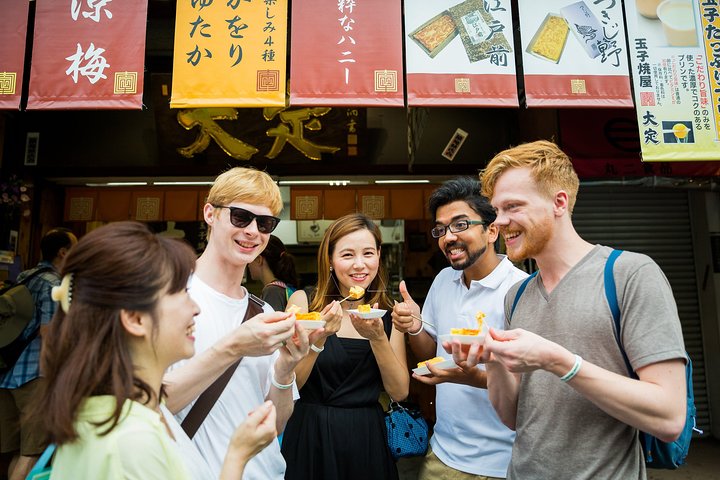
Tokyo Tsukiji Fish Market Food Walking Tour with 5 Tastings
A market walk with tastings - best done early in the morning.
4.8(3,685)3 hoursViewFrom$93.63
Best of Shinjuku: Izakaya Food Tour (3-4 Stops, 14+ Tastings)
An izakaya crawl - the format that is hardest to attempt alone on a first trip.
4.9(2,825)3 hours 30 minutesViewFrom$89.37
Tsukiji Fish Market: Street Food & Culture Walking Tour
A shorter, cheaper market walk at ninety minutes.
4.9(1,071)1 hour 30 minutesViewFrom$12.78
Tokyo Ginza Friendly Food Tour Explore Taste Enjoy By Local Guide
5.0(1)4 hoursViewFrom$180Tokyo: Tsukiji Fish Market Food and Walking tour
4.9(2,022)2 hoursViewFrom$16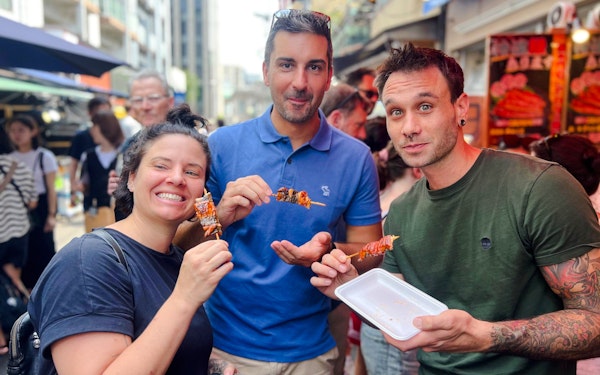
Tokyo Food Tour: Tsukiji Fish Market Walking Tour with Temple Visit
0.0(0)2 hoursViewFrom$28
Tokyo Tsukiji Fish Market Food and Walking Tour
4.8(116)2 hoursViewFrom$21
Tokyo Ginza Authentic Food Tour (Izakaya Hopping by local guide)
5.0(33)3 hours - 4 hoursViewFrom$190
Experience Izakaya With A Mini Food Tour Of Tokyo
5.0(2)3 hoursViewFrom$158
3. Neighbourhood and backstreet walks - the second tour
Once you have your bearings, the second tour should go somewhere the first did not. Tokyo's districts differ enough that doing two tours in the same area is a waste of one of them.
The backstreet-focused walks are the ones that most reliably show you things you would not have found - the small streets one block off the main thoroughfare where the city stops performing and starts just being itself.
Neighbourhood and backstreet walks

Tokyo: Shinjuku Historical Walking Tour & Secret Backstreets
The back-street version of a district most visitors only see on the main road.
4.9(984)1 hour 30 minutesViewFrom$16.37
Tokyo: Tsukiji Fish Market Food and Walking Tour
A market-district walk combining food stops with the surrounding streets.
4.9(1,928)2 hoursViewFrom$31.94
Tokyo Customized Private Tour in 1 Day with Licensed Guide
A private full day built around whatever you actually want to see.
4.9(2,876)6 hoursViewFrom$138.52
1-Day Tokyo Bus Tour
The non-walking alternative for covering distance across a spread-out city.
4.9(1,517)9 hours 30 minutesViewFrom$124.48
Tokyo Walking Tour with Licensed Guide Shinjuku
4.8(114)1 hourViewFrom$19Harajuku Meiji Shrine Walking Tour in Tokyo
5.0(111)2 hoursViewFrom$20
ENJOY ALL SHINJUKU Red Light District Walking with DEEPest info
5.0(49)1 hr 30 minViewFrom$24
The Dark Side of Tokyo - Night Walking Tour Shinjuku Kabukicho
4.8(397)2 hoursViewFrom$20
Shinjuku Night tour Include drinks and food w/ Local Guide
5.0(1)3 hoursViewFrom$96
Tokyo Tsukiji Fish Market Food Walking Tour with 5 Tastings
4.9(3,719)3 hoursViewFrom$96
4. Evening and nightlife walks - the experience, not the briefing
The bar-hopping and night walks are a different product. They are not there to orient you; they are the evening itself.
Their specific value is access to a format that is genuinely intimidating to attempt cold on a first trip - tiny bars with a handful of seats, no English menu, and conventions about how you are expected to behave. Going once with a guide converts that from a closed door into somewhere you can return alone.
Tokyo evening and bar-hopping tours

Tokyo Bar Hopping in Shinjuku: Free-Flow, Full Dinner, Golden Gai
A guided evening through a dense bar district, dinner included.
4.9(3,906)3 hoursViewFrom$106.29Tokyo: Shinjuku Food Tour (13 Dishes at 4 Local Eateries)
An evening food route that functions as both dinner and a district walk.
4.9(8,560)3 hoursViewFrom$79.84
Flagship 2-Hour Official Street Go-Kart Tour - Tokyo Bay
Not a walk at all - the alternative way to cover the city at street level.
4.9(5,100)2 hours 15 minutesViewFrom$63.88
Official Street Go-Kart in Shibuya
A shorter version through one of the busiest districts.
4.9(3,786)1 hour 15 minutesViewFrom$105.39
Osaka Bar Hopping Night Walking Tour in Namba (3 bars, 6 tastes)
4.9(981)3 hoursViewFrom$112
Taipei Nightlife: Pub Crawls / Bar Hopping (2 Different Routes)
4.5(29)3 hoursViewFrom$30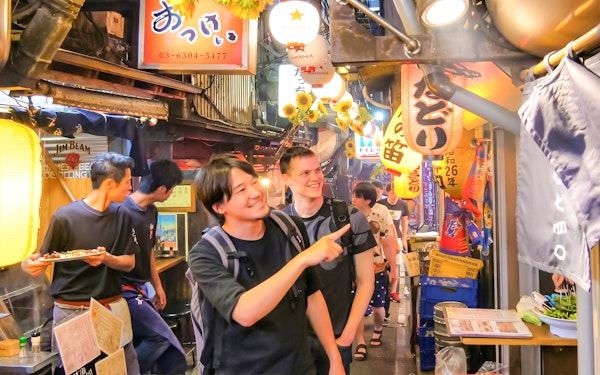
Tokyo: Shinjuku Bar Hopping Tour with All-You-Can-Drink and Dinner
0.0(0)3 hoursViewFrom$97
Tokyo: Shinjuku Bar Hopping & Night Walking Tour
5.0(82)3 hoursViewFrom$35
Tokyo: Shinjuku Golden Gai Bar Hopping that only locals know
5.0(3)2 hoursViewFrom$96
Shinjuku Unlimited Food and Drinks Bar Hopping Tour
5.0(7)3 hr 30 minViewFrom$102
What the free tours give you
The free and volunteer-guided walks in Tokyo have a good reputation and it is deserved. They are frequently run by locals who genuinely enjoy showing visitors their city, they concentrate on the major historical sites, and the standard of English is generally high.
What they cover well: the big temple and palace districts, historical background, and general orientation.
What they do not cover: food, nightlife, backstreets, and the ordering-and-etiquette layer that is the main practical benefit of a paid small-group tour. That is not a criticism - it is a different format with different constraints.
The sensible approach for most visitors is to treat a free tour as a supplement rather than a substitute. Do one at a major site, and separately pay for the food or neighbourhood walk that the free format cannot deliver.
Insider tip
Two tours, two districts, two purposes. The pattern that works best on a first Tokyo trip: one orientation walk early in a central district, and one food or evening walk somewhere different, later. Two tours in the same neighbourhood duplicate each other; two of the same type teach you the same thing twice.
Choosing between a group tour, a private guide, and a free walk
Three formats, three different jobs, and the price difference is not the deciding factor most people assume it is.
Small-group paid tours are the default and the right choice for most visitors. Ten or twelve people is small enough that you can ask questions and get into places that would not accommodate a coach, and the guides are professionals who do this daily. The cost is moderate, the quality is consistent, and the main constraint is availability.
Private guides are worth it in three specific situations: you have a narrow interest that a general tour will not serve, you are travelling with someone whose pace or mobility does not match a group, or you are on a repeat visit and want to go somewhere specific rather than be shown the highlights. Outside those cases, the extra money buys flexibility you may not use.
Free and volunteer walks are excellent for the historical sites and for a friendly first contact with the city. The guides are enthusiasts rather than professionals, which is sometimes better and sometimes less structured. Tipping is customary where it is permitted, and where it is not, the guides are genuinely doing it for the pleasure of it.
The mistake is treating these as a price ladder where you pick according to budget. They are different products, and the right answer for most first trips is one free or cheap orientation walk plus one paid food or neighbourhood tour.
Tour density by trip length
How many is too many is the question people most often get wrong, in both directions.
| Trip length | Tours | Which ones |
|---|---|---|
| 2-3 days | 2 | Orientation early, food later |
| 4-5 days | 2-3 | Add one neighbourhood or evening walk |
| 6-7 days | 3 | Spread out, different districts each time |
| Repeat visit | 1-2 | Skip orientation; specialist or private only |
The upper bound exists for a reason. Tokyo is a city that rewards aimless walking more than most, and a schedule packed with guided departures removes exactly the unstructured time in which that happens. Two well-chosen tours plus four days of wandering beats five tours every time.
Seasonal considerations
Walking tours here are outdoor activities in a climate with real extremes, and the season should shape which departure time you pick.
Summer is hot and humid enough that a midday walking tour is genuinely uncomfortable. Book morning departures, or better, evening ones - the food and bar tours are naturally suited to this and are the right seasonal choice. Carry water; the guides will tell you the same thing.
The rainy season brings sustained wet spells rather than short showers. Tours generally run regardless, and a wet walk through covered arcades and market streets is more pleasant than it sounds. Check the cancellation terms before booking rather than after.
Autumn and spring are the best walking conditions of the year and also the busiest. This is when the small-group tours sell out furthest ahead, and when booking early matters most.
Winter is cold but dry and clear, and it is an underrated season for walking here. Fewer visitors, crisp air, and the evening tours feel especially good. Dress properly and it is arguably the most comfortable season to be on your feet all day.
What a good guide actually does for you
Worth being specific, because "a guide gives you context" undersells it in this city.
They order for you the first time, and explain what they did, so you can repeat it. They tell you which queue is worth joining and which is a tourist artefact. They walk you into a place with no English signage and no obvious entrance, which is a category of venue you would otherwise never enter on a short trip. They explain the etiquette you were about to get wrong, before you get it wrong, without making it a lecture.
And they answer the questions you did not know to ask. The single most common feedback from people who take a Tokyo walking tour early is not that they learned history - it is that the rest of the trip became easier. That is the actual product.
Booking practicalities
Book food and small-group tours as early as you book flights. They are the constraint. General district walks can wait.
Read the inclusion list, not the title. Two tours with near-identical names can differ by several stops and an hour of duration.
Check the group size cap explicitly. "Small group" is not a regulated term. A cap of ten is a different experience from a cap of twenty-five.
Note the start time against your jet lag. A 7 a.m. market tour on your first morning sounds efficient and is frequently a mistake in the opposite direction from the usual one - many visitors arriving from Europe or North America are wide awake at 5 a.m. and asleep by 8 p.m. for the first two days. Use that rather than fighting it.
Confirm the language. Most tours aimed at visitors run in English, but on the cheaper and more locally-oriented options it is worth confirming rather than assuming.
How to fit tours into a Tokyo trip
On a three-day trip: two tours. One orientation walk on day one, one food or evening tour later. That is the right density - more and you are being led around a city you came to explore.
On a five to seven day trip: two or three, spaced out. Add a neighbourhood walk in a district you would not otherwise reach, or a private guide for one day if there is something specific you want.
With children: shorter is better, and food-based is better than history-based. Ninety minutes is the realistic ceiling, and anything involving eating buys you considerably more goodwill than anything involving standing and listening.
On a repeat visit: skip the orientation walk entirely and go straight to the specialist and backstreet options, or book a private guide and give them a specific brief. This is where the real value sits for people who already know the basics.
The practical details
Small groups fill early. Anything capped at around a dozen people is booking out weeks ahead in the busy seasons. This is the single most common frustration for people who plan Tokyo late.
Check the meeting point carefully. Tokyo's major stations are enormous and have many exits, and "meet at the station" is not a location. Give yourself fifteen minutes more than you think you need to find a specific exit the first time.
Food tours replace a meal. Most of them are substantial enough that booking dinner afterwards is a mistake. Read the description for the number of stops and tastings.
Weather matters more than you expect. These are outdoor activities in a city with a genuinely hot summer and a wet season. Book flexible where you can, and prefer morning and evening departures in the hot months.
Cash still has a place. Card acceptance is broad and improving, but small bars and market stalls are exactly the kind of place a good tour takes you and exactly the kind of place that may prefer cash. Carry some.
Common regrets, and how to avoid them
Four patterns come up repeatedly from people who wish they had planned their Tokyo tours differently.
Leaving the tour until the end. The most frequent one. A walking tour on day five teaches you things you needed on day one, and the recognition that you have been doing something the hard way all week is not a pleasant discovery. Front-load.
Booking three tours in the same district. Easy to do, because the well-reviewed tours cluster in the same two or three areas. The result is three guides showing you overlapping ground. Check the meeting points against each other before you book the second one.
Assuming the food tour is a snack. Several of the food and izakaya walks involve enough stops to constitute a full evening's eating, and people who booked a restaurant afterwards routinely cancel it. Read the tasting count.
Skipping a guide entirely because the city is easy to navigate. True and beside the point. Tokyo's transport is superb and its streets are safe, which means independent travel is easy. What is not easy is knowing which of the ten thousand identical-looking doorways is worth opening, and that is the gap a guide fills.
The short version
Do a walking tour early, not late. Tokyo is the rare city where the guided version genuinely improves the unguided days that follow, and a tour on your last afternoon wastes most of what it is for.
Book the food or small-group walk well in advance and arrange the general district walk closer to the day. Do two, in two different neighbourhoods, with two different purposes. Then spend the rest of the trip walking on your own, which is what you came for and what the tours were there to make possible.
Compare Tokyo walking tours, food tours, and guided experiences →Are walking tours worth it in Tokyo?
More than in almost any other major city, and the reason is practical rather than cultural. Tokyo is genuinely hard to read on your own - it has no single centre, the good things are frequently upstairs or downstairs rather than at street level, and menus, signage, and etiquette all present a barrier that a guide removes in one go. A tour on your first or second day repays itself across the rest of the trip.
When should I do a walking tour in Tokyo?
Early - day one or two. The value of a walking tour here is orientation, and orientation is worth most when you still have days left to use it. A tour on your last day is pleasant and largely wasted. The one exception is a food or nightlife tour, which works at any point because it is an experience rather than a briefing.
Are the free walking tours in Tokyo any good?
The free and volunteer-guided options are genuinely useful, particularly for the major historical sites where the guides are often locals who enjoy showing visitors around. What they generally do not cover is food, nightlife, or the back-street navigation that paid small-group tours specialise in. Treat free tours as a good introduction rather than a substitute.
What is the best neighbourhood for a walking tour in Tokyo?
It depends on what you want. For history and the classic Tokyo image, the old temple district. For contemporary city life, the big western hubs with their crossings, backstreets, and nightlife. For food, the market areas. Most visitors do best with two tours in different districts rather than two in the same one.
How long are Tokyo walking tours?
Most run between ninety minutes and three hours. The shorter ones are focused on one district or theme and fit easily around other plans. The longer ones, particularly food and bar-hopping tours, are effectively an evening's entertainment rather than an activity, and you should not schedule anything after them.
Is a food tour a walking tour in Tokyo?
In practice, yes - Tokyo food tours are walking tours where the stops happen to be places to eat, and they cover real ground between them. They tend to be the single best-value guided experience in the city, because they solve two problems at once: navigating neighbourhoods and navigating menus, ordering, and etiquette.
Do I need to book Tokyo walking tours in advance?
Yes for the small-group and food tours, which cap at a low number and fill genuinely far ahead, particularly in the busy seasons. General walking tours of the major districts are easier to get at short notice. As a rule: if the tour caps at a dozen people or involves eating, book it before you book anything else.
Can you walk around Tokyo without a guide?
Absolutely, and you should - the city is safe, the transport is excellent, and wandering is one of the best things to do here. The argument for a guide is not that you cannot manage without one, it is that the first tour changes how well you use the unguided days afterwards. One or two guided walks plus a lot of independent walking is the right mix.
Keep reading
Listicle
Things to do in Tokyo: the experiences worth booking
The Tokyo shortlist, ranked by what is actually worth your time.
Read more
Tokyo pillar
Tokyo travel guide: first-time visitor essentials
Where to stay, how the rail network really works, and what to book ahead.
Read more
Itinerary
3 days in Tokyo: a realistic itinerary
Where the walking tours fit, and what has to give way for them.
Read more
Day trips
Best day trips from Tokyo
Which trips out of the city justify a full day.
Read more
Mere læsestof
Flere guider der hjælper dig med at planlægge din rejse

2 Days in Tokyo: Two Districts, Done Properly
Two days in Tokyo is enough for two districts and nothing else - and that is the right plan. A day-by-day route, what to book, and what to deliberately skip.

5 Days in Tokyo: How to Use a City With No Centre
Five days in Tokyo, organised by district rather than by sight - a day-by-day plan, the day trip worth taking, and why the fifth day should not be booked.

Tokyo in Summer: How to Enjoy a City That Is Genuinely Hot
Summer in Tokyo is hot, humid, and full of things worth seeing. How to structure days around the heat, what to book, and when the season is actually at its best.

The Best Day Trips from Tokyo: Mt Fuji, Kamakura, Nikko and More
The best day trips from Tokyo ranked by what is worth a full day: Mt Fuji and Hakone, Kamakura, Nikko, Yokohama, and Kawagoe, with the top-rated tours for each.

Tokyo in Winter: Clear Skies, Illuminations, and the Best Fuji Views
Tokyo in winter is the underrated season: crisp clear skies, the year's best Mt Fuji visibility, city-wide illuminations, onsen day trips, and thin crowds.

Things to Do in Tokyo with Kids: A Family Guide That Actually Works
The best things to do in Tokyo with kids: teamLab, the Skytree, a theme park day, animal cafes and parks, plus the transit and hotel logistics that matter.

The Best Time to Visit Tokyo: A Month-by-Month Guide
The best time to visit Tokyo, month by month: the real trade-offs between weather, crowds, and prices, plus the two sweet-spot windows for cherry blossom and autumn colour.

Kamakura Day Trip from Tokyo: The Great Buddha and Beyond
Plan a Kamakura day trip from Tokyo: the Great Buddha and temples, Kamakura plus Enoshima combos, guided walks vs the train on your own, and the top-rated tours.