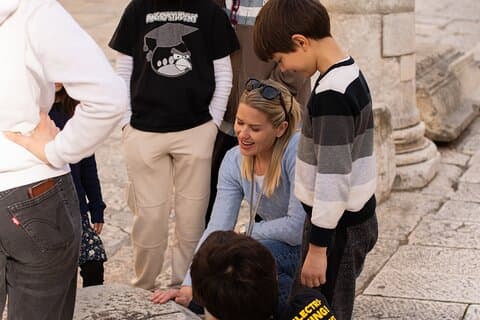
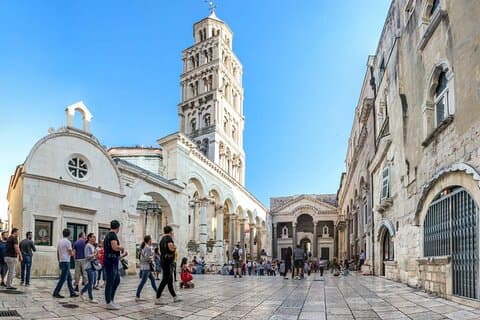
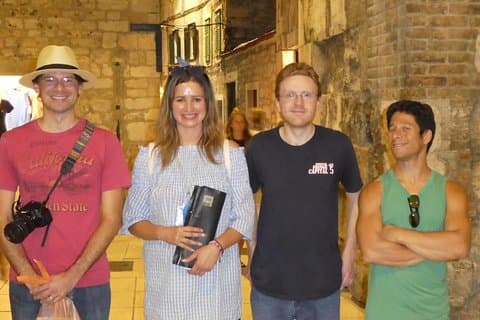
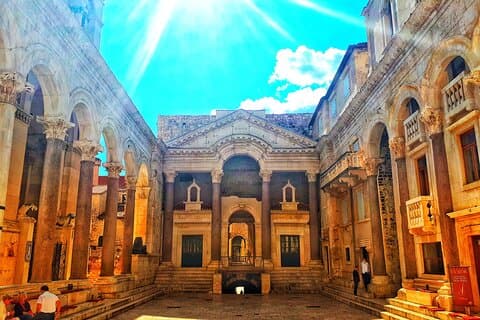
We start our tour at the Riva, the promenade of Split. Through the Bronze City Gate we enter the basement of the palace. The vaulted cellars are intact and very well preserved after more than 1700 years. Then we move on to the sacral part of the palace, the Perystil and the Cathedral, which was once Diocletian's mausoleum. The pagan temple of Jupiter became a baptistery in the 7th century. We will walk along the Cardo, the former main street of the palace and admire the Golden Gate. Then we will move on through the old town, to the Pjaca and the fruit market. Marvel at the rich offer at the fish market and, if you wish, treat yourself to a coffee or drink at the Procurative Square, where our tour ends. You will hear many interesting anecdotes and stories about the city and its inhabitants. Immerse yourself in the eventful history of Split. Discover the sights of this city at your leisure and get a lot of background information along the way.
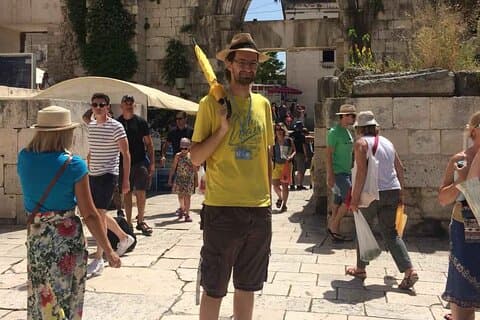
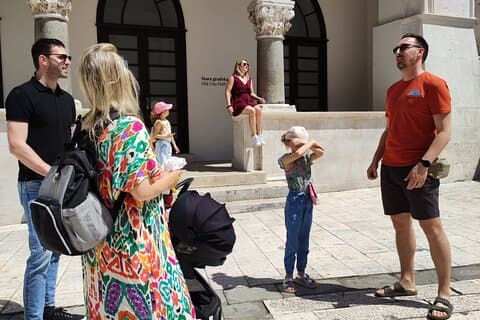
There I will give you some general information about the city and our tour.
If there is no worship or event and the attractions are open we will visit the basement of the palace, the interior of the Cathedral and the Temple of Jupiter together. The entrance fees for those three attractions are included.
The cellars, like the palace, were built more than 1700 years ago and are very well preserved. Here we get a very good impression of what dimensions the palace had.The entrance fee is included.
Preistil Ul., Split, Croatia
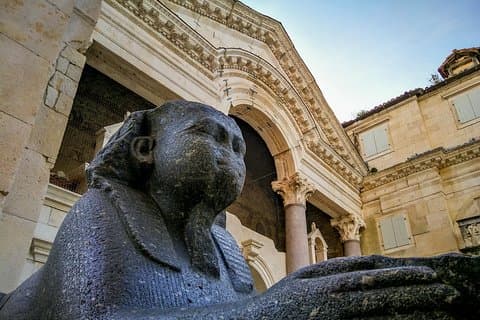
The Peristyle was the sacral meeting place in the time of Diocletian. Here he showed himself to his subjects and had himself worshipped as the son of the Roman god Jupiter.
Kraj Sveti Ivana, , Split, Croatia
The Temple of Jupiter is now a baptistery with a beautiful casket ceiling, the design of which influenced the architects of the Renaissance in Dalmatia.
Ulica Iza Vestibula 1, Split, Croatia
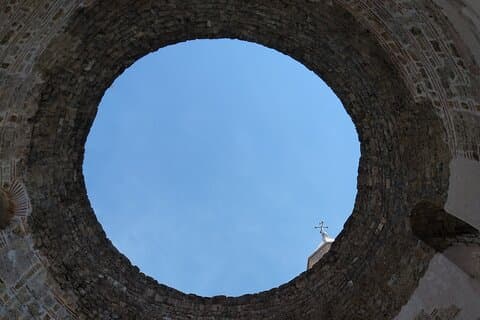
The vestibule was the entrance area to Diocletian's private chambers.
Ul. Kraj Svetog Duje 3, , Split, Croatia
Split Cathedral used to be the mausoleum of the late Emperor Diocletian. In the course of Christianization, the coffin and remains of the emperor disappeared and the pagan mausoleum became a Christian cathedral.
From here the road led to the city of Salona, the capital of the Roman province.
Narodni Trg, People's Square, Split, Croatia
From the North Gate we continue along the palace walls to the actual center of the Old Town, Narodni Trg and further to the former fruit market, Voćni Trg. This part of the city developed west of the palace since the Middle Ages.
Here are many old Venetian palaces and the old city hall in neo-Gothic style.
Trg Brace Radic 5, , Split, Croatia
Voćni trg used to be the market place for fruit. Today there is a monument to one of Split's most important Renaissance authors, Marko Marulić.
Obrov 5, Split, Croatia
The fish market in Split is an attraction. Next door are the sulfur baths. Even Diocletian knew that sulfur baths can provide relief from rheumatism and other diseases. By the way, the smell of sulfur is the reason why there are no flies in the fish market.
It was built by the French under Napoleon's rule at the beginning of the 19th century.
TRG Republike 1, Split, Croatia
We end our tour at Procurative. The beautiful square is reminiscent of St. Mark's Square in Venice. Here numerous cafes and restaurants invite you to linger.
We meet at the bronze model of the city of Split on the Riva. Directly opposite the south gate and the parking lot.
For a full refund, cancel at least 24 hours before the scheduled departure time.
Parcourez Split par catégorie - billets coupe-file, visites à pied, excursions d'une journée, expériences culinaires et plus