Open your door to the world of sightseeing with this private Athens city tour combined with Cape Sounio! Departing from your hotel in a luxury vehicle, you’ll set off on a full-day excursion that includes stops at major sights such as the Acropolis, Lycabettus Hill, Panathenaic Stadium and many more. But we don't stop there, this tour takes you along south Attica’s scenic coastal roads to reach the Temple of Poseidon, an ancient temple built on top of a towering sea cliff. The view of the Aegean Sea from this temple dedicated to the Greek god of the sea is breathtaking.
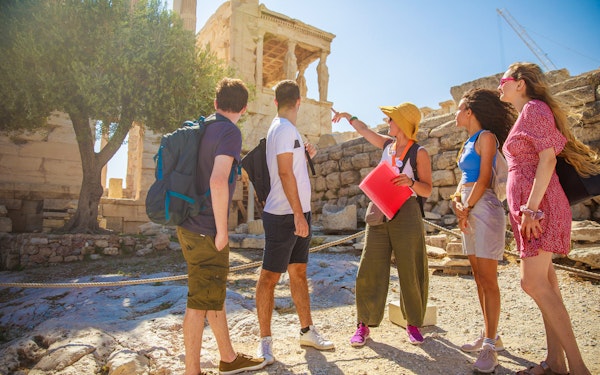
he city of Athens and contains the remains of several ancient buildings of great architectural and historical significance, the most famous being the Parthenon. The word acropolis is from the Greek words ἄκρον (akron, "highest point, extremity") and πόλις (polis, "city"). The term acropolis is generic and there are many other acropoleis in Greece. While there is evidence that the hill was inhabited as far back as the fourth millennium BC, it was Pericles (c. 495–429 BC) in the fifth century BC who coordinated the construction of the buildings whose present remains are the site's most important ones, including the Parthenon, the Propylaea, the Erechtheion and the Temple of Athena Nike. The Parthenon and the other buildings were seriously damaged during the 1687 siege by the Venetians during the Morean War when gunpowder being stored in the Parthenon by the Ottomans was hit by a cannonball and exploded.
me of ancient Greek architecture, where you will experience the greatness of ancient Greece captured on every piece of marble. An architectural jewel that hosts the best of what the human spirit and genius has ever conceived, an open embrace that awaits its famed sister marbles to welcome them home again.
Built around 420 BC, the temple is the earliest fully Ionic temple on the Acropolis. It has a prominent position on a steep bastion at the southwest corner of the Acropolis to the right of the entrance, the Propylaea. In contrast to the Acropolis proper, a walled sanctuary entered through the Propylaea, the Victory Sanctuary was open, entered from the Propylaea's southwest wing and from a narrow stair on the north. The sheer walls of its bastion were protected on the north, west, and south by the Nike Parapet, named for its frieze of Nikai celebrating victory and sacrificing to their patroness, Athena and Nike.
Athens in Greece which was dedicated to both Athena and Poseidon.
It is built on the south slope of the Acropolis hill, originally part of the sanctuary of Dionysus Eleuthereus. The first orchestra terrace was constructed on the site around the mid- to late-sixth century BC, where it hosted the City Dionysia. The theatre reached its fullest extent in the fourth century BC under the epistates of Lycurgus when it would have had a capacity of up to 17,000, and was in continuous use down to the Roman period. The theatre then fell into decay in the Byzantine era and was not identified, excavated, and restored to its current condition until the nineteenth century.
ic Stadium, the house of the first modern Olympic games, made of Pentelic marble in which the Olympic ideals are still reflected today.
s hill where you will enjoy the beautiful panoramic view of the city and admire the combination of ancient and modern Athens from above.
ses the Greek Parliament in an impressive building in downtown Athens overseeing Syntagma Square, protected by the presidential guard that consists of two soldiers dressed in the traditional Greek combat uniform, standing stationary and guarding beside the tomb of the unknown soldier. The two guards perform the guard change ceremony every hour with impressive accuracy and agility.
The square is named after the Constitution that Otto, the first King of Greece, was obliged to grant after a popular and military uprising on 3 September 1843. It is located in front of the 19th century Old Royal Palace, housing the Greek Parliament since 1934. Syntagma Square is the most important square of modern Athens from both a historical and social point of view, at the heart of commercial activity and Greek politics. The name Syntagma alone also refers to the neighbourhood surrounding the square.
It is a cenotaph dedicated to the Greek soldiers killed during war. It was sculpted between 1930 and 1932 by sculptor Fokion Rok. The tomb is guarded by the Evzones of the Presidential Guard.
It was designed by the Danish architect Theophil Freiherr von Hansen, as part of his famous Trilogy of neo-classical buildings including the Academy of Athens and the original building of the Athens University. It was founded by Ioannis Kapodistrias.
It was established in 1926 and operates under the supervision of the Ministry of Education. The Academy's main building is one of the major landmarks of Athens.
tern slopes of the Acropolis, and incorporating labyrinthine streets and neoclassical architecture. Plaka is built on top of the residential areas of the ancient town of Athens. It is known as the "Neighborhood of the Gods" due to its proximity to the Acropolis and its many archaeological sites. Free time for walking around and shopping.
ntal gateway resembling a Roman triumphal arch. It spanned an ancient road from the center of Athens, Greece, to the complex of structures on the eastern side of the city that included the Temple of Olympian Zeus.
It is situated in the southern parts of the Athens' Urban Area.
Since the 2011 local government reform it is part of the municipality Vari-Voula-Vouliagmeni, of which it is the seat and a municipal unit.
Vouliagmeni Lake, in the heart of the Athenian Riviera, is the hidden treasure of Attica's nature. Lake Vouliagmeni ("Sunken Lake") is a small brackish-water lake fed by underground currents seeping through the mass of Mount Hymettus located to the south of Vouliagmeni.
restaurants, taverns, complexes and other amenities.
Free time for having lunch at a local tavern by the beach.
kilometres (5.0 mi) south of the town of Lavrio and 70 kilometres (43 mi) southeast of Athens. The ancient Greek temple of Poseidon at Cape Sounion, built during 444–440 BC, is one of the major monuments of the Golden Age of Athens. A Doric temple, overlooks the sea at the end of Cape Sounion, at a height of almost 60 meters (200 ft). The ancient Greek temple of Poseidon at Cape Sounion, built during 444–440 BC, is one of the major monuments of the Golden Age of Athens. A Doric temple, it overlooks the sea at the end of Cape Sounion, at an elevation of almost 60 metres (200 ft).
Your personal driver will pick you up and return you to the same place or at the point you prefer. In case of a hotel, he will be waiting for you at the hotel lobby. In case of an apartment, he will be waiting for you at the entrance of the building. In case of Piraeus port, he will be waiting for you at the gate, just as you disembark, holding a sign with your name on it to spot him upon arrival.
For a full refund, cancel at least 24 hours before the scheduled departure time.
Parcourez Athens par catégorie - billets coupe-file, visites à pied, excursions d'une journée, expériences culinaires et plus