A magnificent circuit with more than splendid landscapes in Beni Mtir where you will enjoy the panoramic view of Djebal and the lake, passing through Tabarka and the village of Aïn Draham to discover the immense forest which covers the Khroumirie massif. They are also exceptional places to stay for absolute relaxation in an invigorating environment.
Thereafter, you will go to the city of Bni Mtir to visit the Charchara waterfall and the forest. To end this adventure, you will enjoy a visit to the city of Béja to shop for traditional dairy products such as cottage cheese, salt-free cheese, butter, etc.
n of the governorate of Béja) in the northwest of Béja. This Mosque was founded at the beginning of the 17th century. It is the result of an unprecedented synthesis between local African traditions and those of Hispano-Moorish decorative and architectural design. This mosque is the most remarkable example of Morisco art in Tunisia.
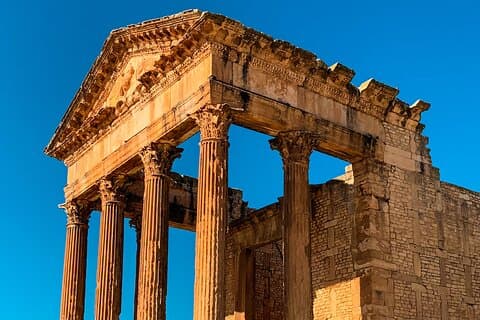
it is the “best preserved small Roman city in North Africa”. this archaeological site preserves, within its delimitation, the vestiges of different periods of the ancient city with all its components: the monumental center (capitol, forum, market, place of the wind rose ...), the buildings of shows (theater, circus) and the public baths clearly reflect the way in which an indigenous foundation evolved during the Roman period.
In a unique setting where the greenery of nature embraces the blue of the sea during the summer and where the whiteness of the snow dominates in winter, Tabarka offers its visitors a great diversity of landscapes and a wide choice of visits. Famous for its mountains, its tiled houses, wild boar hunting, corals, Jazz, scuba diving and other criteria, the city of Tabarka presents not only a quiet seaside resort for visitors who decide to escape the crowds but also a starting point for various archaeological and cultural visits.
gerian border, the Aiguilles de Tabarka constitute one of the tourist attractions in the landscape of the region. On the geomorphological level, these "needles" correspond to salient vertical reliefs which are formed by a succession of massive coarse sandstone bars, of about ten meters each and which are separated by relatively softer clay valleys. These sandstone protrusions, which are sculpted into steep cliffs, can reach 25 m in altitude. These sandstone reliefs which are subjected to the simultaneous actions of rainfall and wind factors, thus creating real arched structures, under which visitors can walk, taking the winding path that runs along the coast.
stern Tunisia and is part of the governorate of Jendouba. This city is also the capital of a delegation of 40,372 inhabitants, the city hosts a population of only 9,788 inhabitants (according to 2014 statistics). Ain Drahem settles on an altitude of 800 meters on the slopes of Djebel Bir (1014 meters). This mountain is part of the Kroumirie mountains. This region is the wettest area of Tunisia and it holds the national record for rainfall with 1534 millimeters of precipitation per year and it is one of the few where you can see snow. Well yes, it snows in Tunisia too! and besides, in winter a large number of Tunisians travel to the northwest of the country just to see the snow (don't laugh, we don't see it often).
tainous region of Kroumirie a few kilometers from Aïn Draham. Beni Mtir is on the territory of the confederation of Berber tribes of Kroumirs. Located 650 meters above sea level and attached to the governorate of Jendouba.
For a full refund, cancel at least 24 hours before the scheduled departure time.
Parcourez Sousse par catégorie - billets coupe-file, visites à pied, excursions d'une journée, expériences culinaires et plus