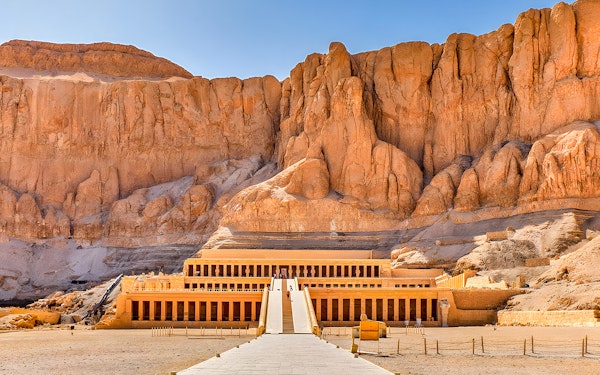
Discover the beauty of ancient Egyptian history with a visit to the Valley of the Kings in the west Bank of Luxor and the Valley of the Queens. The Valley of the Kings is an archaeological site containing the tombs of the Egyptian pharaohs, including the famous tomb of King Tutankhamun. The Valley of the Queens is a site containing the tombs of queens and noble women . And also Learn about the Temple of Medinet Habu Mortuary temple of King Ramses III one of the largest temples in ancient Egypt. It is distinguished by its exquisite design and beautiful See the funerary temples and tombs on the Nile’s West Bank. Visit the Valley of the Kings, valley of the queens, the Colossi of Memnon and Hatshepsut Temple, dedicated to the most famous powerful queen of Egypt Queen Hatshepsut
Start your day visiting the Valley of the Kings, the magnificence of the grandeur of architecture that was used for burial, there are many kings buried in this valley. You will visit 3 tombs excluding the Tomb of King Tutankhamun.
psut, daughter of Thutmosis I, who ruled Egypt for about 20 years during the 18th Dynasty (approximately from 1490 to 1469 B.C), the only pharaonic woman who reigned ancient Egypt. Later on, you will be transferred back to your hotel in Luxor.
al site located on the west bank of the Nile River in Egypt, near the ancient city of Thebes (modern-day Luxor). It is situated opposite the Valley of the Kings, another prominent necropolis of ancient Egypt. The Valley of the Queens served as the burial place for the wives and children of pharaohs during the New Kingdom period (approximately 1550-1070 BCE). The tombs in this valley were constructed for queens, princesses, and other royal family members. The name "Valley of the Queens" is a modern designation, as the ancient Egyptians referred to the area as "Ta-Set-Neferu" or "The Place of Beauty."
ancient Egyptian temple complex located on the west bank of the Nile River in the city of Luxor, Egypt. It was built during the New Kingdom period, specifically during the reign of Pharaoh Ramses III, who ruled from approximately 1186 to 1155 BCE. The temple served as a funerary temple dedicated to Ramses III and was intended to honor and worship him after his death. It was a place of ritual and offerings, as well as a site for the pharaoh's mortuary cult. The temple complex is quite large, covering an area of about 24,000 square meters (260,000 square feet).
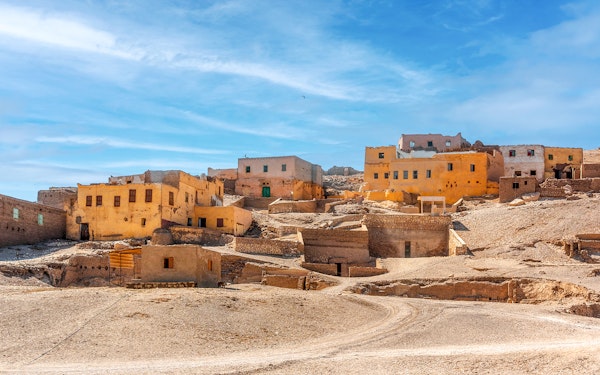
ite located on the west bank of the Nile River near Luxor, Egypt. It was an ancient Egyptian village that served as a home for the craftsmen and workers who constructed and decorated the royal tombs in the nearby Valley of the Kings and Valley of the Queens. Deir el-Medina was established during the New Kingdom period and was inhabited from approximately the 15th century BCE to the 11th century BCE. The village provided housing, facilities, and support for the skilled artisans and laborers who worked on the royal tombs. These workers were highly skilled and specialized in various crafts, including carving, painting, and sculpting.
They are among the most famous and iconic landmarks in the area. The Colossi of Memnon depict Pharaoh Amenhotep III, who reigned during the 18th Dynasty of ancient Egypt. The statues originally stood at the entrance of Amenhotep III's mortuary temple, which has since been mostly destroyed. Each statue is about 18 meters (60 feet) tall and weighs around 720 tons. These statues are made of quartzite sandstone and are intricately carved, depicting the pharaoh seated on a throne with his hands resting on his knees. Originally, the statues were further adorned with colorful paint, although most of it has faded over time.
We picking up all travelers in Luxor city
For a full refund, cancel at least 24 hours before the scheduled departure time.
Browse Luxor by category - skip-the-line tickets, walking tours, day trips, food experiences & more