Discover the highlights of ancient Luxor on a private full-day tour covering both the East and West Banks of the Nile. Explore magnificent temples and ancient royal tombs, including the Valley of the Kings, Temple of Hatshepsut, Colossi of Memnon, Karnak Temple, and Luxor Temple.
Enjoy comfortable private transportation with pickup and drop-off from your Luxor hotel, cruise ship, Luxor Airport, or train station. Explore the sites at your own pace with a professional and comfortable private service.
Choose the option that best suits your needs: • Private transportation only • Private transportation with a licensed guide • Private transportation with a licensed guide and entrance fees
Bottled water and lunch are included.
Please note: The standard Valley of the Kings ticket includes access to three tombs. Special tombs, such as Seti I and Tutankhamun, require an additional ticket, which can be arranged at an extra cost.
statues of the Pharaoh Amenhotep III, which stand at the front of the ruined Mortuary Temple of Amenhotep III, the largest temple in the Theban Necropolis. They have stood since 1350 BC, and were well known to ancient Greeks and Romans, as well as early modern travelers and Egyptologists. The statues contain 107 Roman-era inscriptions in Greek and Latin, dated to between AD 20 and 250; many of these inscriptions on the northernmost statue make reference to the Greek mythological king Memnon, whom the statue was then – erroneously – thought to represent.
It is a valley in Luxor, Egypt where, for a period of nearly 500 years from the 16th to 11th century BC, rock-cut tombs were excavated for the pharaohs and powerful nobles of the New Kingdom (the Eighteenth to the Twentieth Dynasties of Ancient Egypt). The valley stands on the west bank of the Nile opposite Thebes (modern Luxor), within the heart of the Theban Necropolis. The wadi consists of two valleys: the East Valley (where the majority of the royal tombs are situated) and the West Valley (Valley of the Monkeys). Almost all of the tombs seem to have been opened and robbed in antiquity, but they still give an idea of the opulence and power of the pharaohs
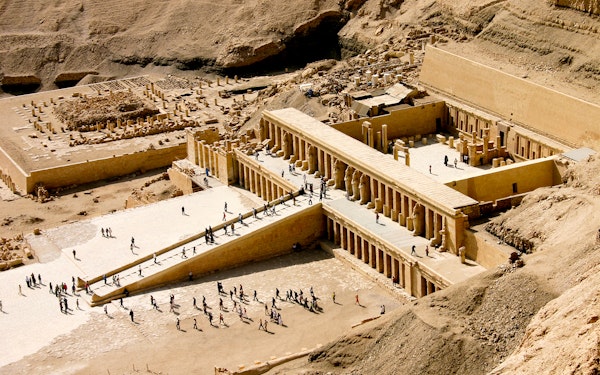
Pharaoh Hatshepsut of the Eighteenth Dynasty of Egypt. Located opposite the city of Luxor, it is considered to be a masterpiece of ancient architecture. Its three massive terraces rise above the desert floor and into the cliffs of Deir el-Bahari.
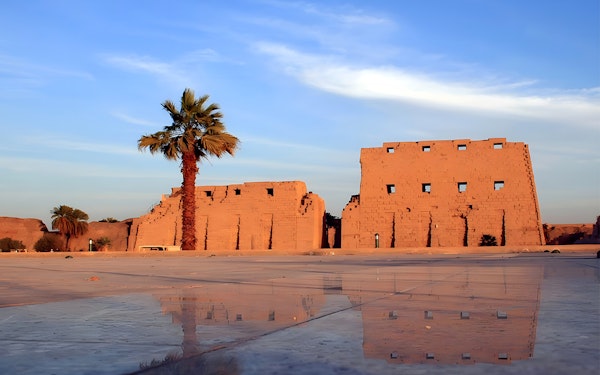
ayed temples, pylons, chapels, and other buildings near Luxor, Egypt.
bank of the Nile River in the city today known as Luxor (ancient Thebes) and was constructed approximately 1400 BCE. In the Egyptian language it was known as ipet resyt, "the southern sanctuary". It was one of the two primary temples on the east bank, the other being Karnak. Unlike the other temples in Thebes, Luxor temple is not dedicated to a cult god or a deified version of the pharaoh in death. Instead, Luxor temple is dedicated to the rejuvenation of kingship; it may have been where many of the pharaohs of Egypt were crowned in reality or conceptually (as in the case of Alexander the Great, who claimed he was crowned at Luxor but may never have traveled south of Memphis, near modern Cairo). Along with the other archeological sites in Thebes, the Luxor Temple was inscribed on the UNESCO World Heritage List in 1979.
We also pick you up from the Nile cruises
For a full refund, cancel at least 24 hours before the scheduled departure time.
Browse Luxor by category - skip-the-line tickets, walking tours, day trips, food experiences & more