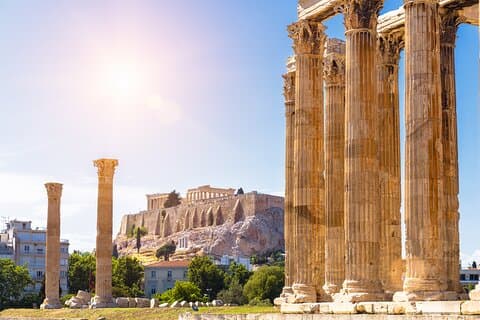
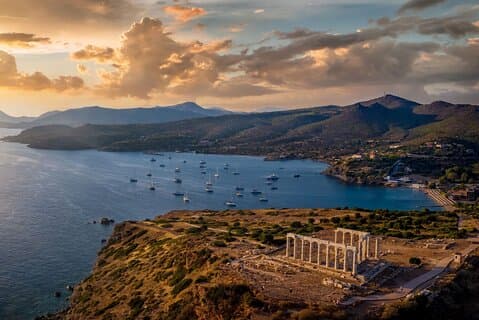
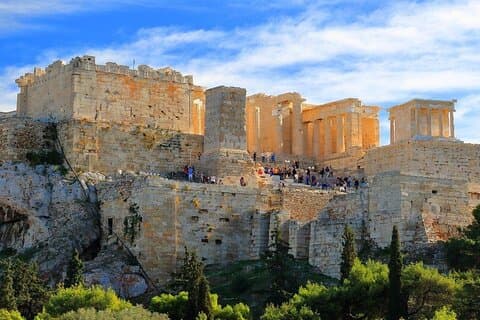
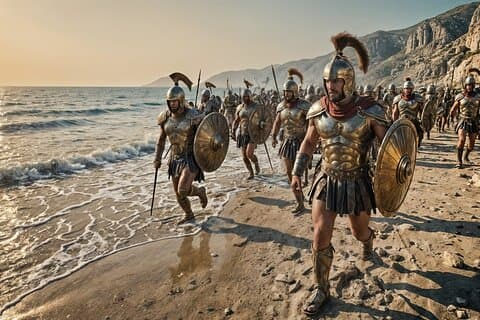
On a 5-hour private tour, learn about Athens's best-kept secrets as well as its main attractions. For tourists who prefer the freedom to personalize their sightseeing experience without having to worry about the specifics, the half-day excursion is perfect. Take private transportation to see the Acropolis, the Roman Agora, the Temple of Zeus, and other sites. Your driver -guide offers insightful information and expert advice for the remainder of your trip to Athens. Lastly, take a break for lunch, which includes one souvlaki and one soft drink or beer per person.Get the personalized experience of a private tour.Travel comfortably in all-inclusive transportation.Customize the itinerary to suit your interests. See the top sights of Athens in just five hours
The Monastery is built on the site of the ancient sanctuary of Apollo Daphnaios which was destroyed during the invasion of the Goths in 395 A.D.The first monastery was erected on the site in the 6th century A.D. and was enclosed by strong defensive walls, almost square in plan. The catholicon was a three-aisled basilica which stood in the center of the courtyard. Along the inner NE side of the walls, two-storied buildings were constructed, containing the cells of the monks. A refectory and a second block of cells were attached on the north wall of the enclosure.
dministrative and social activity, the religious and cultural centre, and the seat of justice.
with a donation of Julius Caesar and Augustus. During the reign of Hadrian the court was paved with slabs. After the invasion of the Herulae in A.D. 267 the city of Athens was restricted to the area within the Late Roman fortification wall, and the administrative and commercial centre of the city was transferred from the Ancient Agora to the Roman Agora and the Library of Hadrian.
mpeion was the sanctuary of Olympian Zeus. Here stands one of the greatest ancient temples of Zeus and, according to Vitruvius, one of the most famous marble buildings ever constructed. The sanctuary's foundation is attributed to mythical Deukalion. The site also comprises the temple of Apollo Delphinios - the sanctuary of Apollo Delphinios was traditionally associated with Theseus - and a tripartite building with a south courtyard of ca. 500 BC. The latter has been identified as the Delphinion Court, which was allegedly founded by Aegeas.
Its history is directly connected to the Modern Olympic Games, from their revival in 1896 until the Athens Olympic Games in 2004. It is also the place from which the Olympic Flame is delivered to all the Olympic Games, Winter, Summer and Youth, as well as the Athens Authentic Marathon.
During 1844–63 and 1927–35 the parliament was bicameral with an upper house, the Senate, and a lower house, the Chamber of Deputies, which retained the name Vouli. Several important Greek statesmen have served as Speakers of the Hellenic Parliament.
It is a cenotaph dedicated to the Greek soldiers killed during war. It was sculpted between 1930 and 1932 by sculptor Fokion Rok. The tomb is guarded by the Evzones of the Presidential Guard.
The Academy Building constitutes one of three parts in an “architectural trilogy”. It was founded with the Constitutional Decree of March 18th, 1926, as an Academy of Sciences, Humanities and Fine Arts.
t in 1837 and is the oldest higher education institution of the modern Greek state and the first contemporary university in both the Balkan Peninsula and the Eastern Mediterranean. Today it is one of the largest universities by enrollment in Europe, with over 69,000 registered students. The University of Athens was founded on 3 May 1837 by King Otto of Greece and was named in his honour Othonian University. It was the first university in the liberated Greek state and in the surrounding area of Southeast Europe as well.
last of the Architectural Trilogy of Athens, a group of three neoclassical buildings which also includes the Academy and the University.
It now houses the country's National Historical Museum
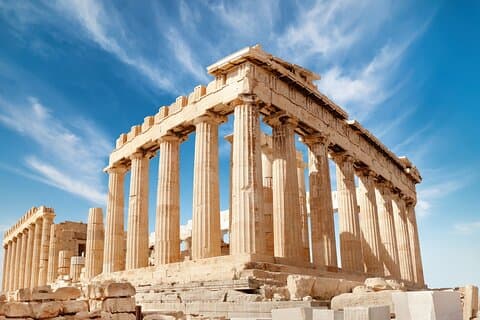
The uncovering and restitution of its monuments has been gradually accomplished, since 1834. The main visible monuments of the archaeological site were built during the Classical period, in the second half of the 5th c. B.C., in the framework of the Periclean building program. It is about the Propylaia, the monumental entrance of the classical Acropolis, the Parthenon, doric temple dedicated to goddess Athena and major achievement of the ancient Greek architecture, the Erechtheion, in whose interior space very ancient cults and memories of the city were hosted, and the ionic temple of Athena Nike on a prominent position to the south of Propylaia.
It is also the starting point of most of the city’s demonstrations and it also houses concerts and festivals. The square is always full of life, packed with people in its bars.
that has been inhabited for six thousand consecutive years! It is among the oldest, most historic and important neighborhoods in Western Culture. The name “Monastiraki” was established during the Greek Revolution against the Ottoman Occupation. It was inspired by the nunnery (female monastery) that was established on the square. The area includes the Ancient Agora, one of the most important archeological sites in Athens, which was the center of the ancient city of Athens. Just next to the Monastiraki square, one will find also the Hadrian Library and the Roman Agora with the Tower of Winds. We will stop to enjoy a lunch in a greek taverna
Your personal tour driver will pick you up and return you to your hotel in Athens, meeting you at the lobby. In the case of an AirBnb apartment, he/she will contact you upon arrival so you can meet at the entrance of the building. For Airport and Port pick-up, your driver will meet you at the arrivals area holding a signboard with the guest's name.
For a full refund, cancel at least 24 hours before the scheduled departure time.
Bläddra Athens efter kategori - biljetter utan kö, promenader, dagsturer, matupplevelser och mer