During this tour you will visit some of the most important tourist destinations in Montenegro, Albania, N. Macedonia, Kosovo and Bosnia & Herzegovina. Walk through the narrowed streets of UNESCO-city Berat and admire the beauty of the UNESCO world heritage site of Ohrid on this 8-day tour. This small group tour (up to eight participants) offers the opportunity to get the best out of these 5 unique countries in a short period of time. The tour can be joined either from Dubrovnik or Kotor
ready to get soaked up into your Balkan adventure. At 07:30 am you will be picked up from your hotel in Dubrovnik by our local representative (driver) who will shuttle you to the border where you will meet your tour leader for this amazing trip.
We will wander through the maze of narrow, cobblestone streets crisscrossing the old town. This street plan seems quite chaotic, but it was created this way on purpose. The intention was to confuse intruders who came to plunder the town, while nowadays it characterizes the city. Many of the old buildings and churches have small plaques on it with their dates of construction and original use. We will visit the Saint Luke’s church which has a great significance for the locals because it represents unity to them.
s for its beaches, gorgeous nature and old characteristic buildings. The city is separated between an old and new part. On one hand, in the New Budva, there are many modern buildings, offices, shopping malls, restaurants and bars. On the other hand, in the Old Budva, there is the historical centre and many sights to visit, such as the St. Ivan church, the small church of St. Mary and the medieval splendours of the old town, which we will visit on this tour.
After arriving in Tirana, check in at your accommodation and get ready to enjoy a unique experience in the city while learning more about the city's culinary treasures.
Located on the main boulevard opposite the government building, this site honors the political prisoners who suffered under the oppressive regime. Next, we’ll head towards the colorful and lively Blloku Neighborhood. Once a restricted area for members of the Albanian politburo, Blloku is now one of Tirana’s most vibrant areas, full of cafes, boutiques, and colorful street art. While there, Blloku we will also pass by the residence of Albania’s communist leader Enver Hoxha
The main square is surrounded by the National Museum, the Bank of Albania, the theatre of Opera, Skanderbeg Statue, Ethem Beu Mosque and fancy bars. Our tour continues towards Tirana Castle, found in the city center. The castle is now a pedestrian street where modern and tradition perfectly merge creating one of the fanciest areas of modern Tirana. In 1967, Albania was declared the world’s first atheist state, with all religious practices banned and institutions shut down or repurposed by the regime. We will get to learn more about Albanian’s religious while we pass by Namazgah Mosque (the largest in the Balkans); Orthodox Cathedral and Catholic St. Paul’s Cathedral.
Walking through the narrowed stone streets offers a fantastic view of the medieval old houses, with windows that seem to stand on top of each other. The city’s life began in the 6th-5th century B.C. as an Illyrian settlement. Later, in the 3rd century B.C., it was turned into a castle city known as Antipatrea. Uniquely today, residents still live inside of the castle walls
ively lower town consisting of grand old houses draped on steep hillsides, an old stone bridge, great museums and remains from the communist era in Albania.
e oldest human settlements in all of Europe. Ohrid city and the Lake are part of UNESCO World Heritage since 1980. The Lake was named by the Romans as “Lyhnidas” (the Light Lake), it’s surroundings where inhabited by the Illyrian Tribe of Enkeleys. We will visit the famous view point of Church of St. John at Kaneo. Ohrid became an important centre for the Orthodox believers during the Byzantine Empire and is famous for its 365 Orthodox churches, said to have one church for each day of the year. During the Ottoman Empire the houses were built with a very specific architecture that created narrowed streets, tunnels and tiny yards on the hilly terrain, making it possible for every house to have a good view of the lake.
Here, you will learn about the ancient art of handmade paper production, crafted using techniques that date back to the time of Gutenberg. You will even have the opportunity to purchase a piece of handmade paper as a unique souvenir, a lasting reminder of your visit.
Macedonia. The city has European, Ottoman and even Asian influences.
Impossible to miss in Skopje is the Alexander the Great Statue in the center. Another bridge that stands out is the Art Bridge that leads to the Archaeological Museum. The bridge is lined with flamboyant street lanterns and statues of Macedonian artists and musicians. We will wander through the Old Bazaar of Skopje, the biggest one in the Balkans, that combines the modern way of living with centuries of history. The cross on top of the mountain can be seen kilometres away from Skopje and has become a symbol of the city.
o, mixing its rich history, incredible nature, religious tolerance and gastronomic delights. Prizren has played an important role in the region as an Illyrian settlement and a crossroad for the Byzantine and Ottoman empires, contributing to the unique architecture of the city. The river flows through the heart of the old town and under the many bridges that crisscross the city
We will take a tour around the farm. In addition, we will learn about the story of this farm and how it created jobs for more than 400 people in the surrounding area. The farm collects, elaborates and preserves regional bio fresh local products. We will also learn how this family business adapted some old communist buildings to serve as storage for local-made bio products. You will have some free time to enjoy a traditional lunch or buy some fresh produce products from the farm.
rt of Albania, giving its name to the biggest lake in the Balkans. It is one of the oldest cities in Albania, with a history of a thousand years of habitation. The oldest wall of the Shkodra castle dates from the 1st millennium BCE. The Roman historian Livy cited the town as the capital of the Illyrian king Gent, who fought the Romans in 168 B.C.
f the most fascinating artistic workshops in Albania. Inspired by Venetian traditions, this small factory handcrafts exquisite papier-mâché masks, each one painted and decorated entirely by hand. The vibrant studio is filled with color and creativity, where every mask tells a story, from classic Venetian carnival styles to imaginative modern creations.
As we cross into Montenegro, you will witness rolling green hills, tranquil villages, and glimpses of the shimmering waters of Shkodra Lake come into view. Shkodra Lake is the largest lake in the Balkans and one of the most important natural reserves in the region. It lies between Albania and Montenegro and is home to over 260 species of birds, including pelicans and herons, as well as countless species of fish and unique flora. The area is a protected national park and a true paradise for nature lovers, photographers, and anyone seeking tranquillity away from the cities.
ribed as the gateway to Shjodra Lake National Park. The village’s stone bridges and traditional houses create an authentic Montenegrin charm. Here, you can take some time to stroll through the small local market or relax with a coffee or a glass of local wine while overlooking the peaceful waters of the lake.
In the evening, you may explore the city’s main attractions, such as the Millennium Bridge, Old Ribnica River, and Independence Square, or enjoy dinner in one of Podgorica’s many restaurants.
sit Blagaj, a little bit outside of Mostar. On the foot of a cliff, with beautiful blue waters in front of it, Blagaj is a small Ottoman medieval town with its stunning nature and imposing spring of river Buna.
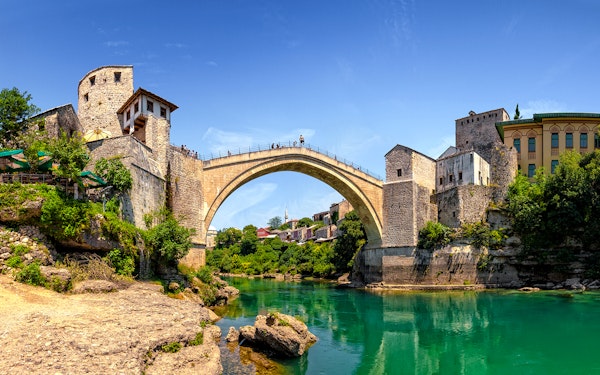
Our first stop will be the iconic Old Bridge also known as Stari Most, part of UNESCO world heritage and built in a typical Islamic architectural style in the 16th century. We will also wander through the Old Bazaar with its colourful streets and lively atmosphere. The city has stones with “Don’t Forget” all around the town, commemorating the city’s history. Mostar combines the old with the new, which you will notice while wandering through the streets. We will also visit the Bišćevića Kuća, one of the finest examples of Ottoman residential architecture in the region. Built in the 17th century and beautifully preserved, this riverside house offers an intimate glimpse into the lifestyle of a wealthy Ottoman family.
perience through the rich history and culture of this part of the World. Your tour leader will take you to the Croatian border. Upon reaching the border our local representative (driver) will shuttle you to your hotel in Dubrovnik. We hope this has been a wonderful experience with great memories to cherish for a lifetime.
On request (at least 12 hours before tour departure) we can pick you up in Dubrovnik at 9:00 am or on Kotor at 11:00 am free of charge.
All sales are final. No refund is available for cancellations.
Procure Dubrovnik por categoria - ingressos sem fila, passeios a pé, excursões de um dia, experiências gastronômicas e muito mais