Maximize your time on this 2 half days & 1 full day tours combination. If you arrive on a midday flight and leave on the third day this program is for you ! Start exploring the island right upon you arrive at Easter Island. See major sites of Easter Island Private guide for a more personalized experience Learn more about the fascinating Rapa Nui history
Chile
Orongo village is located on one side of the Rano Kau volcano crater. It's one of the two main sites on the island as in this place was celebrated the Birdman ceremony.
Chile
Located on the southwest side of the island the crater of this volcano is one of the most beautiful natural landscapes of Rapa Nui. With 1.5 Km large this crater is the biggest reserve of the endemic flora of Rapa Nui and its lake served as an important source of drinking water in ancient times.
Chile
Highlighted archeological site characterized by the fine work of the ancient builders of Rapa Nui. There are some theories about the construction of this first platform establishing a hypothetical relationship with the Inca construction style.
Rapa Nui, Chile
Ceremonial Complex restored in 1974 by the American archaeologist Dr. William Mulloy. Tahai embraces three principal ahu from north to south: Ko Te Riku (restored eyes one), Tahai, and Vai Ure. For its proximity to town, it's a popular place for sunset photos.
Hanga Roa, Chile
Located on the southeast coast of the island it is considered as an emblematic place. In this place, we can understand how the village was arranged in relation to the ceremonial center or ahu. Seeing the giants on their backs and on their foreheads on the ground is a great experience.
Chile
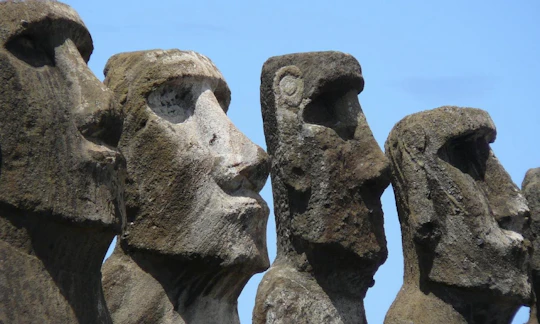
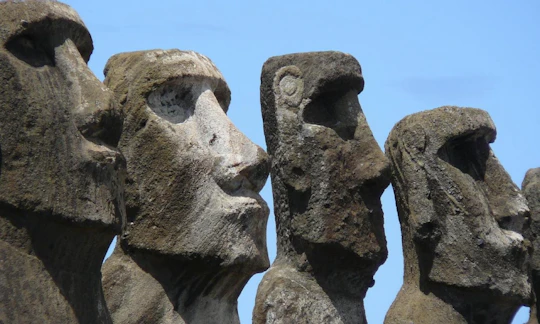
Located opposite to Rano Raraku this is the largest platform from all of the reconstructed on the island. The ahu Tongariki is the most imposing moai platform on the island. This altar has fifteen visible standing statues overlooking the island with their backs to the Pacific Ocean.
Chile
This is the only volcanic cone tuff quarry existing on the island. This material allowed the construction of the moai on a larger scale. Rano Raraku houses the quarry where the moai were built and from where they were moved to the ahu (ceremonial platforms) on the island.
Chile
With 11 meters long and about 90 tons weight here we find the largest moai transported from Rano Raraku: Ahu o Paro. Next to this Ahu we find the famous rounded stone called Te Pito 'o te Henua. According to tradition, this stone was brought to the island by the ancestors.
Chile
This beach is characterized by warm turquoise waters and coral sand. It is the main beach of the island and used to be the ancestral residence of the Miru Araki royal family. The ahu Nau Nau is undoubtedly one of the most accomplished Ahu of the island because of the refinement of its moai.
Chile
Prepare to be seduced by the breath-taking sunrise in the Moai statues of Ahu Tongariki. The sun rises behind the platform during summertime (October to March) and from Poike volcano during the rest of the year. There are more chances of unclear skies during wintertime.
Chile
One of the very few ceremonial platforms not located by the sea. Its seven moais have been restored to their standing position by the archaeologists William Mulloy and Gonzalo Figueroa along with the Rapa Nui community. These moai have the particularity of having astronomical positioning guidance and look towards the setting sun.
Hanga Roa, Chile
Quarry from where the red volcanic stone was extracted and used for the carving of the Pu Kao or the moai's hair. In this place we find 23 cylindrical prototypes of Pu Kao at an early stage of carving facilitating the transportation to the ahu. Here you also have a privileged view of Hanga Roa village
We pick up travelers at all hotels/accommodations at the island Please let us know your hotel on the island so we can pick you up for the tour.
For a full refund, cancel at least 24 hours before the scheduled departure time.
Bla gjennom Påskeøya etter kategori - skip-the-line billetter, gangsturer, dagturer, matopplevelser og mer