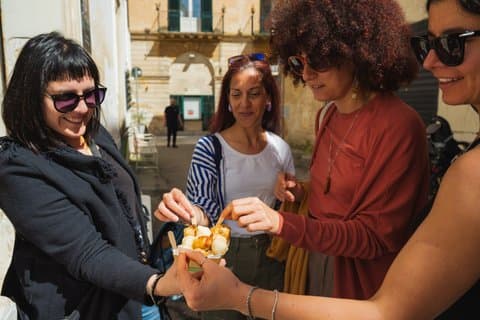
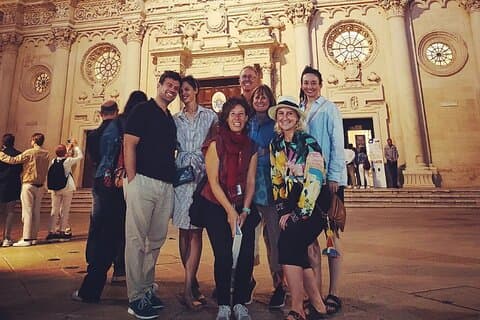
If you're looking for a fun and curious way to visit Lecce, you've come to the right place! With this digital guide created with the support of a local, you will be able to visit all the most important monuments at your own pace. You'll get to know the stories and curiosities of Lecce! But also you will discover everything about local foods, Italian Aperitivo in authentic local restaurants, and much more!
Via Giuseppe Libertini, Lecce, Italy
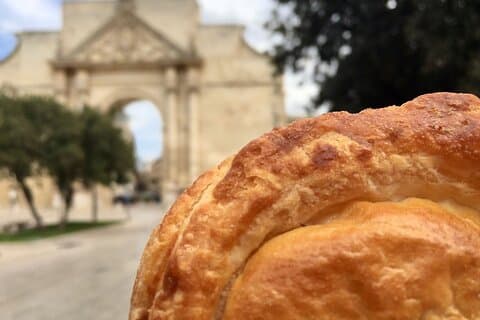
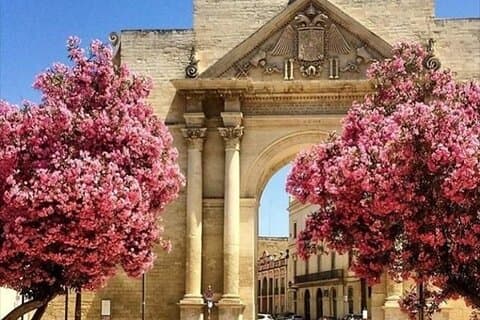
Porta Rudiae is one of the historic gates of the city of Lecce that allowed access to the city by crossing its defensive walls. The current structure, built in 1703, is a baroque reconstruction realized thanks to Prospero Lubelli.
Lecce, Italy
In the past, the square was known as the “Courtyard of the Bishop’s Palace,” an area reserved exclusively for the clergy and surrounded by religious buildings that isolated it from the rest of the city.
Sant’Oronzo, is the center of the city’s religious life. The cathedral was rebuilt in 1659 on the ruins of a previous church, which had been demolished because it was no longer adequate to accommodate the growing population of believers.
ith balustrades, flower vases, pyramids and other elaborate decorations. Amazing view from the top!
Via Arte della Cartapest, , Lecce, Italy
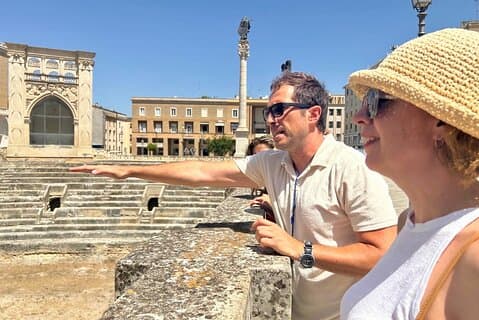
The Roman Theatre, one of the most significant testimonies of the ancient imperial city of Lupiae. Built during the first decades of the 1st century AD by order of the emperor Octavian Augustus, the theatre, together with the amphitheatre which I will tell you about later, represented an important entertainment centre for this city of the Roman Empire.
Lecce, Italy
It was the emperor Octavian Augustus, in the first decades of the 1st century AD, who wanted the construction of this great Amphitheater. Studies suggest a capacity of about 20,000 spectators.
Piazza Sant'Oronzo, Lecce, Italy
Piazza Sant’Oronzo represents the true vital center of the city of Lecce, not only from an artistic point of view, but also symbolic and social. Piazza Sant’Oronzo is located in the heart of what was once the Roman Lupiae.
Piazza Duomo, 5, Lecce, Italy
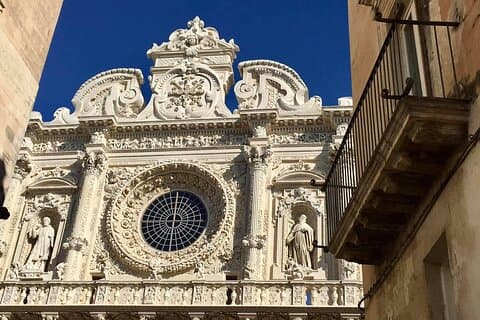
The Basilica of Santa Croce is considered the symbol of Lecce Baroque. Its construction began in 1549, on the initiative of the Celestine Fathers, a religious order, after the demolition of the previous temple and convent founded in the second half of the 14th century in the area of the Carlo V Castle.
Viale XXV Luglio 52, Lecce, Lecce, Italy
The Charles V Castle is the largest castle in Puglia. Built in the 12th century AD, it was named after the Spanish king Charles V because, in 1539, the emperor ordered the reconstruction of the previous castle, considered unsuitable to defend the city from Turkish incursions in the Mediterranean.
My itinerary starts out from this place! However, you can access to the digital guide even before getting here!
For a full refund, cancel at least 24 hours before the scheduled departure time.
Bla gjennom Lecce etter kategori - billetter uten køanstand, gåturer, dagturer, matopplevelser og mer