Experience an 7-day small group tour from Budapest that includes European capital of Culture 2021 - Timisoara, and from 2007 - Sibiu. Learn how three different cultures converge in one country. Enjoy sightseeing in Bucharest, Romania's capital. Visit Dracula's birthplace, also Unesco citadel - Sighisoara. See Borgo Pass, Dracula's Castle, Peles Castle, Bicaz Gorges and the magnificent painted churches from Bucovina.
rkish, Serbian, Austrian and German elements, which will become the European Capital of Culture in 2021
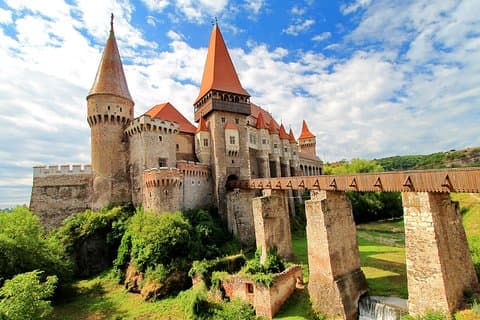
eautiful and greatest of our continent, the famous Corvin Castle
Great United Romania was made here on December 1st, 1918, so immediately after the First World War
dominated by the Tower of the Clock or Council Tower dating to the medieval era and by the extensive 18th – 19th century Brukenthal museum, the former residence of the governor of Transylvania. The big square, the small square and Huet Square, with the Evangelical Cathedral, show off in all their beauty.
This citadel is the best preserved in Europe and, extraordinary, it is still inhabited. Since 1999 the historic center of Sighisoara is a UNESCO heritage site. Here we will admire the church on the hill, reachable after a wooden staircase called the schoolchildren’s ladder. We will also see the statue of the famous Hungarian national poet Petofi Sandor, testifying to the fact that in Sighisoara the Magyar community was in the past numerically important. Next to the statue is the beautiful Catholic church, reserved for the Hungarian community, and the tower of the shoemakers. You can have lunch at the house where Vlad the Impaler was born (not included)
In this transylvanian city, the Hungarian community is still numerous and the architects who have worked on the design of historic buildings are all Hungarians
heran church, built in the fourteenth century in Gothic style but remodeled with Renaissance elements in the second half of the sixteenth century.
pathians, founded by the great prince Stephen the Great and characterized by a beautiful blue color, inimitable and unique in the world
Rares in the 16th century and whose interior and exterior frescoes enchant the visitor.
Like the previous two, too, it presents Gothic and Byzantine elements, which merge to form the fascinating Moldovan architectural style. The frescoes on the northern façade of this monastery have remained visible thanks to the protective walls that have never been demolished here.
t work with the famous black ceramic, here you will have the opportunity to enter the workshop to closely observe the various working phases of ceramic pots, but you can also buy items typical of Bucovina. At Marginea you can buy not only ceramic vases, but also beautiful painted eggs and decorated with the traditional Romanian technique
el founded at the time of Stephen the Great, in the fifteenth century and an 18th century synagogue. The city has a wonderful geographical position being surrounded by mountains that guard beautiful lush vegetation.
The Bicaz gorges are crossed by a road flanked by a stream and constitute a landscape of strong emotional impact with thrilling cliffs. Along the gorges there is a market with typical handicrafts and souvenirs that make the attraction even more lively.
ndslide of a part of a mountain, in fact the trunks of the trees are still present in the lake and this gives a particularly evocative atmosphere. The place is interesting especially for the legends that were born and have spread in reference to the name of the lake. During the visit you will become aware of these legends
This area is also called the Siberia of Romania for the low temperatures and the landscape that characterize this area
ant cultural, tourist and commercial center. Brasov impresses with its typically German architecture, where the Gothic, the Baroque and the Renaissance intersect to give life to an interesting and culturally very lively city. Visit of the First Romanian School, which is located in the oldest district of the city, and which was inhabited exclusively by Romanians, the Schei district, interesting for the entrances into the city that were carried out in medieval times through the Caatherine’s and Schei Gate, quest last of the nineteenth century. In Brasov we will also visit the impressive Black Church, the largest evangelical Gothic church in Eastern Europe, with a 65 meter high bell tower and a length of 90 meters, the church houses the most beautiful nineteenth-century mechanical organ of Romania. We will then admire the palaces and houses of the historic center, recently restored, with the Council Square which now houses a beautiful museum, and the pedestrian Avenue of the Republic.
In the Middle Ages, Bran was exactly on the border between Wallachia and Transylvania, so it was essential for the inhabitants of Brasov to build and preserve a defensive stronghold. In the 90s of the 900 this fortress was transformed into a beautiful castle thanks to the intervention of Queen Maria of Romania
he beautiful Sinaia monastery founded by the great Michele Cantacuzino, a leading figure of the nobility and the Romanian culture of the seventeenth century.
ia, the King Charles 1 of Hohenzollern, of German origins. The castle was beautifully designed by a Czech architect, and is famous for being one of the most modern castles in Europe at the time of its construction, between the 19th and 20th centuries. Each room is characterized by a unique style, different from the styles of the other rooms. We will also admire the Florentine room, where we will breathe a typically Italian and Renaissance atmosphere.
riumph Arch, Atheneum, Revolution Square and Parliament Palace
Departure directly from your hotel or from the airport at 09.00 a.m.
All sales are final. No refund is available for cancellations.
Bla gjennom Budapest etter kategori - billetter uten køanstand, gåturer, dagturer, matopplevelser og mer