In Gyeongju, which has a 1,000-year history of the capital city, it is a World Natural Heritage point. Design the perfect personalized outing in Gyeongju&Yangdong folk village during this fully-private tour.
Pick only the attractions you want to see as highlights like Yangdong folk village, bulkuksa temple, daereungwon tomb complex, gyochon village, and much more in 9hours. Most visitors have time for 4-6 site visits and meal stops during their outings.
A full day to explore and go where you want to go Learn about South Korea's history and culture from your private driving guide.
The tour is a one-day tour where you can feel all the races in a day, and is conducted with the list below. Vehicle-related expenses, guide-related expenses are all included, and the only thing you need to pay is admission fees and lunch expenses. We will have free time meals at Hwangridan-gil or recommend Korean food to suit your taste. you can try the most famous Korean local food place in Gyeongju.
You can visit anywhere in Gyoengju. Discover the rich history of Gyeongju at your own pace on a private full-day tour of its UNESCO World Heritage Sites. Get the personalized experience of a private tour in Korea Travel comfortably in a private air-conditioned vehicle Make the most of your limited vacation time in South Korea Visit multiple UNESCO World Heritage Sites in South Korea. Departing from Busan or Gyeongju, you’ll enjoy the flexibility to choose a round-trip or one-way tour. Bulguksa Temple (1h), Daereungwon Tomb Complex (1h), Gyeongju National Museum (1h), Cheomseongdae (30min), Hwangridan-gil road (1h), Donggung and Wolji (1h), Gyochon village (1h), Woljeonggyo Bridge (20min) * Times given in parentheses refers to approx. time taking at each place. They don't include transportation time.
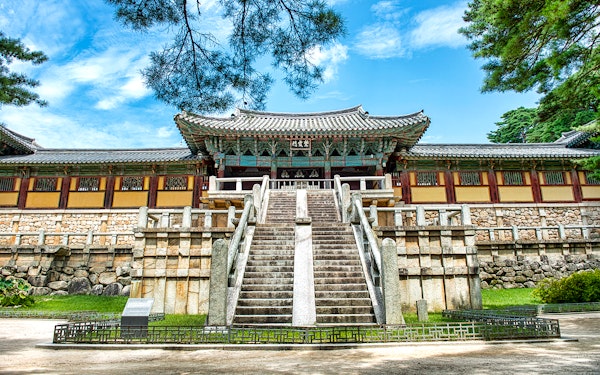
The temple was built during the 15th year of King Beopheung's reign (514-540) to wish for peace and prosperity for all. Starting in 1920, the temple has undergone continual restoration work. The temple now holds seven national treasures and a number of additional important heritages and was designated a World Cultural Heritage Site along with the nearby Seokguram Grotto by UNESCO in December 1995. and good for maple leaves tour.
lla period (AD 676-935), but was burnt down during the Joseon dynasty. Through historical research, the bridge was rebuilt in April 2018 to become the largest wooden bridge in Korea.
Artifacts excavated from the tomb include a gold crown, gold cap, gold waist belt, gold diadem, and gilt-bronze shoes worn by the buried. The gold crown, in particular, is known as the largest and the most elaborate of all gold crowns unearthed in Korea.
ed in traditional hanok buildings, making it popular among the younger generations in Korea. The street also demonstrates newtro aesthetics due to the remaining old and worn buildings built during the 1960s and the '70s.
ditional village of old hanok houses that offers visitors a glimpse into life during the Joseon period. One of the famous sites here is the Gyeongju Hyanggyo, a Confucian academy and shrine, where Korea’s first state-operated educational institute “Gukhak” was established in 682.
632-647) of the Silla Dynasty for observation of the movements of heavenly bodies. It is the oldest astronomical observatory in Asia and is widely regarded as a precious cultural heritage that gives us a clear idea of the level of technological development of that time.
The palace, along with other secondary palaces, was used as the eastern palace where the prince lived, and banquets were held during auspicious events or to welcome important guests.
casing the traditional culture of the Joseon dynasty and the beautiful natural surroundings. Thanks to its many cultural heritages, including treasures, national treasures, and folklore materials, the entire village has been designated as a cultural heritage site. Many people have visited this village to see its wealth of cultural heritages and scenic surroundings, including King Charles III, who visited this village in 1993. Seolchangsan Mountain and its four spines of mountains can be seen beyond the village. Approximately 160 old houses and 500-year-old thatched-roof cottages are nestled within the valley. Fifty-four of these homes are over 200 years old and have been excellently preserved in their original state, offering the opportunity to view a variety of unique traditional Korean houses in person.
Please leave the pick-up place you want. If your tour starts from or ends in Gyeongju, the service time will be 8 hours.
Vehicle information and guide information will be provided two days before the start of the tour. We will contact though Whats app, Please make sure to install it.
For a full refund, cancel at least 24 hours before the scheduled departure time.
Explora Busan por categoría - entradas sin cola, tours a pie, excursiones de un día, experiencias gastronómicas y más