类似体验
 Viator
 Viator
 Viator
 Viator
 Viator
 Viator
 Viator
 Viator
 Viator
 Viator
 Viator
 Viator
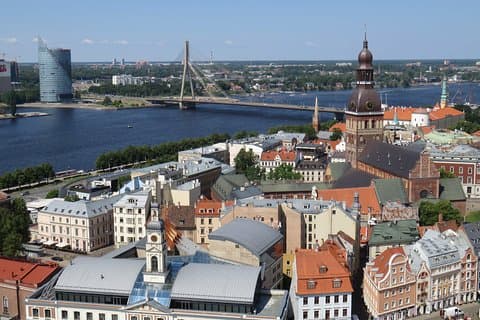
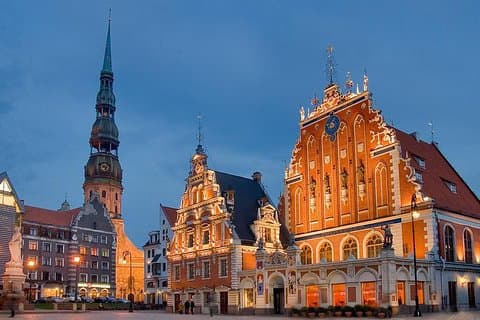
The tour includes a sightseeing tour of Riga and a walking tour of the city center. You will see Daugava embankment, Riga Castle, House of the Black Heads, St. Peter's Church, Riga Cathedral, Art Nouveau Riga, Swedish Gate, Cat House, Latvian National Opera, Riga Art Nouveau, etc.
The Western bank of the river has contemporary buildings, including the elegant wave of the National Library. The Eastern bank has the Old town buildings, including the Town Hall square with the House of the Blackheads. The significant landmark of the embankment is the statue of St. Christopher, hidden in the glass box, that is a popular lucky charm of the town.
It was the Livonian order residence, currently occupied by the president of Latvia. The castle is an impressive structure with the white walls, fat towers and red roof. After the 2013 fire, the castle is closed for renovation till the end of 2018.
Take a walk through the labyrinth of the narrow brick streets, enjoying the colorfull buildings, little shops and sweet restaurants. See the famous Dome square and cathedral, Castle with the Castle square, Town Hall, house of the Blackheads and others.
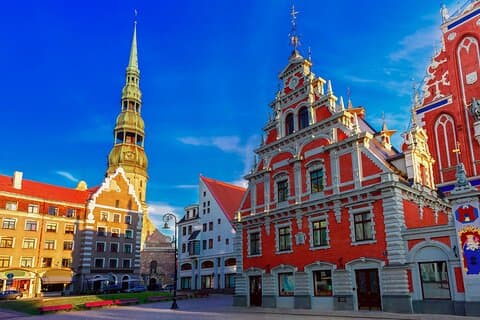
It belonged to the society of merchants and ship owners, formed in 15th century in the Baltics. The current exterior of the building dates back to the middle of the 17th century.
privileges of a medieval city, often associated with the Hanseatic Trade League. It's placed it the heart of the old town. Roland was respected as a patron of the trade, people came to his statue, seeking health, fortune, wealth
e of the oldest and most valuable monumental architecture edifices in the Baltic States from the Middle Ages. St.Peter's is the tallest of the Riga churches, a significant landmark, and a prime example of the 13th century Gothic style.
ed in or the subject of paintings, photographs and television travelogues. Like all of the ancient churches of the city, it is known for its weathercock on the top. It was built in 1211 on the high Daugava bank. The cathedral has the 2nd largest organ in Latvia. You can visit the regular organ concerts in the cathedral.
It houses several architectural monuments: Riga Cathedral, Riga Bourse House and other buildings from the 19th and early 20th century. A lot of activities of the city meet here, flowing in from seven streets.
Riga fell into this important register due to its medieval buildings, wooden architecture of the 19th century and art nouveau architecture, which in terms of quality and distribution have no equal in the world.
in medieval times, serving as both a fortification wall and an important border for trade purposes. The Swedish gate was also one of the few entrances to the city that provided access to the barracks outside the city wall, and were built in 1698.
of the angry looking cats on the top of the building's towers. There are lots of legends about the origin of this symbols, and historians still debate about the true one. And the cats are watching the city from the tower tops.
These are the oldest residential complex in the city. The White brother with the gothic steps on the roof is the oldest one with the unique stone benches at the door. The Middle brother is also middle of age. It features the Dutch architectural Mannerism with elegant window tops and unusual roof. The Green brother is the youngest. It features the strict but charming early baroque with the traditional Gable.
ch also includes the National Ballet, Chorus and Orchestra. Formerly the German theater, the building is the 1883 post fire reconstruction of the 1863 structure.
od, national unity, independence and freedom.
After the Second World War the clock during long period of time was used as political information stand. In 1999 the clock has gone through the total reconstruction, brining back the looks it had in 30s.
Meet your driver and guide at the cruise ship.
All sales are final. No refund is available for cancellations.