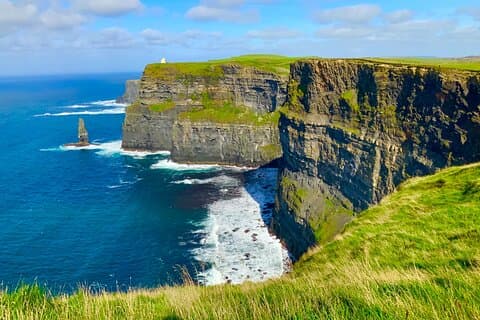
Nothing can compare to that first time when you excitedly walk towards the viewing point at the Cliffs of Moher. Your gasp of astonishment will cement that incredible spectacle in your memory for decades to come. We can enjoy lunch with ample choice at the visitor centre or at a pub in Doolin - a place that’s famous for its traditional music (at night, naturally).
We’ll caress the jagged coastline along The Wild Atlantic Way, one of the world’s most scenic drives, looking out to Galway Bay. Before you realise, we’ve ventured into The Burren, a surreal landscape of bright grey limestone.
There is such an energy to Galway city that sets it apart. It is regarded as the most ‘Irish’ city, due to its isolation in western Ireland and the high number of Irish-speakers.
We’ll return to Dublin directly. Lying in your bed later, you’ll reminisce over the stories, history, culture you heard raccounted, the medieval castles, and your first glimpse of the Cliffs of Moher.
It’s difficult for your eyes to comprehend their height as drop down to the foamy waters below, but they say the cliffs are 120 metres (390 ft) on average, with a maximum height of 214 metres (702 ft). Now, this is impressive enough, but the fact that they extend for as long as 14 kilometres (9 miles) makes this a bucket list item. Look out and you’ll see the Aran Islands and Galway Bay. Gaze deeper and you might see a very distant island floating on the horizon - Hy Breasail or St. Brendan’s Island - a fictional island that inspires who knows how many dreamers to travel west to ‘the island of promise’. Once the wind has refreshed you well enough, seek shelter in The Atlantic Edge interpretive centre, to gain a deeper understanding of the topology, flora and fauna of the area. Then warm up with some snacks, beverages or even a meal.
n family, this impressive castle appeases most expectations of a stereotypical ‘medieval castle’. Today, adjoining the castle is "Bunratty Folk Park" that demonstrates life in 19th century Ireland. It’s an open-air museum featuring around 30 buildings. In the evenings, the castle itself holds banquets that are as true to the medieval format as is practical.
But look a bit closer and you’ll find treasures. In fact, the protected area is quite unique in that naturally hosts flowers from sub-arctic, mountainous and Mediterranean areas. 23 of Ireland’s 27 orchid species can be found in the Park. 75% of Ireland’s native plant species can be found in this ostensibly barren landscape. This is a surreal karst landscape that has been compared to the moon for its blanket of nearly endless limestone.
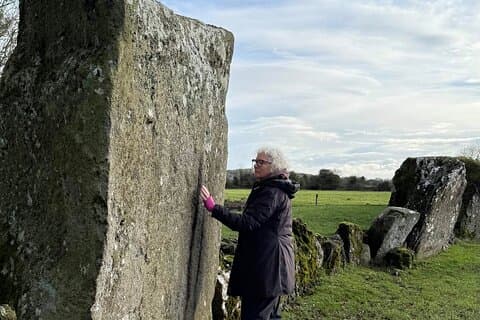
They’ve been a part of the native architecture of Ireland for longer than the existence of the Egyptian pyramids. Few of them are more epic than the Poulnabrone Dolmen. It the best known and most widely photographed of the approximately 172 dolmens in Ireland. Dolmens are not only impressive megalithic arrangements, they are burial sites. The remains underneath this dolmen date from between 3800 BC and 3200 BC, though the construction could have happened anytime between 4200 BC and 2900 BC.
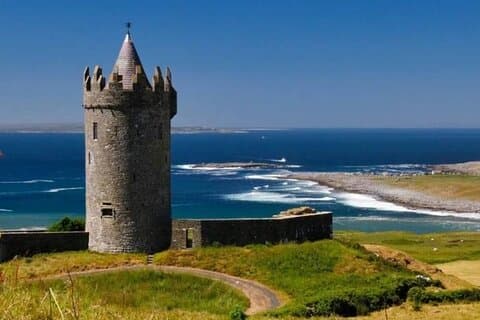
Built in the 1520s by Rory Mor O'Shaughnessy, the castle has been and continues to be an inspiration for historians, writers, musicians and poets.
Regarded as the most ‘Irish’ city, due to its isolation in western Ireland and the high number of Irish-speakers, Galway has a refreshing and energetic air. Architecturally, Galway has a unique feel thanks to the preservation of townhouses from the 17th and even 16th centuries. The best place for a proper ‘session’ (Traditional Irish Music session), Galway has no shortage of authentic and charming pubs. But even during the day, you’ll hear talented buskers breathing music into the narrow streets. Learn about the famous Claddagh ring, Arran Sweater or Galway Hooker (it’s a boat!).
tches the entire west coast of the island of Ireland. The untamable Irish coastline has stood defiantly against the north Atlantic’s storms for millenia. It shows us just how beautiful yet powerful and unforgiving the mighty sea can be.
Ciarán in the mid-6th century on the eastern bank of the River Shannon. The site includes the ruins of a cathedral, seven churches (10th-13th century), two round towers, three high crosses and the largest collection of Early Christian graveslabs in Western Europe. The original high crosses and a selection of graveslabs are on display in the visitor centre. The long and varied history of Clonmacnoise is recounted in an audiovisual presentation shown in the visitor centre. There are also exhibitions that deal with the flora, fauna and landscape of the region.
All sales are final. No refund is available for cancellations.
按分类浏览 Dublin - 免排队门票、漫步游、一日游、美食体验等