Explore the famous landmarks of these two híghly urbanized cities in Central Visayas Region and discover why Cebu City was declared as the “Queen City of the South” and Lapu-Lapu City as a “Historic Resort City”.
● Fort San Pedro / Plaza Independencia * ● Basilica Minore Del Santo Niño ● Yap - San Diego Ancestral House ● Heritage of Cebu Monument ● Taoist Temple * ● Magellan’s Cross ● Cebu Museum (Museo Sugbo) ● Mactan Shrine ● Alegre Guitar
rtuguese explorer Ferdinand Magellan on the Mactan Island of Cebu, the Philippines. The spot is believed to be the site where Magellan was killed in the 1521 Battle of Mactan.
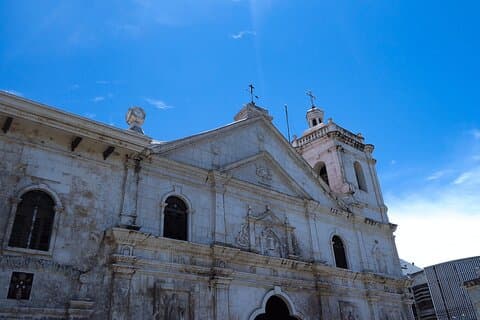
anto Niño de Cebú and commonly known as Santo Niño Basilica, is a minor basilica in Cebu City in the Philippines that was founded in 1565 by Fray Andrés de Urdaneta and Fray Diego de Herrera. It is the oldest Roman Catholic church in the country, allegedly built on the spot where the image of the Santo Niño de Cebú was found during the expedition of Miguel López de Legazpi.
s the teachings of the ancient Chinese philosopher, Lao Zi. In the temple, devotees perform rituals. One ritual is where one prays to the gods to grant one's wish.
depicting significant and symbolic events in the history of Cebu back from the time of Rajah Humabon to the recent beatification of the Cebuano martyr, Pedro Calungsod. The monument was built by the local artist, Eduardo Castrillo.
It is said to be among the first Chinese houses to be built outside of the country.
The structure is octagonal kiosk made of coral stone
Designed in 1869 by Domingo de Escondrillas, the lone architect in Cebu at the time, the Cárcel de Cebú was originally proposed as the Cárcel del Distrito, the main prison for the Visayas District.
Free Pick Up & Drop Off from any hotel within Tri-Cities (Mandaue, Lapu-Lapu, Cebu) 7:00 - 9:00 am hotel pick up
All sales are final. No refund is available for cancellations.
Browse Cebu by category - skip-the-line tickets, walking tours, day trips, food experiences & more