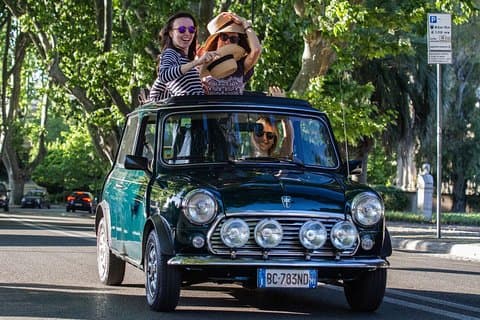
Enjoy a great half-day of sightseeing in Rome. An English-speaking driver will offer commentary on landmarks and help customize the tour to your request. This tour starts and ends in Rome
e route of aRoman stadium here built by emperor Domitian.Piazza Navona (Navona square) is one of the most ancient and full of history places in Rome. Called originally theCircus Agonalis built by Domitianand was flooded for mock battles into the 19th c.-is thronged with vendors, portrait artists, and picture snapping tourists who tend to crowd the view of the main attraction,Bernini’s Fountain of the Four Rivers .
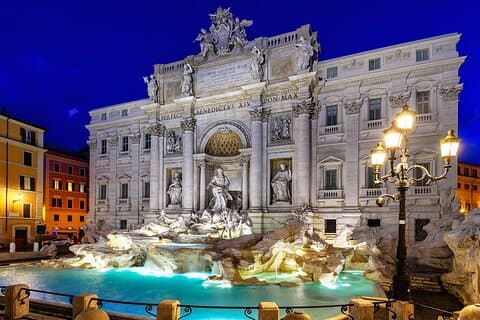
in in the city.The origins of the fountain go back to the year 19 B.C., in which period the fountain formed the end of the Aqua Virgo aqueduct. The first fountain was built during the Renaissance, under the direction of Pope Nicholas the 5th.The Trevi Fountain dates from 1762, when after many years of works at the hand of Nicola Salvi, it was finalized by Giuseppe Pannini. Interestingly enough, the name of Trevi derives from Tre Vie (three ways), since the fountain was the meeting point of three streets.
at took care of Romulus and Remus, which is located in the Palatine Hill. According to the legend, when the brothers grew up they decided to form a city on the banks of the river, but when they could not come to an agreement in some points of the decision, Romulus killed Remus and founded the city of Rome.
l beauty, but also the fact that it represents a true cultural revolution. It was the first temple built for the common people. Today, this could seem an obvious concept, but in ancient times temples were forbidden places, only for vestals and priests.
ich would have been located on Piazza di Spagna (literally ‘Spanish Square’) at the base of the monument. After they were completed in 1725, the steps quickly gained a reputation for being a prime people-watching spot because they attracted a crowd. And not just any gathering, but a particularly good-looking crowd. Why did such a beautiful bunch congregate here? It's simple really. A high concentration of artists and later photographers, who were themselves drawn to the attractive monument, served as bait for wannabe models. Of course, decades of heavy footfall took their toll on the monument. A huge restoration project in 2015 and 2016 saw the Spanish Steps scrubbed clean and returned to their former splendor. These days, they are looking as spick and span as they ever have.
It was built at the turn of the 20th century to honour Italy's first king, Vittorio Emanuele II – who's immortalised in its vast equestrian statue. The building provides the dramatic setting for the Tomb of the Unknown Soldier. Also inside is the Complesso del Vittoriano, a gallery that regularly hosts major art exhibitions. But as impressive as any of the art on show are the glorious 360-degree views from the top of the monument. See for yourself by taking the panoramic Roma dal Cielo lift up to the Terrazza delle Quadrighe.
Crowd gathered there every day. The Roman Forum is situated in the area between Piazza Venezia and the Colosseum is one of the most important archaeological sites in the world. The area soon began to develop and already at the end of the 7th century BC, it was home to many markets and a hive of social activity. The most incredible panoramic view of the entire Forum complex can be seen from the magnificent terraces of Campidoglio. Here you can observe the imposing ruins of Basilica Emilia, the only remaining Republican basilica, or the Curia, which was once the seat of the Senate. Starting from the Arch of Septimius Severus, the pathway winds through the most unique place in the world and passes beside the imposing Basilica di Massenzio, one of the most magnificent buildings of Imperial Rome, and ends near the Arch of Titus, where you will get a glimpse of the unmistakable Colosseum.
For a full refund, cancel at least 24 hours before the scheduled departure time.
Browse Rome by category - skip-the-line tickets, walking tours, day trips, food experiences & more