Our guide will pick you up from Alexandria Port or Hotel or Airport holding a sign showing your names. You will choose visiting 4 sites from these : bibliotheca Alexandrina , catacombs of kom El Shokafa , Ancient Roman Amphitheater , St.Mark Cathedral , Abu El Abbas Mosque , Fort Qaitbay , Royal Jewelry Museum , Montaza Gardens , Stanely Bridge , Serapeum of Alexandria and Alexandria National Museum . then you will be back to Your hotel/port/airport.
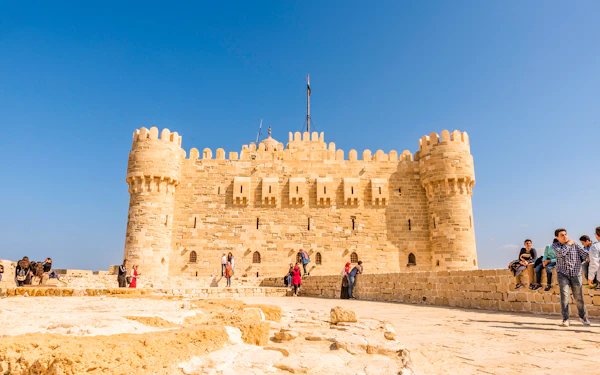
The Mamluk sultan al-Ashraf Abu al-Nasr Qaitbay built it between 882 AH/ 1477 AD and 884/ 1479 AD over the ruins of Alexandria’s Lighthouse. It served as Alexandria’defence against naval attacks. The citadel was made of limestone and spanned an area of approximately 17550 m2. An outer wall plotted with defence towers surrounds the building.
ese catacombs make up the largest-known Roman burial site in Egypt and one of the last major works of construction dedicated to the religion of ancient Egypt. Demonstrating Alexandria’s hallmark fusion of Pharaonic and Greek styles, the architects used a Graeco-Roman approach. The catacombs consist of three tiers of tombs and chambers cut into bedrock to a depth of 35m (the bottom level is flooded and inaccessible).
Believed to stand on the site of a church founded in AD 42 by Mark the Evangelist, in AD 311 a chapel was recorded here, containing bodies said to be of Mark and his successors. Enlarged in the days of Pope Achillas, the church was ruined in 641 when the Arabs invaded Egypt, but was rebuilt in 680 by Pope John III of Alexandria. In 828, most of the body of Saint Mark was stolen and removed to Venice, with only the head remaining in Alexandria.
The mosque interior is approximately 22-26 metres tall, and the floors are covered with white marble. Its walls are made of a combination of artificial stone and mosaic. Several Arabic inscriptions, arabesque interlacing, mosaics, mashrabiyas, and ventilation openings that surround the mosque from all directions are present on the interior of the roof.
The theatre used to host huge ceremonies and events with a capacity of 600 spectators. The audience section consisted of 13 rows made of white marble and the supported columns were made of granite exported from Aswan city south Egypt. The five compartments on the top of the audience section probably were used to host some royals or public figures during performances, and was covered by ceilings in the shape of domes supported by granite columns to protect the audience from the sun and rain. In the 6th century A.D, an earthquake hit Alexandria and destroyed most of these structures leaving only some ruins that still stands until today, reflecting the beautiful and magnificent architectural skills that Romans had.
ns, and while replacing it might seem a Herculean task, the new Bibliotheca Alexandrina manages this with aplomb. Opened in 2002, this impressive piece of modern architecture is a deliberate attempt to rekindle the brilliance of the original centre of learning and culture. The complex has become one of Egypt’s major cultural venues and a stage for numerous international performers, and is home to a collection of brilliant museums
built by Ptolemy III Euergetes (reigned 246–222 BC) and dedicated to Serapis, who was made the protector of Alexandria, Egypt. There are also signs of Harpocrates. It has been referred to as the daughter of the Library of Alexandria. The site has been heavily plundered.
Most of these pieces came from other Egyptian museums. The museum mainly focuses on three collections spread over three floors: Floor 1: Pharaonic epoch. The mummies are shown in a recreation of a funerary chamber. Floor 2: Artifacts from the Hellenistic period and Roman period, including pieces from Heraklion and Canopus. Objects include canopic jars, and pieces from the rule of Nectanebo II. Objects include pieces of Caracalla, figures of Medusa, a mosaic portrait, representing Queen Berenice II wife of Ptolemy III. Floor 3: Ancient Egyptian, Coptic, and the Muslim world as well as 19th and 20th century. The city of Alexandria is also included in the collection.
founded by Muhammad Ali Pasha in 1805 and continued to rule for 150 years, until 1952. Zaynab Fahmi built the palace in 1919 in Zizinya, Alexandria. It served as the residence of Fatma al- Zahra’, daughter of Prince Ali Haider, a descendent of Muhammad Ali Pasha. The palace serves as a striking backdrop to the magnificent possessions owned by the family. It uniquely merges between European and Islamic styles, reflecting the fine taste of the royal family whose paintings, gilded ceilings, and mosaics decorate the palace rooms. The palace consists of two wings, eastern and western, connected by a corridor. Each wing has a basement and two floors
2 by Khedive Abbas II, the last Muhammad Ali Dynasty ruler to hold the Khedive title over the Khedivate of Egypt and Sudan. It was used as a hunting lodge and residence for his companion
We pick you up from any hotel in alexandria or alexandria port or alexandria /borg el arab airport .
For a full refund, cancel at least 24 hours before the scheduled departure time.
Browse Alexandria by category - skip-the-line tickets, walking tours, day trips, food experiences & more