Meet us at our meeting place and see the most interesting places in Krakow. Learn about the history of the medieval city - the Jewish Quarter - Kazimierz and Podgórze (former territory of the Krakow ghetto).
What You see on this tour ? 1. Planty Park 2. History Krakow - description 3. Jewish Quarter - description 4. Skałka Church 5. Church of St. Catherine 6. Wolnica Square - Jewish City Hall 7. Church of Corpus Christi 8. Tempel Synagogue 9. Kupa Synagogue 10. Isaac Synagogue 11. Ciemna Street 12. Old Synagogue 13. Popper Synagogue 14. Family House of Helena Rubinstein 15. Remuh Synagogue and old cemetery 16. Memorial Stone of the Nissembaum Family Foundation 17. Old Jewish Shops 18. Former Ghetto - description 19. Ghetto Heroes Square 20. Pharmacy under the Eagle - Residence of Tadeusz Pankiewicz 21. Oskar Schindler's - history 22. Life in Ghetto - description 23. Ghetto Wall 24. Church of St. Joseph
also known as Skałka, which means "a small rock" in Polish, is a small outcrop in Kraków atop of which a Pauline monastery is located, a place where the Bishop of Kraków saint Stanislaus of Szczepanów was slain by order of Polish king Bolesław II the Bold in 1079. This action resulted in the king's exile and the eventual canonization of the slain bishop.
It used to be as large as the Krakow market square and served similar functions - trade took place here, and there was also a town hall, where the highest administrative and judicial authorities of the city of Kazimierz had their seat. Other public buildings were also located here: stalls, scales or a shearing room. The present name of Plac Wolnica derives from the Latin Forum liberum (the right to free trade in meat outside stalls) and has existed in this form since the end of the 18th century, when Kazimierz was granted the privilege of free trade.
It was intended as a monastery church, which explains the large plot of land on which it stands, and the presence of a monastic cemetery next to it. In 1404 King Władysław II Jagiełło gave it to the Canons Regular of the Lateran, a congregation which he had brought in from Kłodzko
The current shape was established in the regulatory projects of 1808 and 1844. On the northern side of the square, along the defensive walls of Kazimierz, there are houses that used to belong to the Jewish hospital at the Kupa synagogue
Tempel Synagogue is not only a major place of worship, but also a booming center of Jewish culture, which hosts numerous concerts and meetings, especially during the Festival.
It is located in the former Jewish quarter of Kazimierz developed from a neighborhood earmarked in 1495 by King John I Albert (Polish: Jan I Olbracht) for the Jewish community, which has been transferred from the budding Old Town. Kupa Synagogue serves Kraków's Jewish community as one of the venues for religious ceremonies and cultural festivals, notably the annual Jewish Culture Festival in Kraków.
owicz Synagogue, is an Orthodox Jewish synagogue from 1644 situated in the historic Kazimierz district of Kraków, Poland.The synagogue is named for its donor, Izaak Jakubowicz (d. 1673), also called Isaac the Rich, a banker to King Ladislaus IV of Poland. The synagogue was designed by Italian-born architect Francesco Olivierri.
Also known as the "Tall Synagogue", the name corresponds to its height or, alternatively, because the prayer hall was situated upstairs. It is the tallest synagogue in the city and is an example of Late Renaissance architecture.
ated in the Kazimierz district of Kraków, Poland. In Yiddish it was referred to as the Alta Shul. It is the oldest synagogue building still standing in Poland, and one of the most precious landmarks of Jewish architecture in Europe. Until the beginning of the Second World War in 1939, it was one of the city's most important synagogues as well as the main religious, social, and organizational centre of the Kraków Jewish community.
w, Poland, used to be one of the most splendid Jewish houses of prayer in the old Jewish quarter of Kazimierz established in a suburb earmarked in 1495 by King Jan I Olbracht. The Synagogue was founded by Wolf "The Stork" Popper in early 17th century. Its entrance was once adorned with openwork doors depicting four animals: an eagle, a leopard, a lion, and a buck deer, which symbolize the main traits of a devout man. The synagogue, featuring porches, annexes, Aron Kodesh, rich furniture and decorations, went into a decline not long after the passing of its founder and chief benefactor. At present, Popper Synagogue serves as bookshop and also as an art gallery in the women's area upstairs.
e (Gitel) Shaindel Rubinstein née Silberfeld and Horace – Naftoli Hertz Rubinstein. Her father was a shopkeeper in Kraków, Lesser Poland, which was then occupied by Austria-Hungary following the partitions of Poland in the late 18th century. The existentialist philosopher Martin Buber was her cousin. She was also the cousin of Ruth Rappaport's mother.
the smallest of all historic synagogues in the Kazimierz district of Kraków, Poland. The synagogue is named after Rabbi Moses Isserles (c.1525–1572), known by the Hebrew acronym ReMA (רמ״א, pronounced ReMU) who's famed for writing a collection of commentaries and additions that complement Rabbi Yosef Karo's Shulchan Aruch, with Ashkenazi traditions and customs. It is currently one of two active synagogues in the city.
are in Kraków, in the 13th district, in Podgórze. In the years 1941–1943 it was within the Kraków ghetto. It was a place of concentration of the Jewish population before being transported to concentration camps. At number 18, there was the Pharmacy "Under the Eagle" by Tadeusz Pankiewicz, the only non-Jewish inhabitant of the ghetto.
a Square, under number 18 (formerly Maly Rynek, then Plac Zgody) in Kraków, Poland. Since 1910, its proprietor was Jozef Pankiewicz and after him Tadeusz Pankiewicz (21 November 1908 – 5 November 1993), his son who ran it since 1933. Before World War II, it was one of the four pharmacies in Podgórze district. Its clients were both Polish and Jewish residents of the district. A frequent customer was, e.g., "Bikkur Cholim" charity. In March 1941, the Germans established a ghetto in Podgórze for Kraków's Jews, Pankiewicz's pharmacy was the only one within its borders and its proprietor was the only Pole with rights to stay in it.
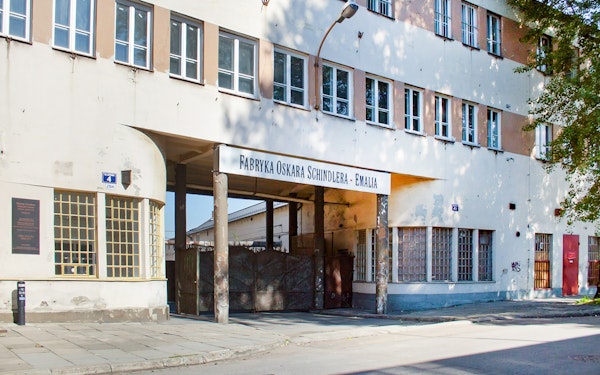
It now hosts two museums: the Museum of Contemporary Art in Kraków, on the former workshops, and a branch of the Historical Museum of the City of Kraków, situated at ul. Lipowa 4 (4 Lipowa Street) in the district of Zabłocie [pl], in the administrative building of the former enamel factory known as Oskar Schindler's Deutsche Emailwarenfabrik (DEF), as seen in the film Schindler's List. Operating here before DEF was the first Malopolska factory of enamelware and metal products limited liability company, instituted in March 1937.
Józefa) is a historic Catholic church in the Podgórze district of Kraków, Poland. It is located on Podgórski Square on the northern slopes of the Krzemionki foothills in the south-central part of the city.
Meet us in the large kiss-and-ride car park
For a full refund, cancel at least 24 hours before the scheduled departure time.
Browse Krakow by category - skip-the-line tickets, walking tours, day trips, food experiences & more