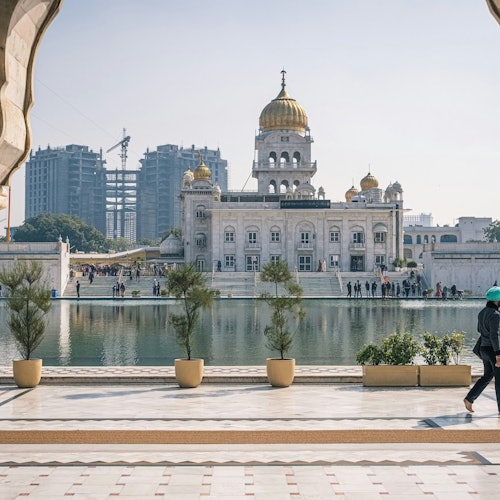
Golden Tringle Tour with Ranthambore is Combining the cultural richness of the Golden Triangle with the adventure of Ranthambore National Park, this tour provides a comprehensive experience of India's heritage and natural wonders. Travelers get to immerse themselves in the grandeur of historical monuments, experience the vibrant colors of Rajasthan's culture, and witness the majestic beauty of India's wildlife, making it a truly unforgettable journey. Overall, the Golden Triangle tour with Ranthambore seamlessly blends cultural immersion with wildlife adventure, providing travelers with a comprehensive experience of India's heritage, natural beauty, and biodiversity. From the grandeur of historical monuments to the excitement of encountering wildlife in the wilderness, this tour promises an unforgettable journey through the heart of India.
Check-in at your hotel and relax after your journey. Depending on your arrival time, you may have the option to explore some of Delhi's attractions,
a reminder of the historical and cultural diversity of the country. It stands as a testament to the fusion of different architectural styles and the passage of time.
It took almost ten years to complete this magnificent monument. The architect of Humayun’s tomb was Mirak Mirza Ghiyuath and it was constructed under the supervision of Haji Begum, the Persian wife of Humayun.
for which he designed the Cenotaph, London (1919–20); the Great War Stone (1919); and military cemeteries in France. His vast project for the Roman Catholic cathedral at Liverpool was incomplete at his death.
as the palace fort for his capital Shahjahanabad. He commissioned the construction of the fort by the River Yamuna when he decided to shift his capital to Delhi from Agra. The construction, which started in 1638, took over 8 years to complete.
The mosque was designed by architect Ustad Khalil, and constructed by approximately 5000 workers. The workforce was diverse, consisting of Indians, Arabs, Persians, Turks, and Europeans.
famous for its unique architectural construction in the shape of a large lotus flower. The building consists of 27 free-standing petals made of concrete and coated in white marble (sourced from Greece’s Pintail mountain) and includes a central prayer hall, walkways, ground with ponds, and a greenhouse
it was built during 1565-1573 by Mughal Emperor Akbar it was the main residence of the mughal rulers.
the monument of Love built by Mughal emperor Shah Jehan in the Memory of his beloved queen Mumtaz. with the help of 20 thausand workers work on it. started to built in 1631 and complete in 1653.
The town was founded in 1569 by the great Mughal emperor Akbar. In that year Akbar had visited the Muslim hermit Chishti, who was residing in the village of Sikri. Chishti correctly foretold that Akbar’s wish for an heir would be gratified with the birth of a son; the child, Salīm, was born in Sikri that same year, and he would later rule as the emperor Jahāngīr.
around 3 hrs tour there is best opportunities for Tiger sightings into the wild with the magnificent vistas of beautiful varieties of flora. Scenic dry-deciduous forest system teeming with incredible varieties of wild animals and birds along with some historical landmarks like the royal Fortress of Ranthambore makes it one of the exquisite and best areas to enjoy Wildlife Jungle Safari
This is the ruins of 10th century colossal citadel, which was built by Chauhan Rajput clan. The land covering the fort and the national park was under the control of Rajputs, who built this fort on top of a small hillock, Thambhore Hill. The fort is surrounded by pavilions, lakes, ponds, and a verdant jungle.
isit - City Palace The City Palace, Jaipur was built in the 18th century by Maharaja Sawai Jai Singh II. The palace reflects a classic mix of Indian, Mughal and European architectural styles
cted by Maharaja Jai Singh of Jaipur in 1724.
nk City of Jaipur in Rajasthan, India, is one of the most famous tourist attractions and a prominent landmark of the city that is renowned for its rich cultural and architectural history. Built in 1799 by Maharaja Sawai Pratap Singh
The fort was completed over a period of two centuries after the consistent efforts of three kings, finally ending in 1727 by Raja Sawai Jai Singh II. Amer fort was designated as the new residence for the royal family as opposed to the older establishment of Jaigarh Fort
An architectural marvel in itself, it is an embodiment of the engineering prowess of the Rajput period. The palace, which was built as a hunting lodge for the Maharajas of Jaipur,
chedule driver ytransfer you to Delhi airport or hotel.
For a full refund, cancel at least 24 hours before the scheduled departure time.
Browse New Delhi by category - skip-the-line tickets, walking tours, day trips, food experiences & more