8-hour fully customized tour of Rio with a private local guide. Have private transportation at your disposal to take you to all the sites you want to see in Rio. Great for experienced travelers who want to make the most of their visit. Whether you're looking to go to the main attractions, or the places that aren't so touristy, your private guide will be there to recommend the best spots and ways to beat the crowds. Tour is limited to a maximum of four people and includes pickup and drop-off from your accommodation in Rio, or the cruise port or airport.
te block over 1,200 feet above sea level located at the very entrance of Guanabara Bay in Rio. The access to the monument is at Urca neighborhood. The monument can be reached by taking 2 cable cars straight to the summit of Sugarloaf.
ue das Ruínas is now a cultural center that keeps her legacy of supporting artists everywhere.
The Theatro Municipal has drawn international artists and important names from Brazilian culture, including dancers, musicians, opera singers, and performing artists. Since the 1930s, the Theatro Municipal of Rio de Janeiro has maintained its artistic independence, and is the only Brazilian institution to have its own choir, a symphony orchestra, and ballet company. We do not enter, but we take time enjoying the architecture aspects of this building.
a temporary site for acclimatizing exotic plant species from all over the world broth there by the Portuguese. During the walk we will also be able to see the majestic imperial palm trees and the orchid and Bromeliad greenhouses. Rio’s Botanic Garden is also one of the best spots to observe the city wildlife, such as capuchin and marmosets monkeys, toucans, red throated guan and several other animal species.
o de Janeiro and Palace of the Viceroys, is a historic building.The Paço Imperial was built in the 18th century to serve as residence for the governors of colonial Brazil. From 1808, it was used as a royal residence by King John VI of Portugal as King of Portugal and later also as King of Brazil.
Its foundation stone was launched in 1880, materializing the project of Francisco Joaquim Bethencourt da Silva (1831-1912), architect of the Imperial House, founder of the Society of Fine Arts and the Lyceum of Arts and Crafts
Don´t miss the opportunity to see Tom Jobim´s statue and take great shots of the beach and Dois Irmãos´hill.
omplexes in Brazil where there is a surprising contrast between the austere, purposefully simple appearance of the exterior and the richness of the interior highlighting gilded Baroque engravings with plants motifs. See for yourself the exuberant Rococo style in the engraving on the high altar, followed by a view of the dome and the Chapel of the Santíssimo Sacramento.
alk looking for marmoset monkeys with Sugarloaf and the Red Beach as background.
The fort was built in 1776 as a lookout to spot incoming ships. To reach the summit of the 183m (600-ft.) hill we’ll walk for 20 minutes on an 800 meters cobblestone road that crosses the natural preserve area kept by the Brazilian Army. Several species of the Brazilian fauna live in the area. It is not uncommon to spot mamorset monkeys, tropical birds and lizards on the way up. Once we reach the summit, a series of spectacular views will be discovered. From the hill top we’ll have a vantage point of view of the entire extension of Copacabana Beach, Corcovado Mountain, Sugarloaf Mountain and the entrance of Guanabara Bay.
During the 16th century the place was a sugar mill owned by the governor of Rio de Janeiro province. In 1840 an English nobleman became the new owner and hired the landscape designer John Tyndale to design the romantic style garden at the property.
Now it is used as a passageway for the tram that connects Downtown Rio and Santa Teresa neighborhoods.
ed by the Palácio Tiradentes, the Legislative Assembly of Rio de Janeiro; and the Paço Imperial. The Praça XV Station is a ferry terminal servicing a number of destinations in the city of Rio de Janeiro and Niteroi
This is the first step to reach Sugarloaf Mountain by cable car.
now an artsy neighborhood full of bars, cafés and good restaurants that offer a myriad food options including the best Acai and cheese bread in Rio. The place offers great photo opportunities with its painted murals, street art, cobblestone streets and a variety of souvenirs shops, including the only one in Rio listed on Lonely Planet for having only items made by local artists.
About 700 permanent tents offer a sample of Brazilian Northeast culture, such as typical food, handcrafts, forró players, dance, singers and also folk literature. The fair attracts visitors from all over the country and abroad. Every month about 450 thousand tourists and local people visit it. It is a place for dancing, handcraft shopping, and also a place to try some of the local specialties at one of the many typical Northeastern restaurants.
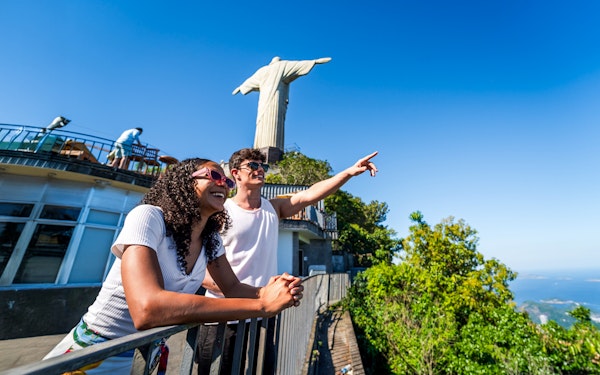
From the monument Rio can be seen at its entire splendor.
They are the work of Chilean-born artist Jorge Selaron who claimed that the staircase is his tribute to the Brazilian people. The steps straddle both the Lapa and Santa Teresa neighborhoods. There are 250 steps which are covered in over 2000 tiles collected from over 60 countries around the world.
These are the places where the locals go to do their grocery shopping, and tourists are welcome to walk around the several stands sampling fruits, street food and vegetables offered in the market. The fruit in Brazil really taste different. More than once I had people telling me “So that is what mango is supposed to taste like! I feel I’ve been cheated all my life…”.
eiro in 1619, occupying a chapel inside the church of the Franciscan convent of Santo Antônio, located on the top of a hill (the Morro de Santo Antônio). In the middle of the seventeenth century, the Franciscan convent gave them a plot of land next to the convent's church to build their own temple there. The Church of St. Francis of Penance was built, with interruptions, between 1657 and 1733.
Today the beautiful building houses the headquarter of Rio de Janeiro State government.
vegetation and reachable only by private transportation.
as MEC (Ministry of Education and Culture), stands out for its architectural composition and for its unique positioning within the surrounding urban context.
een 1811 and 1831 and tell us a bit more about the African heritage in Brazil.
ry mansion, restored to preserve its original features. The mansion belonged to the former Fazenda Barreira do Soberbo, being its owner during the Empire the medical doctor Henrique José Dias, who dedicated himself to planting cinchona (Cinchona calissaia). This historical mansion houses a permanent exhibition with photos and information about the park, a model of the entire PARNASO area, as well as an interesting collection of works by botanist Von Martius.
Nice place to sunbathe and swim in the large pool formed by rocks and boulders.
largest number of works designed by architect Oscar Niemeyer.
Here we’re very likely to observe climbers trying to reach the mountain summit.
At the summit you’ll take the famous picture hanging from the cliff.
ll as the residents with fresh water from the mountains of Rio.
t into two separate beaches, Recreio and Macumba.
There is also a sequence of gratifies that make up an artistic pathway painted by 20 different artists and the famous street Etnias Mural painted by Eduardo Kobra.
the mural signed by Eduardo Kobra was named Etnias (ethnic groups).
the area has significant historical and architectural importance.
s church is considered one of the main Baroque style examples in Rio.
nter and can be visited when going to the Christ Monument by minibus.
The forest takes 10% of the city area and houses the Tijuca National Park.
a Tijuca, this is a must for soccer lovers. The fans can follow the history of the Brazilian Team from their first games to the most important titles. There are nineteen facilities with technological resources that allow the interactivity of the public with the attractions. The collection also has relics such as uniforms, trophies and photographs.
The Belgian crystal mirrors framed by hand-carved frames, the lamps and the beautiful stained glass skylight ceiling are stunning and the food is very representative of Brazilian culinary.
We will pick you up from the pier, airport, hotel or rental apartment in Rio. Please make sure to enter your hotel name. In case of a rental apartment or unlisted hotel please enter the full street address. Places we will drive by on the way to the first attraction will depend on your hotel location.
For a full refund, cancel at least 24 hours before the scheduled departure time.
Browse Rio de Janeiro by category - skip-the-line tickets, walking tours, day trips, food experiences & more