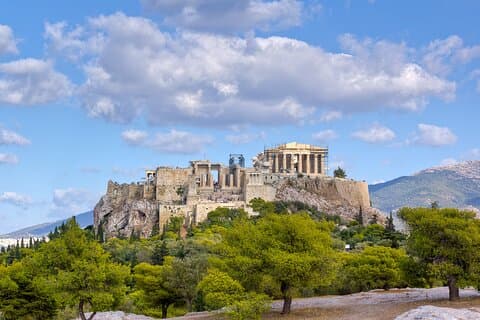
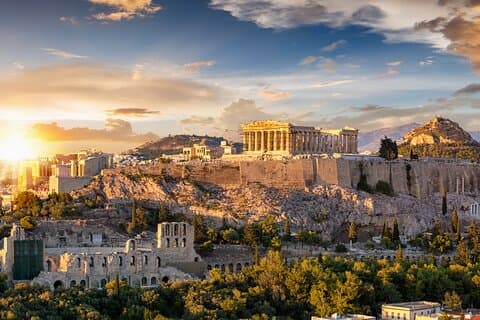
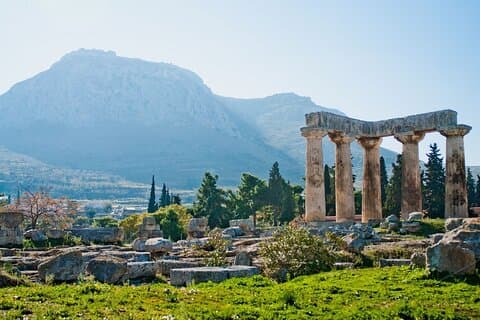
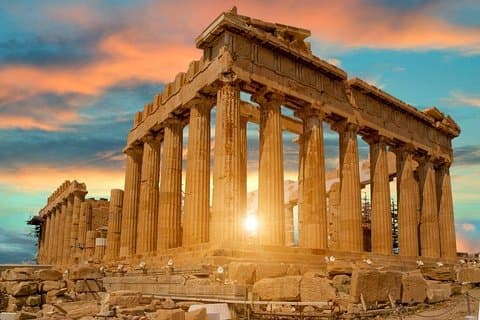
This tour gives you an opportunity to observe the striking contrasts that make Athens such a fascinating city. Our expert guides will take you to see the Panathenaic Stadium where the first Olympic Games of modern times were held in 1896 (short stop). On the Acropolis visit the Architectural Masterpieces of the Golden Age of Athens: The Propylaea, the Temple of Athena Nike, the Erechtheion, the Parthenon. Continue and visit the place where at last the statues found their home and admire the wonders of the classical era: The new Acropolis museum.
Continue in a local restaurant for lunch.
After lunch drive along the coastal road to Cape Sounion, where the white marble pillars of the Temple of Poseidon stand. On the way, you have a splendid view of the Saronic Gulf and the little islands offshore. After visiting the Temple of Poseidon, you have time to walk at leisure on the rocky promontory of Sounion.
Its history is directly connected to the Modern Olympic Games, from their revival in 1896 until the Athens Olympic Games in 2004. It is also the place from which the Olympic Flame is delivered to all the Olympic Games, Winter, Summer and Youth, as well as the Athens Authentic Marathon.
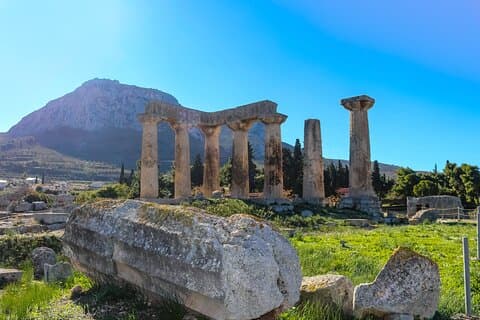
ver several centuries starting in 174 BCE and only finally completed by Roman emperor Hadrian in 131 CE. Its unusually tall columns and ambitious layout made the temple one of the largest ever built in the ancient world.
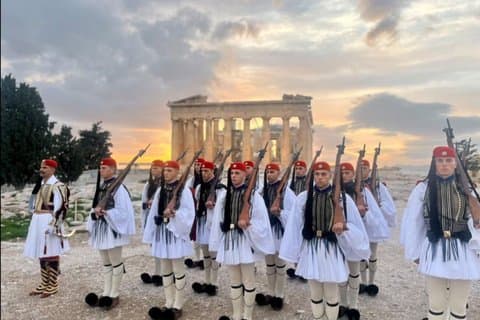
Moreover it is the Old Royal Palace, an austere Neoclassical building, overlooking Syntagma Square in Athens. In addition it is the supreme democratic institution that represents the citizens through an elected body of Members of Parliament.
s as the most beautiful neoclassical building in the world. The Academy’s monumental sculptures and murals, which took a decade to complete, depict ancient Greek mythology, 19th century Hellenism, as well as visions of how the artists imagined the future.
patron, the goddess Athena, dominates the centre of the modern city from the rocky crag known as the Acropolis.
archaeological site of the Acropolis of Athens. The museum was built to house every artifact found on the rock and on the surrounding slopes, from the Greek Bronze Age to Roman and Byzantine Greece. It also lies over the ruins of part of Roman and early Byzantine Athens. It opened to the public on 20 June 2009.[1] More than 4,250 objects are exhibited over an area of 14,000 square metres.
t to his death off the cliff, thus giving his name to the Aegean Sea. Cape Sounion is noted as the site of ruins of an ancient Greek temple of Poseidon, the god of the sea in classical mythology. The remains are perched on the headland, surrounded on three sides by the sea. The ruins bear the deeply engraved name of English Romantic poet Lord Byron (1788–1824).
tes, could propitiate Poseidon, by making animal sacrifice, or leaving gifts.
For a full refund, cancel at least 24 hours before the scheduled departure time.
Browse Athens by category - skip-the-line tickets, walking tours, day trips, food experiences & more