Budapest features a remarkably comprehensive and efficient public-transportation system, so to truly experience Hungary’s capital the way that locals do, there is no better way than getting around the city by tram, bus, metro, and even ferryboat. During this 2.5-hour tour, participants will have the opportunity to try five different means of transport and see the city in a different way. This guided tour of the city allows you to experience it like a local and get to know Budapest and its dwellers as they live their everyday life.
Lined with spectacular Neo-renaissance mansions and townhouses featuring fine facades and interiors, it was recognised as a World Heritage Site in 2002. It is also one of Budapest's main shopping streets, with fine cafes, restaurants, theatres, Embassies and luxury boutiques.
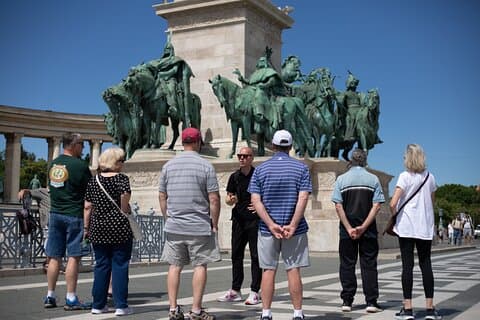
conic statue complex featuring the Seven chieftains of the Magyars and other important Hungarian national leaders, as well as the Memorial Stone of Heroes, often erroneously referred as the Tomb of the Unknown Soldier.
It was built in 1896 as part of the Millennial Exhibition which celebrated the 1,000 years of Hungary since the Hungarian Conquest of the Carpathian Basin in 895. The castle was designed by Ignác Alpár to feature copies of several landmark buildings from different parts the Kingdom of Hungary, especially the Hunyad Castle in Transylvania (now in Romania). Today, it houses the Museum of Hungarian Agriculture, the biggest agricultural museum in Europe.
It was built by the plans of Albert Schickedanz and Fülöp Herzog in an eclectic-neoclassical style, between 1900 and 1906. The museum's collection is made up of international art (other than Hungarian), including all periods of European art, and comprises more than 100,000 pieces.
The museum building is on Heroes' Square, facing the Budapest Museum of Fine Arts. The art museum hosts temporary exhibits contemporary art. Its government partner is the Ministry of Education and Culture. It has a bookshop, library, and the Műcsarnok Café that overlooks the square.
arian capital Budapest, opened in 1870, it is the largest and one of the oldest ice rinks in Europe.
he Margaret-bridge, named after Mari Jászai, one of the most influential actor in the Hungarian theatrical world of her time.
Pest across the Danube and linking Margaret Island to the banks. It is the second-northernmost and second-oldest public bridge in Budapest.
he busiest!) – these two lines transport millions of passengers every year along Budapest’s big ring road (“Nagykörút”). All of this at max. 15min-intervals, although during rush hours they run every 2 minutes.
ply as Nyugati, is one of the three main railway terminals in Budapest, Hungary. The station is on the Pest side of Budapest, accessible by the 4 and 6 tramline and the M3 metro line. The surrounding are has became one of the busiest meeting point in the city, the area is rich in restaurants, bars and diverse stores.
It's a major intersection and transport junction in Budapest. Three lines of the Budapest Metro each converge on the station under the square. Tram lines 47 and 49 also originate from the square, as well as several bus lines.
Alcoholic beverages are sold at the grassy area, and it is common for Deák Ferenc tér to be populated until the midnight hours.
Waves of the Danube are represented in wavy benches and a small fountain with a pond decorates the entry to this unique underground station.
Pool (also known as the Gellért Baths or in Hungarian as the Gellért fürdő) is a bath complex in Budapest, Hungary.
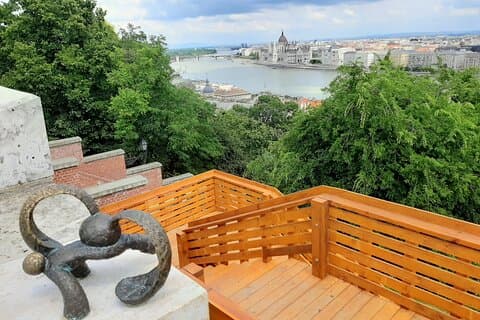
It is located in the 1st and the 11th districts, and undoubtably is the best panorama point above the capital. The hill was named after bishop Gellért who came to Hungary from Italy around 1000 AD. King St. Stephen invited him to help converting the Hungarians into Christianity. Some resisting pagans rolled him down the hill in a barrel into the Danube in 1046.
the emblematic Gellért hill where we find our next stop.
It was named after the French Protestant Reformer John Calvin, due to the large Reformed Church located there. Being a major thoroughfare and locality, the square is a major transport hub with tram, bus, and trolleybus routes serving the square. The Hungarian National Museum is near Kálvin tér.
We meet up every guest from their accommodation and the tour starts from there, please provide your address in the special requirements box.
This Itinerary is a basic outline to this tour that may be a subject to change. Changes may be made in order to personalize the experience. Minor alterations may be made without notification, to ensure the smooth running of the tour. If you would like to follow a precise itinerary of your tour please let us know, and we will happily adapt to your interest.
For a full refund, cancel at least 24 hours before the scheduled departure time.
Browse Budapest by category - skip-the-line tickets, walking tours, day trips, food experiences & more