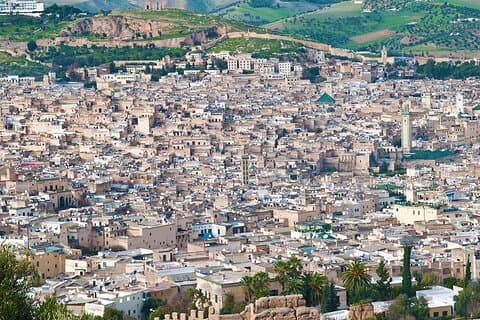
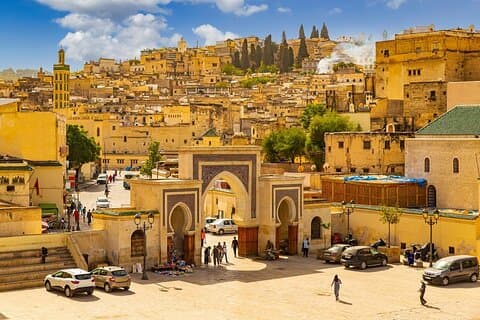
Fez Full Day City Tour Fez is the most ancient city of all the imperial cities, is founded in the 8th century, and is now seen as the spiritual and handicrafts’ capital of the Moroccan Kingdom. Its medina is a World Heritage of UNESCO, is full of palaces, museums, mosques and will make your happiness. This fully guided tour will take you to the heart of the imperial city of Fez, which is the city that most reflects the ancestral past of the Moroccan kingdom and its ancient civilization. It was and still remains the core of the intellectual and spiritual creativity, not only in Morocco, but also in the Islamic world. Fez houses, the oldest university in the world, Al Quaraouiyyne and its ancient medina was classified as Universal Heritage by UNESCO in 1981.
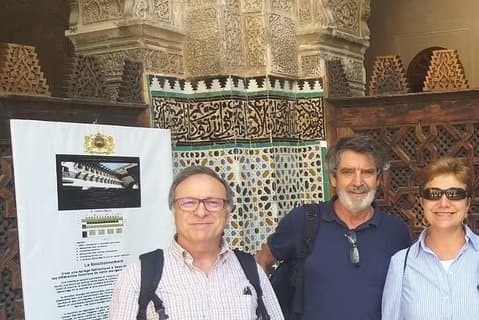
One of the few religious buildings in the city that non-Muslims may enter, the Medersa (madrassa - Islamic school of learning) is a sumptuous architectural gem and one of Morocco's most gorgeous buildings. Up until the 1960s, this was still a functioning theological school, and the restoration efforts since that time have restored it to its original beauty. The carved woodwork and stucco decoration is magnificent and is a tribute to Morocco's master artisans.
The courtyard here is a wonderful display of the intricate decoration from this period, with elaborate zellige tile work and cedar wood carvings. The upper floor is made up of a warren of cells, which were once home to students studying theology at the Qaraouiyine Mosque (once one of the world's first universities). If you climb up onto the rooftop, you can get great views of the green-tiled roof of the Qaraouiyine Mosque itself
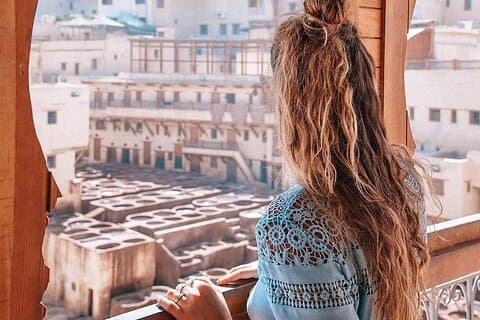
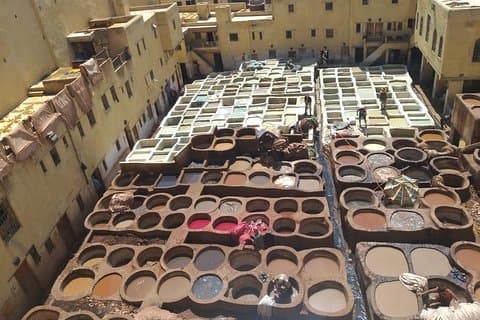
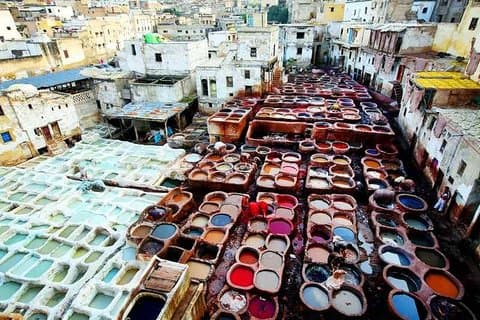
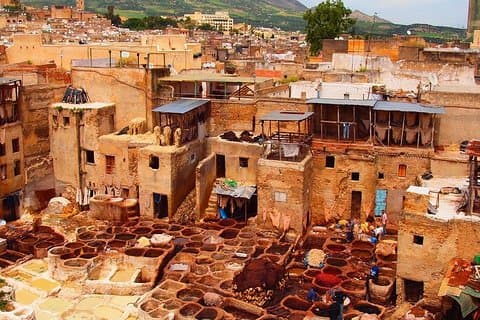
an slippers, leatherwork, metalwork, rainbow-glass lamps, and tiles all displayed at stalls throughout the district. The streets just west of the Qaraouiyine Mosque have the greatest concentration of shopping opportunities. This is also where you can visit the famous Chouara tanneries of Fes, one of the top things to do in this area. Here, you can watch the traditional dying of animal skins-the first step in making Morocco's many leather products. Leather shops surrounding the tanneries provide bird's-eye views over the area from their rooftops and are the best place to take photos.
Throughout this compact district, the lanes are lined with fine (though highly dilapidated) examples of early 20th-century houses, which were once home to the vibrant Jewish community of Fes. The small, restored Aben-Danan Synagogue can also be visited here. On the edge of the Mellah is the rambling Jewish cemetery, one of the city's most tranquil spots, and a Jewish Museum housing a collection of objects highlighting Moroccan Jewish life and culture.
Here, you'll find a 16th-century fortress, home to an impressive arms museum. The collection of weapons includes some extremely rare pieces that represent armory from across the world. Amid the cache is the five-meter-long cannon (with a weight of 12 tons) that was used during the Battle of the Three Kings. After viewing the arms museum, keep heading up the hill to the summit where a scattering of golden-stoned Merenid tombs sits. Although the tombs are in a heavily ruined state today, you're here for the views, which take in the entire walled medina area and out to the green hills beyond.
uiyine Mosque was one of the medieval period's most distinguished universities. Today, in its function as a working mosque, it is one of Morocco's largest centers of worship, with a prayer hall that can hold 20,000. The library is one of the oldest surviving in the world and contains more than 30,000 books. Among the collection is a 9th-century Qur'an. The Fes el-Bali complex cannot be entered by non-Muslims, but you can get excellent views of the mosque from nearby restaurant rooftops.
The museum collection traipses through a selection of traditional Moroccan craftsmanship, with wood carved doors, wrought-iron work, embroidery, carpets, and jewelry all on display. The centerpiece exhibit of the museum is the ceramics room, where the famous Fes blue ceramics, colored with cobalt, are featured. More interesting than the displays themselves is the building's own original decoration and the lovely internal courtyard garden, which is full of shady trees and tall palms and is a true oasis within the city.
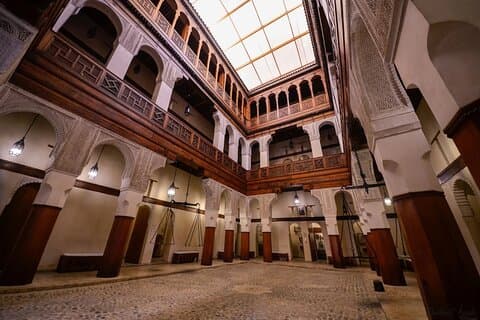
Nejjarine Museum in an old fondouk, which has been transformed into a museum displaying Moroccan wooden arts and crafts. Here, in the salons where traders once slept on their trips to town are displays of engraved granary doors, dowry chests, and mashrabiya (lattice screen) window frames. The central courtyard of the fondouk, with its sturdy pillars and balconies decorated in carved wood and stucco detailing, is worthy of the entrance price alone and has been painstakingly restored to its original glory.
For a full refund, cancel at least 24 hours before the scheduled departure time.
Browse Fez by category - skip-the-line tickets, walking tours, day trips, food experiences & more