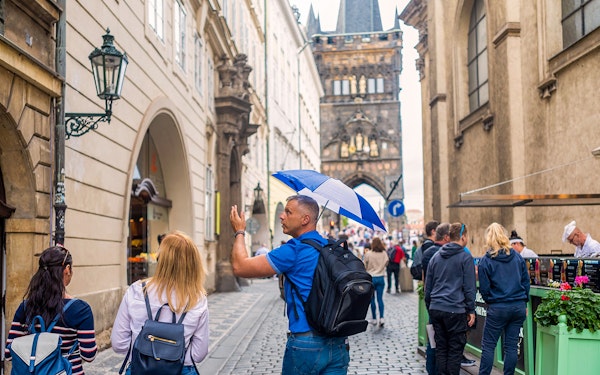
This custom-tailored private walking tour was developed after many years of guiding experience and is especially designed for those who have only one day to see all the major sights in Prague in a relaxed way.
On this tour, you will explore the most famous areas of Prague: the Old Town, Jewish Quarter, Charles Bridge, Lesser Town (Little Quarter), and Prague Castle.
This is a private walking tour, so you set the pace. If you wish, you can also take a break for coffee, lunch, or even a boat trip (not included). Your tour guide will also provide you with tips for the remaining days of your stay.
If you are spending more than one day in Prague, we recommend splitting the Best of Prague tour over two days by booking the right riverbank and left riverbank tours.You can find those tours on Viator under the following titles: - Prague Castle Private Walking Tour (Including Castle Tickets) - Prague’s Old Town, Jewish Quarter and Charles Bridge Private Tour
This stunning architectural achievement, which took centuries to complete, reigns supreme from a hill above the rest of the city. The Castle, founded in 870, is also the seat of the Czech president. Dominating the complex is the breathtaking, mostly Gothic Saint Vitus’ Cathedral, which took a staggering 1,000 years to build. Under Emperor Charles IV, Prague Castle was the seat of the Holy Roman Empire. During darker days, Adolf Hitler occupied it. In rosier times, first democratic president Tomáš G. Masaryk and dissident-playwright-turned president Václav Havel ran the country from here.
The area, located below Prague Castle and extending along the Vltava River, was originally a series of small settlements outside the castle fortifications. At that time, the population was mostly ethnic German, merchants who had been invited by King Přemysl Otakar II. The town was ravaged by fire in a Hussite battle in 1419, then again in the fire of 1541, which also damaged St. Vitus’ Cathedral. In the year 1257, these settlements were consolidated, and a separate royal town was formed. Originally called Malé Město Pražské (Prague Lesser Town), the name eventually changed to Malá Strana (Lesser Quarter). The quarter houses many magnificent buildings once owned by the nobility, such as Valdštejn (Wallenstein) palace.
W.A.Mozart liked to practise on the organ here because of excellent acustics.
trana district may turn a corner and discover a long wall covered in graffiti. These days, it can be difficult to tell at first what the purpose is. Upon closer examination, the scrawls and paintings come together, and it is clear that this is a tribute to John Lennon. Graffiti started appearing on this wall (the property of the Knights of the Maltese Cross) during the Communist era. The Beatles, and Lennon, had a wide following in the former Czechoslovakia, and when news of Lennon’s death in 1980 reached the country, some of these fans were determined to pay tribute to him. This was no small task; Western music was banned at the time, and the fans risked imprisonment for openly stating their admiration for John Lennon.
Commissioned by King Charles IV, Holy Roman Emporer and King of Bohemia, the bridge has served as an essential link between Prague’s Old Town and the Lesser Quarter and Prague Castle, for hundreds of years. The bridge features 30 saintly Baroque statues, mostly made of sandstone and added in the 18th century. Most of the statues you see today are replicas. The first statue to be erected on the Charles Bridge is made of bronze. This is the statue of St. John of Nepomuk, the patron saint of Bohemia. According to legend John of Nepomuk refused to reveal the confessions of the wife of King Wenceslas IV, and was thrown off the side of the bridge to his death. On that same night, five stars appeared in the sky above the place of his death, which is why there is always a five-starred halo above any statue of St. John of Nepomuk. Charles Bridge provides some of the most beautiful views of Prague´s historical center.
many valuable collections of books can be found here.
its walls are covered with names of Jews who perished during second world war. The synagogue also provides entrance to the famous Old Jewish Cemetery.
Completed in 1270 in gothic style, it was one of Prague's first gothic buildings.
Many decisive events of the country took place here.
On its earthy orange façade stand out a Renaissance window from 1520, the inscription Praga Caput Regni and the Old Town coat-of-arms. Crowds gather on the hour to watch the 15th century astronomical clock, as Death tips an hour glass and rings a bell before the 12 apostles march by, the cock crows and another bell rings.
for the wold premier of his opera Don Giovanni which he conducted himself in October 1787.
It is the oldest university in the country and one of the oldest universities in Europe.
Originally called the Horse Market, the Wenceslas Square witnessed many decisive events, e.g. the Velvet revolution in 1989 which put down the Communist regime.
gateway to the Medieval Royal Route, and is currently one of the most iconic buildings of Prague.
Royal Court in 1912 to celebrate the Czech nation. This representative building belongs, for its famous concert hall and beautiful decorations, among the jewels of Prague architecture.
The tour guide will pick you up at your hotel reception or outside your apartment building so please provide your address in Prague when booking the tour.
If you wish to start the tour in the Old Town you can meet our tour guide at the entrance to the Municipal House (next to the Gothic Powder Tower), address: Náměstí Republiky 5, Old Town - Staré Město.
Return point: Our tour guide will tailor the tour in such a way so that you finish the tour where you wish.
For a full refund, cancel at least 24 hours before the scheduled departure time.
Browse Prague by category - skip-the-line tickets, walking tours, day trips, food experiences & more