11 days group tour to Georgia and Armenia will introduce you to the main highlights of two Caucasus countries. Often considered as the bridge between Europe and Asia, these lands hold unique enchantments for the travelers to discover. The tour encompasses travelling by a comfortable coach and with expert guides. You will take guided excursion to the major attractions: Tbilisi, Mtskheta, Borjomi, Yerevan and Gyumri; have short off-road adventure from Kazbegi to Gergeti mountain; explore the ancient two cave towns in Uplistsikhe and Vardzia; visit UNESCO heritage sights and taste national cuisine. The group is “Guaranteed to run” after 4 people book this tour.
Its construction took 7 years and was finished in 2003. Its height goes up to 101 meters with 137 meter diameter including vestibule gallery. 10 churches are disposed in the interior. Together with the main cathedral, the chief gate, Iveria Virgin Mary and Ilya Tetezbitel churches are also included. The dome and 2.5 tone cross of the cathedral are gilded.
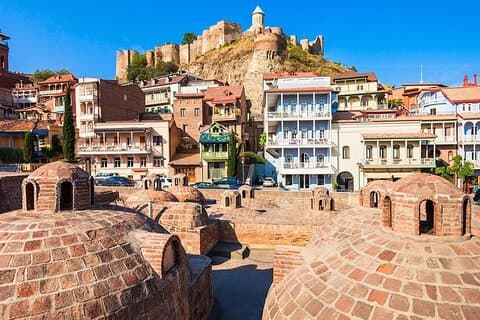
The fortress consists of two walled sections on a steep hill between the sulphur baths and the botanical gardens of Tbilisi.
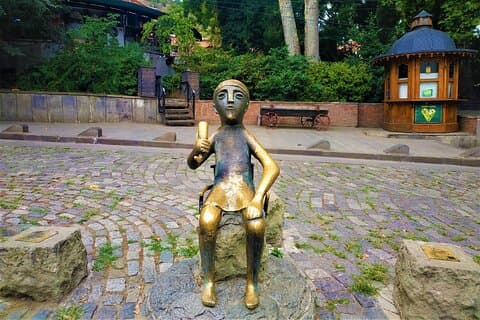
Chardin Street is very narrow and short, it is named after a French ex-plorer Jan Chardin, who visited Tbilisi in 1863. That time the street was called "Dark Row", because it was crowded with shops and workshops. Chardin St., Bam-bis Rigi and Erekle II St. are a great way to wander around the local art galleries and souvenir shops with a chance to refu-el in one of the area's many cafes.
al aspirations in early Georgian Christian architecture. Jvari has been inscribed in UNESCO World Heritage Site List
The Zhinvali Hydroelectric Power Plant has two turbines with a nominal capacity of 65 MW each having a total capacity of 130 MW.
ty which ruled the area from the 13th century. The castle was the scene of numerous battles.
The resort is situated in the Stepantsminda District, along the Georgian Military Highway near the Jvari Pass, at an elevation of 2,200 meters (7,200 ft.) above sea level with skiable area enjoying maximum exposure to the sun.
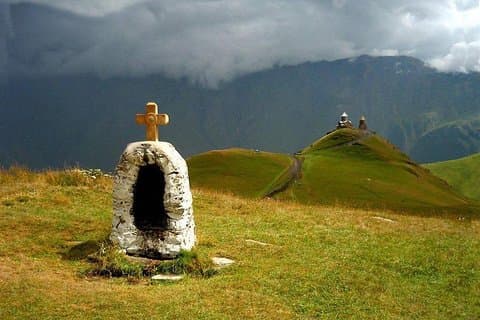
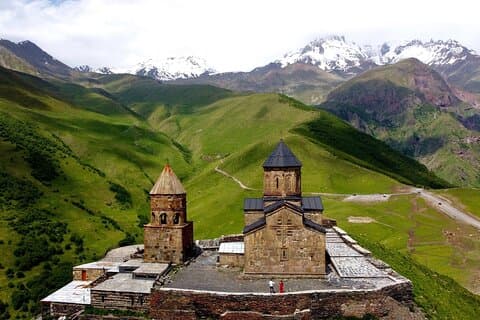
The church is situated on the right bank of the river Chkheri (the left tributary of the river Terek), at an elevation of 2170 meters (7120 feet), under Mount Kazbegi.
oseph Stalin, the leader of the Soviet Union, who was born in Gori. The Museum retains its Soviet-era characteristics.
Built on a high rocky left bank of the Mtkvari River, it contains various structures dating from the Early Iron Age to the Late Middle Ages, and is notable for the unique combination of various styles of rock-cut cultures from Anatolia and Iran, as well as the co-existence of pagan and Christian architecture.
It is one of the districts of the Samtskhe-Javakheti region and is situated in the northwestern part of the region in the picturesque Borjomi Gorge on the eastern edge of the Borjomi-Kharagauli National Park.
Originally established in the 9th century as the Lomisa Castle, it was completely rebuilt by Ottomans. Most of the surviving buildings date from the 17th and 18th centuries.
of the Erusheti Mountain on the left bank of the Kura River, thirty kilometres from Aspindza. The main period of construction was the second half of the twelfth century. The caves stretch along the cliff for some five hundred meters and in up to nineteen tiers.
It is situated in Southern Georgia, in Meskheti region. The fortress was first built in the 2nd century BC. The church was built in 985, and the present walls were built in 1354. As the legend says, Khertvisi was destroyed by Alexander the Great.
erving as the administrative centre of Shirak Province in the northwestern part of the country.
It is one of the oldest surviving churches in the country. The current structure was completed in 618 AD. It is known for its fine Armenian-style architecture of the classical period, which has influenced many other Armenian churches since. It was listed as a UNESCO World Heritage Site.
menian cathedral built by the order of Catholicos Nerses the Builder from 643-652. Now in ruins, it is located at the edge of the city of Vagharshapat (Etchmiadzin) in Armavir Province of Armenia.
It is known for the nearby classical temple. As of the 2011 census, the population of the village is 6,910.
ly carved out of the adjacent mountain, surrounded by cliffs. It is listed as a UNESCO World Heritage Site with enhanced protection status.
Situated along the Hrazdan River, Yerevan is the administrative, cultural, and industrial center of the country.
near the closed border with Turkey, about 8 kilometres (5.0 mi) south of Artashat, Ararat Province, within the territory of ancient Artaxata.
It is best known for its wine production, although the majority of wine produced locally is from the nearby village of Getap.
narrow gorge made by the Amaghu River, near the town of Yeghegnadzor, Armenia. The gorge is known for its tall, sheer, brick-red cliffs, directly across from the monastery.
It is one of the largest freshwater high-altitude (alpine) lakes in Eurasia. The lake is situated in Gegharkunik Province, at an altitude of 1,900 m (6,234 ft) above sea level.
The monastery was founded by Queen Khosrovanuysh, wife of the Bagratid king Ashot III, probably in 976. The nearby monastery at Sanahin was built around the same time.
Check out time untill 12:00 pm. End of service.
Your place of stay in Tbilisi
All sales are final. No refund is available for cancellations.
Browse Tbilisi by category - skip-the-line tickets, walking tours, day trips, food experiences & more