Ayubowan (Welcome) on your Arrival From Airport / Colombo /Negombo, our driver will arrange your tour as your request. in this tour, you can explore the amazing spots in your surrounding area as far as you wish.
During puja(offerings or prayers), the heavily guarded room housing the tooth is open to devotees and tourists. However, you don’t actually see the tooth. It’s kept in a gold casket shaped like a dagoba (stupa), which contains a series of six dagoba caskets of diminishing size. As well as the revered main temple, the complex includes a series of smaller temples, shrines, and museums.
of the botanical gardens of Sri Lanka, couldn't be better located. In the Mediterranean climate of Kandy, the gateway to the Central Highlands, the Gardens, at an elevation of 500 meters above sea-level, were tightly bounded on three sides by a loop of River Mahaweli (Great sandy river), the largest river of Sri Lanka.
As a popular tourist spot, the area brings in a large number of peddlers, though they often sell sub-par items. The area also has a reputation for high pickpocket activity, so keep an eye on your belongings. From the hill, you can enjoy great views over the lake and the city as a whole.
in the heart of the hill city of Kandy, Sri Lanka, built-in 1807 by King Sri Wickrama Rajasinghe next to the Temple of the Tooth. Over the years, it was reduced in size. It is a protected lake, with fishing banned. There are many legends and folklore regarding the lake. One such is that the small island at its center was used by the king’s helm for bathing and was connected to the palace by a secret tunnel.
ght into the long spice history of the island. Step into the unpolluted, green garden, where you can see how herbs are grown in their natural environment, then learn how you can use them to enhance the taste of specialty meals. These spices will reveal to you the secret of traditional Sri Lankan dishes, which have great nutritional value as well as being delicious
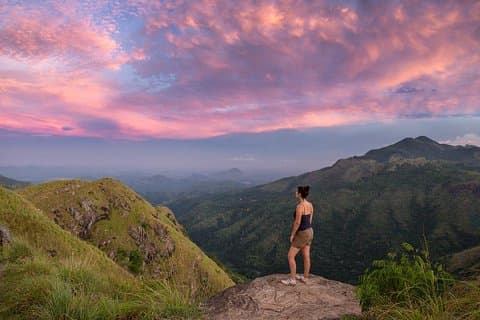
It's determined to a level encompassed by mountains, which are home to tea estates and biodiverse rainforest.
lliam Gregory, supposedly for the purpose of providing electricity. However, the lake was mainly used for leisure and recreation after it was built. At its peak of fame, Gregory Lake was the most prominent attraction in the area and was used as a place to relax by many visitors.
Located in Ramboda on Kandy-Nuwara Eliya Road located approximately 30 odd kilometers North of Nuwara Eliya on A-5 route facing the Kotmale Reservoir. The Chinmaya Mission is a Hindu spiritual organization engaged in the dissemination of Vedanta, the science of the self as expounded in the Vedas, particularly the Upanishads, and other important Hindu scriptures including the Bhagavad Gita.
A stroll around its paths, past manicured lawns, is a pleasure. The park comes alive with flowers around March to May, and August and September. It’s also home to quite a number of hill-country bird species, including the Kashmir flycatcher, Indian pitta and grey tit.
This is the highest village in the entire island, located at an altitude of 7339 feet on the Kikiliyamana Mountain road from Nuwara Eliya. On reaching Shanthipura, visitors are greeted by the small but beautiful Buddhist pagoda which makes the centerpiece of the village at the tallest place; surrounded by the villagers’ houses in differing altitudes. They will also get to see the villagers’ lifestyles and the interesting methods they use to farm on the slopes.
The normally finished Hakgala Botanical Gardens shows roses and tree plants, and asylums monkeys and blue jaybirds. Close by Seetha Amman Temple, a beautiful Hindu sanctuary, is improved with strict figures.
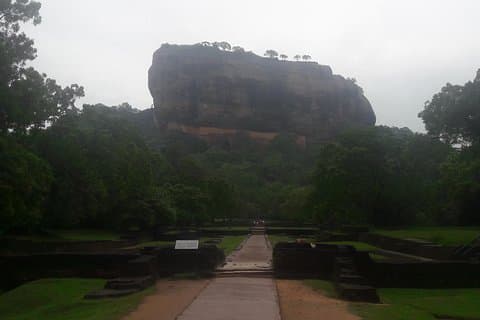
riya is perhaps Sri Lanka's single most dramatic sight. Near-vertical walls soar to a flat-topped summit that contains the ruins of an ancient civilization, thought to be once the epicenter of the short-lived kingdom of Kassapa, and there are spellbinding vistas across mist-wrapped forests in the early morning.
ew and explaining Sigiriya's cultural importance beyond the obvious natural beauty. The theory that Sigiriya was a Buddhist monastery is given here, although the established position that it was a palace or fortress prevails.
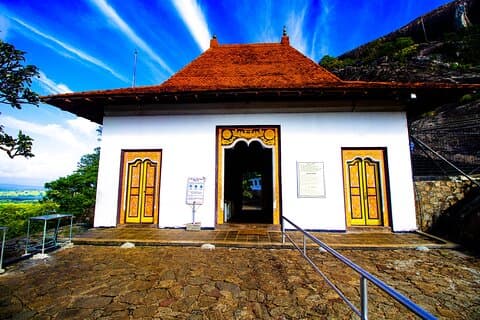
he (Mahavamsa)-the principal Pali Chronicle of Sri Lanka, is situated about forty-seven miles northwest of Kandy, the last capital of the Sinhalese kings, on the main road to Anuradhapura. Dambulla is a scent of unique interest. Its rock temples are the most extensive in the Island, and one of the most ancient, and in the highest state of preservation and order.
Dambulla town started in 1999 to establish a wholesale market for vegetables and fruits. One important feature of the DDEC is thus more direct participation of the farmers is selling farm produce.
and stronghold complex has noteworthy archeological significance and draws in a great many voyagers consistently. It is likely the most visited traveler goal in Sri Lanka.
t by the Portuguese on the Southwestern coast of Sri Lanka. The initial fortifications, which were built in the late 16th century, were quite basic. According to a statement by UNESCO, the site was recognized as a World Heritage Site for its unique exposition of an urban ensemble which illustrates the interaction of European architecture and South Asian traditions from the 16th to the 19th centuries which is the criterion number four for such recognition.
It is built seven meters above the road on the ramparts. This is Sri Lanka’s oldest light station dating back to 1848, but the original lighthouse was destroyed by fire in 1934. It was rebuilt at the current height of 26m. The light station is within the walls of the ancient Galle Fort, a UNESCO world heritage site and well-known tourist attraction, making this the country’s most often visited lighthouse.
a shopping mall located in a beautifully restored colonial building originally built during the Dutch occupation. It has a constantly growing selection of places to eat, drink or shop. There are fabulous bay views from its upper balcony.
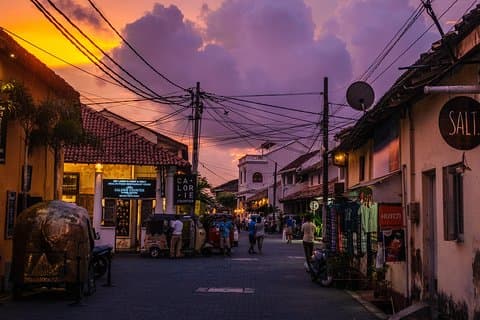
the slow beating heart of Galle‘s history. The walled city has stood since the early sixteenth century, through the Colonial periods of the Portuguese, Dutch and British and in our present times is proclaimed as an Archaeological Reserve and has been identified as a living World Heritage Site. The etymology of the name Galle has explained as probably an altered form of the Sinhalese word “gala”: a cattle fold or posting-place from which the Portuguese named it Point-de-Galle.
lking, a perpetually outlandish old exchanging port favored by forcing Dutch-frontier structures, antiquated mosques, and houses of worship, terrific chateaus and exhibition halls.
a residential area for the venerable monks headed by Arahath Mahinda Mahathera. But soon, with the royal patronage, the sanctuary housed a multitude of with monastic buildings-stupas, uposathgharas, Bodhidharma- to serve the monks. Sixty-eight cave dwellings provided the monks' shade and shelter. Mihintale, the sanctuary for many thousands of laymen as well as holy men, had all the facilities and amenities for basic living.
Ruwanwelisaya, rising with its glory in the city of Anuradhapura, tops the list among Buddhists’ sacred places. Ruwenwelisaya bears witness for his incomparable service to revive Buddhism in the country. It is located just a short walk away from the Maha Bodhi tree in Anuradhapura. The stupa is one of the eight places of veneration situated in Anuradhapura which are places believed to have been visited by Buddha during his three visits to Sri Lanka.
It was originally 400 feet (122 meters) in height and was the third tallest building in the world at that time. Even today as a brick monument, Jethawanaramaya still remains the tallest of its kind in the world.
It is a sapling from the historical Bodhi tree under which Buddha enlightened. It was planted in 288 BCF and is the oldest living human-planted tree in the world with known planting date. It was brought from Buddhagaya India by the Ven. Sanghamitta Therini, a sister of Arhant Mahinda – who introduced the Teachings of the Buddha to Sri Lanka.
ime, was relinquished after an intrusion in 993. Shrouded away in thick wilderness for a long time, the wonderful site, with its royal residences, cloisters, and landmarks, is currently open by and by.
* Operator will reconfirm your pick-up time in advance * Arrive at the hotel lobby 10 minutes before your selected pick up time * This is a shared transfer and early or late pick-up is not possible * Pick up is available in Colombo / Negombo only - if the designated pick-up location is located outside the city limits pick up can be made with additional charge * If the drop off location different from pick up location, please contact the operator additional charges may apply * Kindly provide the WhatsApp contact details - for Better and fast communication
For a full refund, cancel at least 24 hours before the scheduled departure time.
Blader Colombo op categorie - kaartjes zonder wachtrij, wandeltochten, dagtochten, foodervaringen en meer