유사한 경험
 Viator
 Headout
 Viator
 Headout
 Viator
 Headout
Skip The Line: Guided Tour of Bran Castle, Peles Castle & Rasnov Fortress
5.0(1)12 Hours- 무료 취소
- 즉시 확인
시작가$142 Viator
.jpg%3Fw%3D600%26auto%3Dformat%252Ccompress%26fit%3Dcrop%26q%3D75&w=1920&q=75) Headout
Headout Viator
 Viator
 Viator
 Viator
An adventure of a lifetime, for this 6-day tour of Romania we have chosen an assortment of rich sensory experiences, from medieval sites to a taste of the wilderness, with deep forests, vibrantly colored wildflowers and fresh mountain air (in the right season), all the way to modern exhibits, and a dash of traditional herbs and spices with the delicious foods we will be trying in every medieval town we visit.
death of Vlad Tepes tells us that a group of monks were able to secretly bring the ruler’s earthly remains to Snagov Monastery and bury them in front of the altar to be sanctified.
most beautiful castles in Europe, the Romanian royal family’s summer residence is, by far, one of the most important tourist attractions in Romania and in Europe, and you will soon understand why.
as one of the many Romanian tourist attractions with great spiritual and historical value. The monastery is located in the city with the same name, only 500 m away from Peles Castle and fairly close to Bucharest. The orthodox establishment is over 300 years old and it is called as “the Cathedral of the Carpathians” due to its positioning in the most beautiful mountain resort in Romania surrounded by a stunning mountain scenery. It was also the first construction in this territory, founded by Prince (Spatarul) Mihai Cantacuzino. He decided to erect the house of worship following a pilgrimage to the Holy Land, with its name inspired by Mount Sinai.
istory, culture, and rediscover the beauty of nature, all at the same time? The city of Brasov is the ideal destination for lovers of history, music and culture, adventure, good food, winter sports, hunting, hiking, and even romance. It is the quintessential mountain adventure. In Brasov we will have a small brake, perfect for exploring a little bit the Old Town and you have enough tine for lunch. 120 minute break in Brasov City!
Once you see it in person, you will understand why this castle is a symbol of Romanian tourism and why it is the most visited tourist attraction in Romania, so come and join the group!
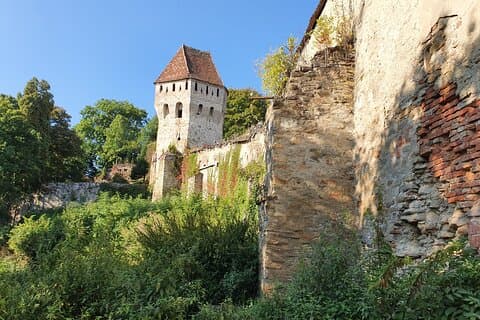
one of the first Transylvanian Saxon settlements in Ardeal, and today it is a UNESCO World Heritage site. Hundreds of tourists come here every year, and coming here you too will find out what makes this place special. Located in a small town that dates back to 1224, the church impresses through its stunning scenery and particular construction – built on a hillock in the center of town, surrounded by three defensive walls and 7 bastions.
style fortress, considered impossible to conquer due to the 7-corner star model designed by the great French engineer, veteran, and architect Sébastien Le Prestre de Vauban. The Alba Carolina citadel, an important destination on our Castles of Romania tour, is surrounded by three lines of fortification and its remarkable architecture make it one of the most representative fortresses in Romania; it is also one of the largest of its kind in Eastern Europe.
century as a simple gate tower with a maximum of two levels: the ground floor and first two floors of the tower were made of sandstone and river rock, the first stage of the tower construction probably had a form identical to the Tailors tower. The thickness of the base walls were 2.35 meters, 1.30 meters on the second floor, stone tiles of basalt were used only at the corners. In the 16th century the old roof was demolished, they have added two floors built of brick and it was built a balcony and the roof. Nobody knows for sure how the roof was before the 1676 fire. The actual 5 turrets baroque roof with bulbs represents an exceptional achievement of the three Pilgrim masters: Veit Gruber from Tyrol, Philip Bong of Salzburg and carpenter Valentinus Auslander, who rebuilt the tower after the great fire of 1676 from March to September 1677 for 650 florins.
this historical monument was built on top of the ruins of a building dating back to the 4th century, and it was constructed in several stages, the final changes having been made in the 13th century. You will marvel at the mixture of styles, which have blended over the centuries in this ancient “temple”, having also been proposed to join the UNESCO Heritage list of historical sites. Nicolae Iorga, the greatest Romanian historian, has deemed the Saint Nicolae Church in Densus “unparalleled in the entire Romanian tradition”. Here you can admire mural paintings dating back to 1443, inside an ingenious construction which has striven to preserve its history throughout each stage.
Many tourists from around the world visit Sarmisegetuza Regia to recharge and reconnect with history, as this used to be an important military, political, and religious center of the Dacians, our brave and wise ancestors and one of the oldest civilizations in Europe.
This private trip to Romania gives you the opportunity to get a taste of what medieval life was like in Romania in the time of knighthood, castles and fortresses with a visit to The Corvin/Hunyadi Castle, one of the top 10 most beautiful gothic castles in the world. This architectural masterpiece is one of the largest castles in Europe and one of the seven wonders of Romania, and it has served a double purpose since the 15th century. After a devastating fire, the castle underwent extensive restoration and is now open to the public as a museum.
me to not venture into one of its most beautiful places, the Turda Salt Mine. This place is a feast for the eyes and the body, as your lungs will be very grateful for the purifying saline air, beneficial especially for those with respiratory problems, such as allergies or asthma. You will discover vestiges of Roman heritage, as salt mining in the area goes back thousands of years. You will get the chance to see the former Iosif, Terezia, and Rudolf mines, and medieval salt exploitation machinery unique in Europe – the hardware, the crivac (or gepel), the salt mill, as well as an altar carved in the salt wall and the “Stairway of the Rich”, with its intricate woodwork.
have the chance to see wild birds :)
Among the Botanical Garden's interesting attractions are the Japanese Garden (a garden in Japanese style, with a brook and a Japanese-style house), the Roman Garden with archeological remains from the Roman colony of Napoca, among them a statue of Ceres, goddess of cereals and bread, alongside cultivated plants that dominate contemporary Romanian agriculture. Jablonovszki Elemér[1] was its head gardener for 45 years.
The square is one of the largest in Romania, with dimensions of 220 m by 160 m. The central district of the city spreads out from this square. The St. Michael's Church, with the highest church tower in Romania (80m), is the second largest Gothic-style church in Romania. The church was constructed in two phases. The first from 1316 to 1390 and the second from 1410 to 1487. Also, the statue of King of Hungary Matthias Corvinus is located here.
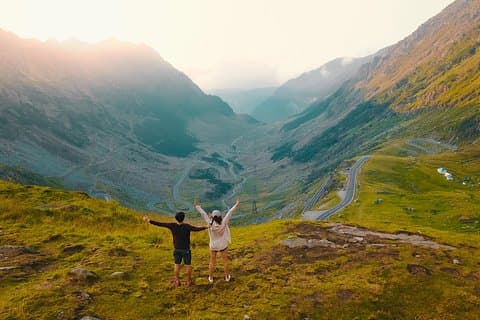
The incredible view and stunning scenery that this paved mountain road offers is indescribable; even the video segment featured on Top Gear, deeming it the most beautiful road in the world, barely does it justice.
y you will understand why thousands of tourists are eager to see it. Guarded for over 600 years, on one side by the Olt river, on the other by mount Cozia, the fortified walls of this ancient monastery that have protected us from invaders in the past seem to preserve the Garden of Eden, a place of mystery and mythical beauty… From Calimanesti Spring you can treat you by liver problems only by drinking water from where Napoleon III use to drink ☺
eal” Castle of Dracula) which was the place where Vlad the Impaler would retreat in the event of an Ottoman invasion. We stop to take pictures to bring home to our friends, knowing that they will make them a little jealous.
hich draws in hundreds of thousands of tourists annually. A wonder of engineering, it offers a breathtaking view of the reservoir lake built on Arges River.
ive, typical to the Renaissance and the following ages. Here we have the historical centre of Sibiu, mentioned for the first time in 1411 as a grain market. The Large Square exits since 1366, alongside the finalization of the third fortification belt of the city. Starting with the 16th century, the Large Square becomes the centre of the citadel. Over hundreds of years it was called Der Grosse Ring or Grosser Platz, between the wars it was named King Ferdinand Square, the communists named it the Square of the Republic and since 1990 it came back to its original name.
er the Bridge of Lies towards the Lower Town. The northern and eastern sides of the square follow the contour of the second fortification belt, forming a circular shape. The buildings situated left of Ocnei Street have a concave shape and follow the contour of the first fortification belt, these buildings separating the Small Square from the Huet Square. The buildings existing in the Small Square date from the 14th to the 16th
Please let us know the pick-up location! We'll pick you up from any location in Bucharest or near Bucharest!
For a full refund, cancel at least 24 hours before the scheduled departure time.
Bucharest를 카테고리별로 둘러보세요 - 스킵더라인 티켓, 도보 투어, 당일 여행, 음식 경험 등