유사한 경험
 Viator
 Viator
 Viator
 Viator
 Viator
 Viator
 Viator
 Viator
 Viator
 Viator
 Viator
 Viator
This Midtown Manhattan walking tour is a comprehensive look at the city's historical development as told through the buildings themselves. Fascinating strands of social, cultural, technological, real estate and zoning law histories are woven together in this wide and deep look New York's Midtown art and architecture.
8th Ave, New York City, United States
We begin at the boundary of Hells Kitchen and Times Square with an overview of the city's historic move uptown. We cover the basics of historical (academic) architecture up to the Modern period, and from overblown Beaux Arts to ornament-free skyscrapers. We learn the fundamentals of zoning in this POPS (Privately Owned Public Space). Works by Sidney Simon and Matt Mullican.
story; incised granite by Matt Mullican is part of the program.
skyline for Hearst Tower and the New York Times Building.
Broadway, , New York City, United States
We stop at the Allianz Building and Warner Music Group to take in the view of Times Square from the north. Zoning laws achieved a look inspired by Tokyo!
e and much of today's Midtown played (and still do) as holding almost a monopoly on the history of American culture: Music, theater, radio, television, books, magazines, newspapers, advertising, even automobiles.
We transition into private corporate space in the lobby of 787 7th Avenue and we go from commercial culture to corporate commercial. Expensive art and monumental feats of architecture are the mainstays of the remainder of the tour. Roy Lichtenstein opens us to the world of corporate art appropriately with Mural with Blue Brushstroke, a work he painted in place before the building opened. Out back in the POPS are works by Sol Le Witt and Barry Flannagan.
6 1/2 Avenue, Pedestrian Arcade, W51st to W54th St between 6th and 7th Aves, New York City, United States
We look as far uptown as we can along this 6-block long quirk in zoning, so-called "6 1/2 Avenue," a mid-block arcade that doesn't quite connect Times Square with Central Park.
1285 Avenue of the Americas, , New York City, United States
They have a world renown collection and their lobby is divided between temporary and permanent exhibits that include Frank Stella and Sarah Morris.
Large wall art by Fritz Glarner, a student of Mondrian.
1251 Sixth Avenue, New York City, United States
Monumental is the common theme to works by Hiroshu Senju and Kan Yasuda. Outside on the plaza is La Gran Manzana.
New York City, United States
We stop in 1221 (the McGraw Hill building) the see a work by visual artist Mark Bradford. Out onto Sixth Avenue stand below "Skyscraper Alley," some of the worst products wrought by man and zoning law. Across the street begins the art and architecture, and story Rockefeller Center, one of the greatest civic-minded entrepreneurial (seriously) projects in modern history. The Art Deco of Rockefeller Center would come to define the style. Most interesting to point out are the subtle shifts from the "Modernistic" (Art Deco) to the Modern as the project progressed after the passing of Raymond Hood.
1260 6th Avenue, Between 50th and 51st Streets, New York City, United States
We learn the origin story of the name for every venue today named Roxy.
45 Rockefeller Plaza, New York City, United States
The politics of the day, and the Rockefeller family dynamic, are the most interesting backstories to the art history of likely the most important corporate lobby in Modern history. The story of radio and David Sarnoff is also integral to the story.
600 5th Ave, Rockefeller Center, New York City, United States
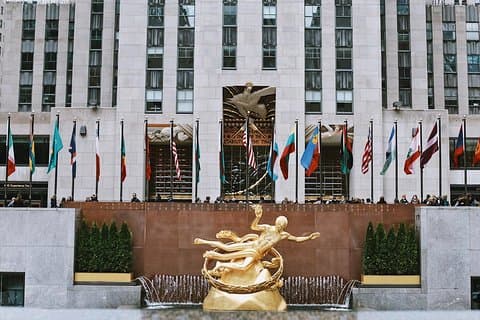
Art and architecture reach their apex outside where the Christmas tree goes every year. There is a mix-bag of interesting history: holdouts, Diego Rivera and the Rockefellers, the story of the ice-skating rink and perhaps the greatest reversal-of-fortune in Rockefeller Center history.
45 Rockefeller Plaza, New York City, United States
The lobby of the International Building is a work of art itself. Light and Movement by Michio Lhaza are the wall "center pieces." Atlas by Lee Lawrie stands outside facing St. Pat's
50th Street & 5th Avenue, Wheelchair accessibility located off the corner of 51st Street and 5th Avenue, New York City, United States
The history of Fifth Avenue is told through its buildings.
the Villard Houses are now the Palace Hotel.
New York City, United States
Architecture. We learn the evolution of Park Avenue from open train tracks, to high end residential, to today's corporate buildings. Buildings discussed are: The Health and Racquet Club (1918), St. Bart's (1919), The New York Central Building (1929), The Waldorf Astoria (1931), The GE Building (1931), Lever House (1952), The Seagram Building (1958), and the Met Life Building (1963).
e French artists, about 20 years apart: Leger, DuBuffet, and Francois-Xavier LaLannes.
A great option for lunch or dinner after the tour.
If there's time we can go inside to see Solid Sky by Alicia Kwade.
Applefest pieces.
w, skinny residential towers that are the latest redesign of the Manhattan skyline; astronomical heights and prices.
enter at the northeast corner of 49th Street and 8th Avenue, we meet just inside the supermarket.
For a full refund, cancel at least 24 hours before the scheduled departure time.
New York City를 카테고리별로 둘러보세요 - 줄서지 않고 구매 가능한 티켓, 도보 투어, 당일 여행, 음식 경험 등