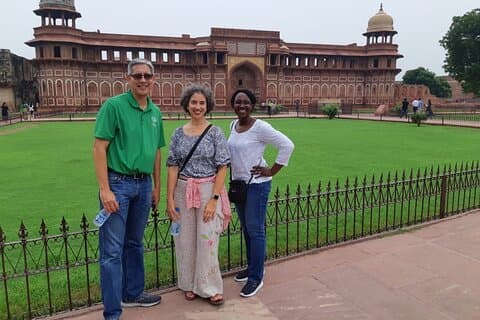
Same Day Gwalior Excursion from Agra
Embark on a memorable same-day excursion from Agra to Gwalior – a historic city once ruled by the great Maratha clan, the Scindias, and renowned for its magnificent monuments and rich heritage.
Your journey begins early in the morning with a pick-up from your hotel in Agra, followed by a drive to the majestic Gwalior Fort, often described as “the pearl amongst fortresses in India.” Upon arrival, your personal tour guide will take you through the fort’s fascinating history and architecture.
Enjoy a sumptuous buffet lunch in a historic palace built by the royal family, now one of the city’s finest heritage hotels. After lunch, explore Gurjari Mahal and Jai Vilas Palace before returning to Agra.
Tour Includes:
Air-conditioned vehicle with an English-speaking driver Personal tour guide Entry tickets to all monuments Buffet lunch in a historic palace One bottled water per guest
in a private car to Gwalior, covering a distance of 120 km. Upon arrival, our expert guide will meet you to begin the sightseeing tour of the historic Gwalior Fort. Built in the 8th century CE by Raja Man Singh Tomar, the fort stands on a steep hill called Gopachal. Inside, you will visit notable structures such as Man Mandir and Karan Mandir, as well as the Archaeological Museum. The Man Mandir, built by Raja Man Singh, is renowned for its beautiful wall artwork.
Lord Vishnu, also known as Sahastrabahu (“one with many hands”), lent the temple its original name, which over time evolved into “Sas Bahu” due to mispronunciation or interpretation. Built to seek the prosperity and success of his kingdom, King Mahipala’s temple is an exceptional example of medieval architecture. The complex comprises two temples—one larger and one smaller—symbolically referred to as the “mother-in-law” and “daughter-in-law” temples. Both feature intricately carved walls, graceful figures, and finely crafted pillars, reflecting remarkable artistic and architectural skill.
u Hargobind Sahib in Gwalior Fort and his historic release, during which he secured the freedom of 52 imprisoned kings. The name “Bandi” means “imprisoned” and “Chhor” means “release.”
She requested a separate palace with a steady water supply, which was provided through an aqueduct from the nearby Rai River. The palace is now an archaeological museum showcasing rare artifacts, including Hindu and Jain sculptures from the 1st and 2nd centuries BCE, a miniature statue of Salabhanjika, terracotta objects, and replicas of frescoes from the Bagh Caves.
Most of the palace now houses the Jiwajirao Scindia Museum, open to the public since 1964, while a portion remains the private residence of the Scindia family.
Please specify your pick up details at the time of booking
For a full refund, cancel at least 24 hours before the scheduled departure time.
Agra를 카테고리별로 둘러보세요 - 스킵더라인 티켓, 도보 투어, 당일 여행, 음식 경험 등