Discover the elegance and rich history of Potsdam on a private tour from Berlin, exploring the former royal residence of the Prussian kings and German emperors. Just outside the capital, Potsdam is renowned for its magnificent palaces, landscaped gardens, and fascinating stories of royalty, war, and diplomacy.
Visit Cecilienhof Palace, where the leaders of the Allied powers met during the Potsdam Conference in 1945 to shape the post-war world. Nearby, stop at the famous Glienicke Bridge, known as the “Bridge of Spies,” where Cold War spy exchanges between East and West once took place.
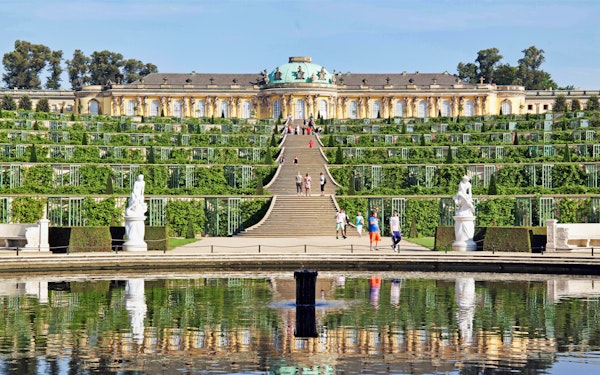
Stroll through the beautiful Sanssouci Park, home to the elegant Sanssouci Palace, Frederick the Great’s beloved summer residence, as well as the grand New Palace, built to demonstrate Prussian power and prestige. Along the way, see the tranquil Friedenskirche, inspired by Italian architecture, and pass through Potsdam’s Brandenburg Gate while exploring charming squares and historic streets.
Im Neuen Garten 11, , Potsdam, Germany
Stroll around the Dutch Quarter with your private guide and see an ensemble of red-brick buildings that is unique in Europe, built by the infamous 'Soldier King', Frederick William I, in the middle of the 18th century to accommodate Potsdam's new community of Dutch artisans.
Maulbeerallee, Potsdam, Germany
See the stunning Sanssouci Palace, favorite residence of Frederick the Great, which is set in beautiful parkland scattered with temples, churches and follies.
Konigstrasse, Potsdam, Germany
After walking over the Glienicke 'spy swap' Bridge, visit Cecilienhof, the manorial residence of Germany's last Crown Prince, used to host the Potsdam Conference in 1945. Your private guide will describe the discussions that took place between Churchill, Truman and Stalin, which were to seal the fate of Cold War Europe for the next half century.
Luisenplatz, Potsdam, Germany
The Brandenburg Gate in Potsdam is an elegant 18th-century triumphal arch built to celebrate Prussian military victories. Commissioned by Frederick the Great in 1770, it stands at the entrance to Sanssouci Park and reflects the grandeur of Prussian architecture. Unlike Berlin’s famous gate, the Potsdam version has two different façades, each designed by a different architect, giving it a unique and distinctive appearance.
Am Gruenen Gitter 3, Potsdam, Germany
The Church of Peace (Friedenskirche) in Potsdam is a serene 19th-century church located within Sanssouci Park. Commissioned by King Frederick William IV of Prussia, it was inspired by early Christian and Italian basilicas, giving it a simple yet elegant appearance. Surrounded by peaceful gardens and cloisters, the church reflects the king’s vision of harmony, spirituality, and quiet reflection within the royal park.
Am Neuen Palais, Potsdam, Germany
The New Palace (Neues Palais) in Potsdam is the largest and most opulent palace in Sanssouci Park. Built by Frederick the Great after the Seven Years’ War, it was intended as a grand statement of Prussian strength and wealth. With its lavish baroque architecture, ornate interiors, and over 200 rooms, the palace served as a place for royal ceremonies, state visits, and lavish celebrations.
Maulbeerallee, 2, Botanical Garden of the University of Potsdam, Potsdam, Germany
The Paradiesgarten (Paradise Garden) in Potsdam is a beautifully landscaped section of Sanssouci Park, designed as a peaceful retreat within the royal gardens. Featuring elegant pathways, ornamental plantings, and carefully planned views, it reflects the refined garden aesthetics favoured by the Prussian court and complements the surrounding palaces and historic architecture.
Please bring comfortable shoes, a camera and loads of questions.
For a full refund, cancel at least 24 hours before the scheduled departure time.
Sfoglia Berlin per categoria - biglietti salta-fila, tour a piedi, gite giornaliere, esperienze gastronomiche e altro