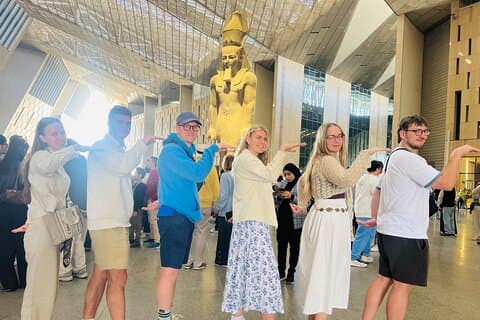
Admire artifacts from Ancient Egypt in the Egyptian Museum. Then visit Salah El Din Citadel, constructed in 1183 AD, and Mohamed Ali Mosque, built inside the castle in the 19th century. Tour Old Cairo, the site of a city that per-dated Cairo with many historic churches like the Hanging church .
ts of Tutankhamen’s tomb and most of the mummies that have been discovered since the 19th century. The museum’s exhibits span from the beginning of the Old Kingdom of Ancient Egypt (approximately 2700 BC) through the Greco-Roman period.The building consists of two floors. On the ground floor, you can follow the history of Egypt from the Old Kingdom up through the Greco-Roman period by turning left at the entrance and looping around the museum. This provides a good background for most of Egypt’s ancient history. Visit the Egyptian Museum See the Golden Mask
This name comes from the fact that it was built atop the walls of the 4th century BC Roman fortress of Babylon, the remains of which are still visible about Coptic Cairo Although the effect is significantly diminished today by the fact that the ground level has risen over 30 feet over the centuries due to the accumulation of trash and dust, originally this church towered above its surroundings on the high walls of the fortress.
an churches and other sites that date from the centuries between the decline of the pharaonic religion and the arrival of Islam when Egypt had a Christian majority. Coptic Cairo is largely built around the fort of Babylon on upon the remains of its walls. The Coptic Museum is here, which holds the largest collection of Coptic Christian artwork and artifacts in the world. Founded in 1910, the museum records Coptic history from the arrival of Christianity in Egypt up through the Ottoman era, displaying a mixture of artwork influenced by Egyptian, Greek, Roman, Byzantine, and Ottoman traditions.
ce of the Mamluks, who had controlled Egypt for six centuries before him, and demolished their palaces within the fortress. He also built one of Cairo’s most recognizable landmarks. His Alabaster Mosque, built in memory of a deceased son, towers over the rest of the complex. Its silhouette is the most dominant feature of Cairo’s eastern skyline. In addition to these two mosques, the Citadel also contains the National Military Museum, full of uniforms and weapons from Egypt long history, a Police Museum, and several more museums dedicated to the palace of Muhammed Ali.
It has been expanded and remodeled by many different rulers. In the 14th century, Sultan Al-Nasir Muhammed built a mosque there that still bears his name and the Southern Enclosure of the fort next to Saladin’s original walls. The most noticeable changes came in the 19th century.
Hotel Lobby / home Address / Train Station / Bus Station
For a full refund, cancel at least 24 hours before the scheduled departure time.
Sfoglia Cairo per categoria - biglietti salta-fila, tour a piedi, gite giornaliere, esperienze gastronomiche e altro