You'll have the convenience of a modern car, complete with a driver and professional bilingual guide, to explore the city at your leisure.
Our itinerary is flexible and can be adjusted to suit your preferences. Your guide will evaluate any changes to optimize the tour and tailor it to your needs, all under the supervision of our agency.
Feel free to request stops along the way to walk around and capture photos of your favorite spots. Your guide will be there to assist you every step of the way.
We'll begin our journey in the heart of the city, exploring highlights such as the iconic 9 de Julio Avenue, the majestic Colon Theatre, and the renowned Obelisk, a symbol of Buenos Aires. We'll visit the Museum of Fine Arts, and the vibrant neighborhood of La Boca, including the colorful cultural hub of Caminito. Our tour continues to San Telmo, a neighborhood steeped in the rich history of Buenos Aires.
After the tour, your guide and driver will ensure your safe return to your hotel.

tholic temple in Argentina, the main headquarters of the Catholic Church of Argentina
imposing mausoleums and vaults, belonging to many of the main protagonists of Argentine history, such as Eva Perón (Evita), one of the busiest tombs. The Cemetery of the Recoleta contains many curious stories in its mausoleums. Like that of Liliana Crociati, who died during her honeymoon and to whom her parents built her a vault where they reproduced her bedroom and placed her sculpture in the entrance, wearing her wedding dress with which she was buried and accompanied by her inseparable dog. Or the one of David Alleno, caretaker of the cemetery, who saved all his life to be able to build his own grave in it. In the visit to the cemetery we will visit the vaults of the historical figures of the country.
Due to its size, acoustics and trajectory, it is considered one of the five best in the world.
building where the Congress of the Argentine Nation develops its activities, it is one of the largest congresses in the world
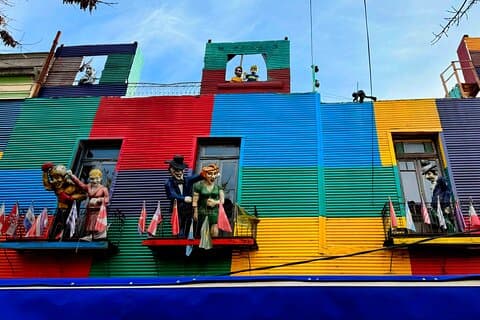
Asadores and street artists mark the entire Caminito, a narrow alley flanked by brightly colored zinc houses that evoke its origin as an immigrant neighborhood.
ks to its temporary art galleries, night bars and street murals. The Defensa street, full of antique shops and bustling brasseries, passes through the Dorrego square, where many tourists come on Sundays to see the street market and street performances. Winding roads run through Lezama Park among jacaranda trees. Here is also the National Historical Museum, Italianate style. The neighborhood is full of exclusive restaurants with tango shows.
or its Parisian-style terraced houses, lavish old palaces and luxurious boutiques. One of the main attractions is the Recoleta Cemetery, which houses extravagant tombs of national icons, such as Eva Perón. The National Museum of Fine Arts exhibits masterpieces by Argentine artists, and the Recoleta Cultural Center offers temporary avant-garde exhibitions. In Plaza Francia, with lawn areas, there is a handicraft market on weekends.
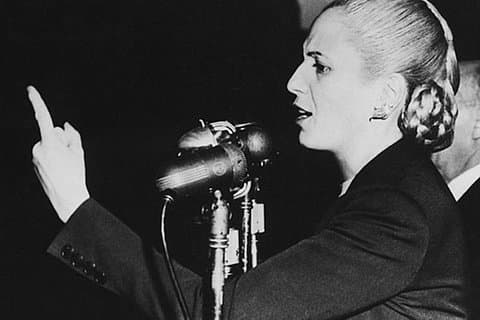
es, such as Palermo Soho and Palermo Hollywood, fashionable areas that house restaurants of all kinds, chic cocktail bars and original clothing stores. The Tres de Febrero park is very popular for picnics and has a rose garden, a planetarium and lakes for rowing. The avant-garde MALBA Museum shows masterpieces by modern Latin American artists and the Evita Museum explores the life of Eva Perón.
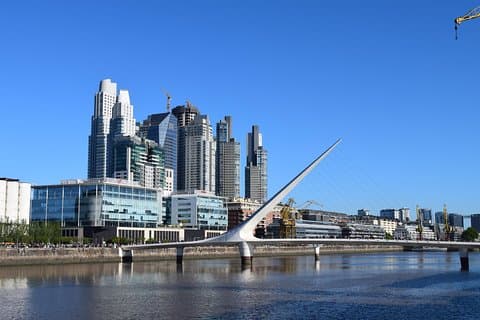
Its renovated redbrick buildings house exclusive grills frequented by tourists and businessmen at lunchtime. There are also modern skyscrapers with multinationals and luxury apartments. The lakes in the area are surrounded by trails, as is the ecological reserve Costanera Sur, very popular with runners and families. The elegant suspension bridge of the Woman connects the ports.
and the backbone of the historical and civic center of the metropolis. It connects the historic Plaza de Mayo with the Plaza del Congreso in an extension of ten blocks. He was born opulent and majestic, with great Spanish influence. It was transformed, over time, into the scene of Buenos Aires social demonstrations.
idered an icon of the city of Buenos Aires, built in 1936 on the occasion of the fourth centenary of the so-called first foundation of the city by Pedro de Mendoza
city and of the unmissable attractions for those who visit it. With its typical sheet metal tenements in the neighborhood of La Boca, which show its walls painted in different colors, it is also an open-air museum of almost 150 meters in length. Its sinuous layout is due to the fact that it follows the course of a stream that flowed until the beginning of the 20th century
Armando Stadium, better known as La Bombonera, is a football stadium owned by Club Atlético Boca Juniors. It is located in the neighborhood of La Boca in the city of La Boca
of all the most important political events in Argentine history, with the exception of the Declaration of Independence.
trict located in the Palermo neighborhood of the City of Buenos Aires.
the San Telmo neighborhood of the city of Buenos Aires, Argentina. Although it retains old shops selling vegetables and meats, nowadays it is a tourist place and antiques abound.
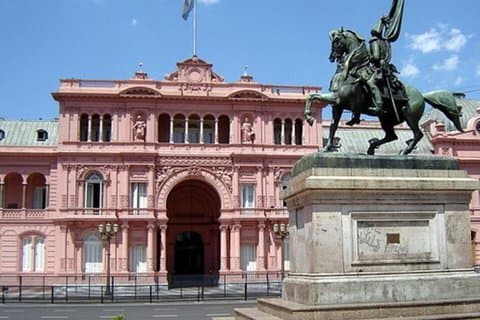
Within it is the office of the president of the Argentine Nation. This building is located in 50 Balcarce Street, in the neighborhood of Monserrat in the City of Buenos Aires, in front of the historic Plaza de Mayo
es, such as Palermo Soho and Palermo Hollywood, fashionable areas that house restaurants of all kinds, chic cocktail bars and original clothing stores. The Tres de Febrero park is very popular for picnics and has a rose garden, a planetarium and lakes for rowing. The avant-garde MALBA Museum shows masterpieces by modern Latin American artists and the Evita Museum explores the life of Eva Perón.
Throughout its 70 blocks, it crosses the neighborhoods of Balvanera, all closely linked to the history of Tango and culture. Being one of the main cultural axes of the city, the Avenue owes its name to the first city of the interior of the country that supported the Argentine Independence. Because of its nightlife it is known as "the street that never sleeps" and this is mainly due to the fact that, around the Obelisk, it has the largest concentration of bookstores, theaters, pizzerias and bars in Buenos Aires, some of them considered "Notables" "
You can see large old houses, large houses and even some mansions that many are embassy headquarters. Inside these houses, the luxury and quantity of maids and employees stand out.
husiastic guide who will share fascinating historical and cultural insights along the way.
Pick up in private service to all hotels located at the city center of Buenos Aires
If you cancel at least 3 full day(s) before the scheduled departure time, you will receive a full refund.<br>If you cancel within 3 day(s) of the scheduled departure, you will receive a 0% refund.
Sfoglia Buenos Aires per categoria - biglietti salta-fila, tour a piedi, gite giornaliere, esperienze gastronomiche e altro