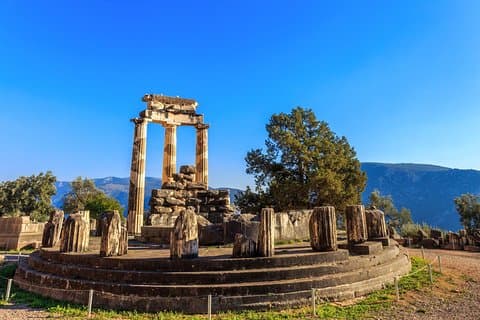
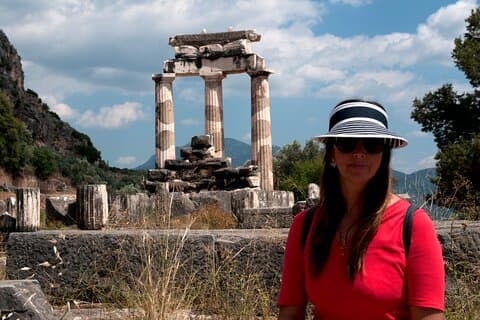
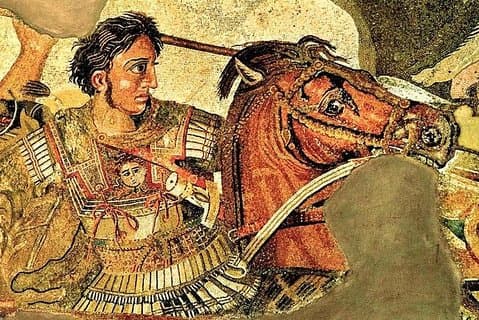
We visit Kalavrtyta,Ancient Olympia, Nafplio, Mycenae, Epidaurus... as travelers, not as tourists. Schedule is flexible, but most importantly our drivers are seasoned travelers and are dedicated to helping you live the tour of your life, that is suited to your needs and lifestyle, allowing all passengers to enjoy the scenic drive, stopping wherever you desire, take photos, have a break, swim.
Day 1: The tour starts with convenient pickup, which takes you via Cornth Canal to Peloponnese. You will take the unique train to Kalavryta. Your driver will wait at the Train station to continue via Aroania mountains to Olympia (Overnight).
Day 2: You will will visit the first ancient Olympic stadium, Zeus Temple, Museums, more... Drive via Arkadia mountains to Nafplio. Visit Palamidi, the most well preserved Castle in Greece (Overnight)
Day 3: Visit Acronafplia castle, the oldest above old Nafplio, Asclepius sanctuary in Epidavros and Agamemnon Palace in Mycenae
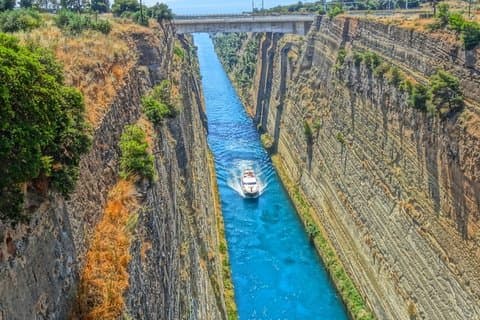
ell as the Peloponnese peninsula with the central part of Greece. More than 2500 workers digging 6.400m for twelve years (from 1881 to 1893) Stop for photography, walk across on a pedestrian bridge and admire the canal from 80 m high
The Romans demolished Corinth in 146 BC, built a new city in its place in 44 BC, and later made it the provincial capital of Greece. Walking in the remains of the ancient City of Corinth is like to walk back in time. For Christians, Corinth is well known from the two letters of Saint Paul in the New Testament, First and Second Corinthians. Corinth is also mentioned in the Acts of the Apostles as part of the Paul the Apostle's missionary travels. Combined ticket 15€ for summer or 10€ for winter
in the Doric style on the ruins of much earlier temple. It is one of the earliest Doric temples in the Peloponnese constructed of local limestone on top of an imposing, rocky hill. This temple was an emblem for the Greek city of Corinth, reflecting its growth and prosperity. The Temple of Apollo was built upon a Temple Hill, which was an outcropping of natural rock, which allowed for a sturdy platform on which the temple could be built. The Temple of Apollo dominated Ancient Corinth. The remains of other temples, a theater, shops, public baths, pottery factories, a gymnasium, a triumphal arch, and other buildings such as villas have been excavated since 1896 on the site around the Temple of Apollo. The temple initially consisted of 42 monolithic, 6×15 limestone columns, over 7 m high.
k railway that links the seaside village of Diakopto to picturesque Kalavryta. Take the Diakopto–Kalavryta Railway, an historic 750 mm gauge cog railway in Greece. It runs 22 km (14 mi) through the Vouraikos Gorge, stopping en route at Zachlorou. It is one of the most beautiful natural sights plus one of the most spectacular railway rides.The little train travels through streams, climbing the majestic narrow gorge,up into the mountains, through bridges and tunnels, over waterfalls, along cliffs and through forest of pine and oak trees. When the incline gets really steep it switches form regular track to a cog system.
Greece, situated at an altitude of 756 meters at the foot of Mount Chelmos (Aroania Mountains). Renowned as a premier year-round alpine destination, it seamlessly blends dramatic natural landscapes, outdoor sports, and a profound historical heritage. Odontotos Rack Railway: Europe's oldest and narrowest rack railway (~75 cm gauge) travels a scenic 22 km route between Diakopto and Kalavryta. It cuts directly through the breathtaking Vouraikos Gorge, passing rivers, waterfalls, and steep cliffside tunnels. WWII Holocaust Memorials: In December 1943, Nazi forces executed the town’s entire male population. Visitors can pay respects at the Place of Sacrifice (Kappis Hill) and visit the highly moving Municipal Museum of the Kalavryta Holocaust, housed in the historic primary school.
The parts of Aroania we drive are between 800 m and 1,800 m elevation and are covered with pine forests. The higher areas consist of grasslands and barren rock. Aroania is rich in butterfly species The mountain is the site of the Aristarchos telescope. The Chelmos Observatory is an observatory located at the top of mount Chelmos, near Kalavryta. It is the largest research infrastructure of the National Observatory of Athens and IAASARS. The observatory was completed and first opened in 2001. Its main equipment is the Aristarchos 2.3 m Telescope, manufactured by German company Carl Zeiss AG. With the finance from the universities of Patras and Manchester.
We can arrange accommodation for you in selected Boutique Hotels A'class or 4* Hotels with breakfast (additional cost 110€ per double room / weekend-holidays 130€ per double room - if more than 2 rooms 10% less. Driver's room complimentary). If you wish to do do your own hotel reservation, you need to reserve an extra room for your driver.
It is is positioned in a serene and rich valley at the confluence of the Alpheios and the Kladeos rivers. In antiquity it was famous beyond the borders of mainland Greece for hosting the Olympic Games every four years, starting in 776 BCE. The archaeological site is located withing walking distance of the modern village called Ancient Olympia and it includes ruins from Bronze Age to the Byzantine eras. The site covers an expanded area of ruins scattered among low trees, as well as Zeus & Hera Temples, Fidias Workshop, Roman emperor Nero villa, the ancient stadium where the Olympics games took place and a lot more. An impressive array of artifacts which were unearthed during excavations are on exhibition at the nearby Olympia Museum Combined ticket: Summer 20€ and includes Archaeological & History of the Games Museums. Under 19 y free /Over 65 y or winter time reduce half
tions, housing the ancient treasures excavated from the sanctuary of Zeus at Olympia. The museum's collections span from prehistoric times to the early Christian period across 12 distinct thematic and chronological rooms: Hermes of Praxiteles: A world-famous, exceptionally well-preserved 4th-century BC Classical sculpture showcasing unparalleled realistic detail. Nike of Paionios: An elegant representation of the winged goddess of victory captured mid-descent. The Zeus Temple Pediments: Monumental, reconstructed limestone and marble sculptures that originally adorned the east and west peaks of the great Temple of Zeus. Ancient Bronzes: One of the most significant collections of bronze votive offerings, cauldrons, and military armor in the world
Learn about its core original events (foot racing, wrestling, boxing and chariot racing), why it's associated with Hercules (or Pelops), and what fate befell women who tried to watch the Games despite prohibitions. The sculptures, mosaics, pottery art and votive offerings all pay tribute to athletes and athleticism, while bronze strigils were used by the athletes themselves to scrape down. Other Games of Ancient Greece also get a mention.
is dedicated to the great Mathematician, Physicist, Engineer, Astronomer and Inventor of the ancient Greece and the Ancient Greek Technology of his time. Archimedes’ Museum is permanently hosted in the center of Ancient Olympia in a two floor building that was granted by the municipality of Ancient Olympia. That was unanimously agreed by the board of directors of the city of the Ancient Olympia and supported by both the Commercial Union of Ancient Olympia “Hermes” and the Hotel owners of the city. Archimedes was a unique and tiptop genius in the spiritual world of all times. He passed on to the global culture great theses in the fields of all the ancient sciences and most of all, he became the springboard for the development of the modern science. He invented a lot of inventions, some of them still in use as at the same time he inspired Da Vinci and he influenced Galileo and Newton.
is one of the regional units of Greece. It is part of the administrative region of Peloponnese. It is situated in the central and eastern part of the Peloponnese peninsula. It takes its name from the mythological figure Arcas. In Greek mythology, it was the home of the god Pan. In European Renaissance arts, Arcadia was celebrated as an unspoiled, harmonious wilderness. Arcadia is mainly grassland with a bit farmland and three wooded mountain ranges, but large areas are covered only by degenerated shrubland. Forests, mainly in altitudes higher than 1000 m, remained in the central north (Mainalo), in winter also a ski resort, in the central south and in the Arcadian part of the mountain range Parnon. In the southwest, “Mount Lykaion” is well known for its ancient history and myths.
castle perched on a 216-meter-high hill overlooking the coastal town of Nafplio, Greece. Built by the Venetians in a remarkably short time between 1711 and 1714, it stands as a masterpiece of military engineering, commanding panoramic views of the Argolic Gulf and the surrounding Peloponnese region
hillsides near the north end of the Argolic Gulf. The town was an important seaport held under a succession of royal houses in the Middle Ages as part of the lordship of Argos and Nauplia, held initially by the de la Roche following the Fourth Crusade before coming under the Republic of Venice and, lastly, the Ottoman Empire. The town was the capital of the First Hellenic Republic and of the Kingdom of Greece, from the start of the Greek Revolution in 1821 until 1834. Nafplion is the most picturesque town in mainland of Greece and we will stay here for overnight. We can arrange accommodation for you in selected Boutique Hotels A'class or 3/4* Hotels with breakfast (additional cost 90€ per double room / weekend-holidays 120€ per double room - if more than 2 rooms 10% less. Driver's room complimentary). If you wish to do do your own hotel reservation, you need to reserve an extra room for your driver.
ict in symmetry, stone-built Venetian structure which covers and encases the central, Syntagma Square on its west side. It was first built in 1713, during the second reign of the Venetians, under the Naval Proveditore Augustine Sagredo to be used as the navy's depository, according to the marble inscription fitted on the building's frontage, written in Latin. It is widely acknowledged as one of the best well-preserved Venetian structures in the whole of Greece. The museum's most exquisite piece of archaeological finds still remains to be the Bronze Suit Armor of Dendra region, exhibited in a specially designed area together with the rest of the breathtaking tools which were excavated such as, armor equipment belonging to the soldier dressed in that armor, bronze and clay jugs. Ticket General 6€ / Reduced 3€
Once the whole city existed within these walls. Parts of the castle was built already in the Bronze Age, and there are still remnants of these old walls in the western part of the castle. Acronafplia was later extended and amplified by respectively Romans, Franks, Venetians and Turks. The thick castle walls form a nice backdrop for the city, and in the last years, the castle is being restored. Especially the eastern parts deserve a visit. Explore this section on foot, by walking off the road that runs through the castle, and in between the old walls. However, there are more good reasons to visit Acronafplia. The view is beautiful, both to the northern parts of the city and towards the bay, and south to Arvanitia beach and the mountains of Arcadia.
The main collection of inscriptions has been housed in the special hall to the northeast of the main building since 1958 as has a storeroom for the sculptures, a pottery room, and a restoration workshop.The museum also displays bronze medical instruments providing an informative insight into medical practice at the sanctuary of Asklepios. Ticket: Winter 6€ / Summer 12€. Under 19 y free./ Over 65 y. reduced
It was the main holy site of Asclepius. The sanctuary at Epidaurus was the rival of such major cult sites as the Sanctuary of Zeus at Olympia and Apollo at Delphi. The temple was built in the early 4th-century BC. If still in use by the 4th-century, the temple would have been closed during the persecution of pagans in the late Roman Empire, when the Christian Emperors issued edicts prohibiting non-Christian worship.
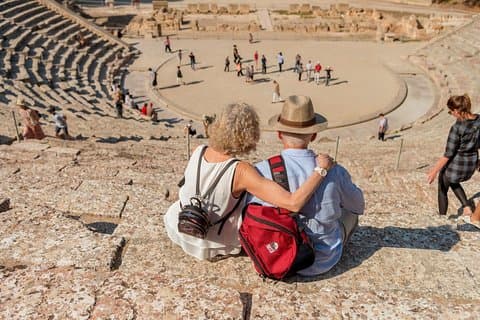
y dedicated to the ancient Greek God of medicine, Asclepius. It is built on the west side of Cynortion Mountain, near modern Lygourio, and belongs to the Epidaurus Municipality. It is considered to be the most perfect ancient Greek theater with regard to acoustics and aesthetics.
The lintel stone above the doorway weighs 120 tons, with approximate dimensions 8.3 x 5.2 x 1.2m the largest in the world. The tomb was used for an unknown period. Mentioned by Pausanias, it was still visible in 1879 when the German amateur archaeologist Heinrich Schliemann discovered the shaft graves under the 'agora' in the Acropolis at Mycenae. The tomb has probably no relationship with either Atreus or Agamemnon, as archaeologists believe that the sovereign buried there ruled at an earlier date than the two, but it was named thus by Heinrich Schliemann and the name has been used ever since. The grave is in the style of the other tholoi of Mycenaean Greece, of which there are nine in total around the citadel of Mycenae and many more in the Argolis. However, in its monumental shape and grandeur it is one of the most impressive monuments surviving from the Mycenaean period. Combined Ticket (Tomb & Acropolis): Winter 6€ /Summer 12€. Under 19 years free / Over 65 y. reduced
olid Plain, is the kingdom of the mythical Agamemnon and the most important and richest palatial center of the Late Bronze Age in Greece. Its name was given to one of the greatest civilizations of Greek prehistory, the Mycenaean civilization, while the myths related to its history, its rulers and their family members (such as Klytaimnestra, Ifigeneia, Elektra, Orestes) have inspired poets, writers and artists over many centuries, from the ancient to the contemporary times. Significant stages in monumental architecture are still visible in the property, such as the massive defensive walls, the cor-belled tholos tombs and the Lions Gate.
e Lions Gate, which was the main entrance. It was erected during the 13th century BC, around 1250 BC in the northwest side of the acropolis and is named after the relief sculpture of two lionesses or lions in a heraldic pose that stands above the entrance. The Lion Gate is the sole surviving monumental piece of Mycenaean sculpture, as well as the largest sculpture in the prehistoric Aegean. It is the only monument of Bronze Age Greece to bear an iconographic motif that survived without being buried underground, and the only relief image which was described in the literature of classical antiquity, such that it was well known prior to modern archaeology.
While the most important Mycenaean artifacts are exhibited at the National Archaeological Museum of Athens, a variety of other objects unearthed in the vicinity are exhibited in its three halls. It provides context to the excavations and it is easily visited after a tour of the archaeological site.
ns or request another drop off location
Traveler pickup/ drop off is offered from/ to your hotel/ apartment in Athens, Piraeus or Airport Traveler pickup/ drop off is offered from/ to your hotel/ apartment in Nafplio Please do not hesitate to request another pick up location.
We suggest that the tour starts at 8:00 am or earlier in summer time If for any reason this is not convenient, you can adjust the time according to your needs.
If you cancel at least 6 full day(s) before the scheduled departure time, you will receive a full refund.<br>If you cancel between 2 and 6 day(s) before the scheduled departure time, you will receive a 50% refund.<br>If you cancel within 2 day(s) of the scheduled departure, you will receive a 0% refund.
Durchsuche Athens nach Kategorie - Skip-the-Line-Tickets, Stadtrundgänge, Tagesausflüge, Fooderlebnisse und mehr