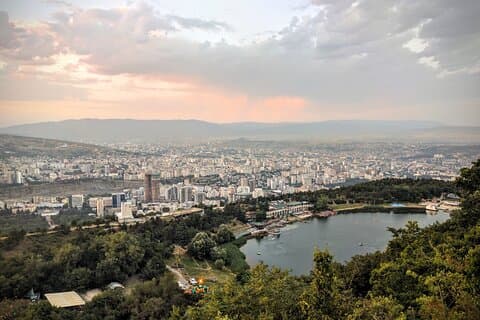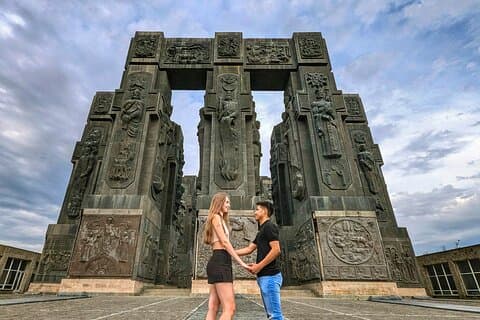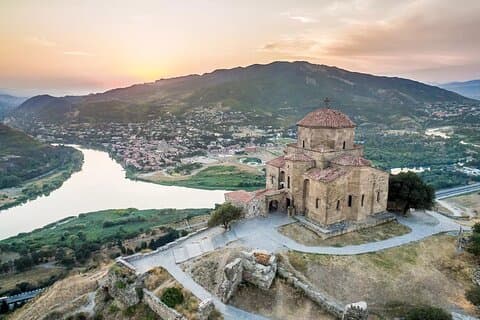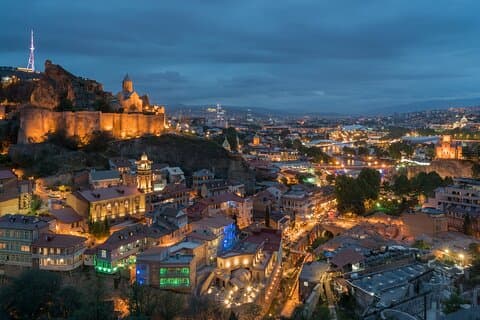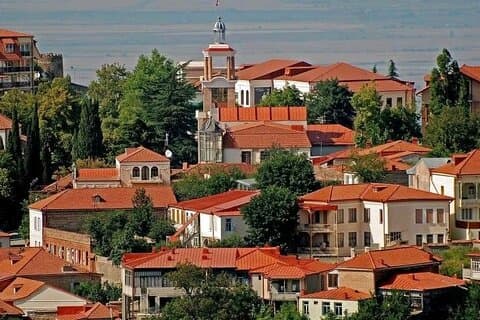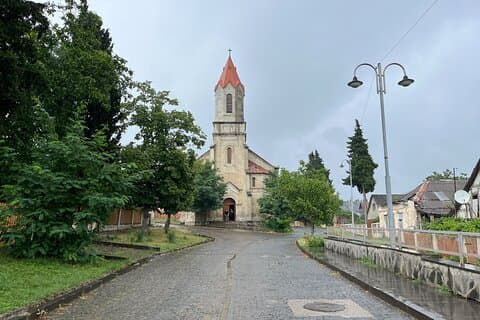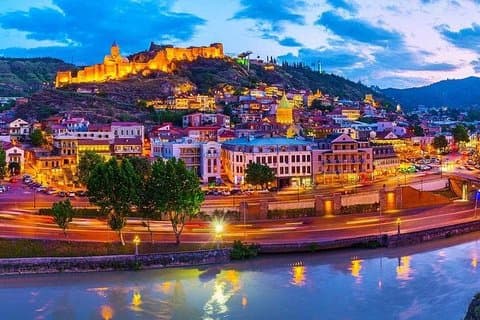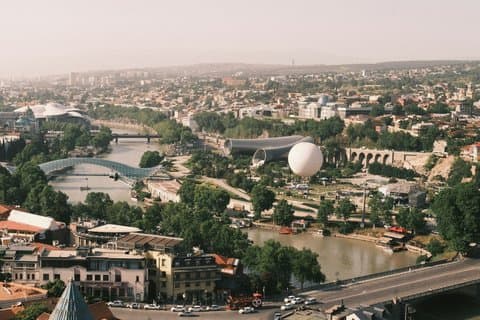
Tour of the main attractions of Tbilisi with photo stops. You will see and visit the Tsminda Sameba Cathedral, Shardeni Street, Monument of King Vakhtang Gorgasali, Metekhi Cathedral, Narikala Fortress, Abanotubani, Jumah Mosque, Anchiskhati Basilica, Sioni Cathedral Church, The Bridge of Peace, Rike Park, Rezo Gabriadze Marionette Theater, Open Air Museum of Ethnography, etc.
Constructed between 1995 and 2004, the cathedral rises on Elia Hill, on the left bank of Mtkvari River and keeps traditional Georgian architectural style. The complex includes nine chapels, various supplementary buildings, and enchanting gardens. The Cathedral is the highest one not only in Georgia but in whole Caucasus region. The height from the ground to the top of the cross is 105.5 meters.
Nowadays, popular restaurants, open cafes and bars, nightclubs and galleries are located on this street. Shardeni is the best place to visit to explore Tbilisi’s nightlife. Furthermore, many exhibitions, celebrations and concerts are organized here.
he first wooden bridge over Mtkvari in Tbilisi was built in 1821.
he head of Iberia, an ancient state on the territory of part of modern Georgia, is located near the Metekhi church, built in the 13th century.
nder standing above the steep cliffs of the Mtkvari River is one of the classic images of Old Tbilisi. The church has been destroyed many times by the enemy. During the Tsarist regime there was a prison there and in Soviet times Metekhi was used as a theatre. In was only in the late 1980s that the church was reconstructed again.
The date of construction of the fortress is the 4 th century AD, i.e. it has been there from the city's beginning. Later the fortress was extended and expanded several times. In the 7 th - 8 th centuries it was done by Arabs. Historians assert that Narikala standing on the Silk Road was the most fortified and impregnable of all in Tbilisi. In 1827 the fortress was destroyed by the earthquake and since then the citadel has not been restored completely.
All my tiredness had gone and I felt strong enough to lift a mountain” – Alexandre Dumas, after a visit to the Sulphur Baths in 1858. Fed by naturally hot mineral waters (47°C), the sulphur baths have been an essential part of Tbilisi life for centuries. The brick-domed underground baths were built in the 17th century and produce 3 million litres of water every day. To make your visit to the baths complete, make sure to take the invigorating massage.
It was built in 1723 by the Ottomans, but later it has been destructed several times. Its present-day appearance the mosque got in 1911 by the initiative of the Kazan Tartars.
Mary Church constructed during the reign of Dacha Udzharmeli, the successor of Vakhtang Gorgasali, in the 4 th century. The beautiful rectangular building of the church was build under the influence of ancient Palestinian architecture. The doors of Anchiskhati church are decorated with traditional Georgian cross similar to the one made by St. Nino. On the western facade of the temple there is a stone medallion with the cross which has survived since the earliest version. The upper parts and arches were reconstructed in the 17 th - 19 th centuries.
e of the most known monuments in the Old Town . The beginning of its construction is dated the 5 th – 6 th centuries and the completion - the first half of the 7 th century. The Cathedral is named in the honor of Jerusalem Zion. Today Sioni is the residence of the Catholicos - the Patriarch of Georgian Christian church.
It is a pedestrian glass and steel bridge in a bow-shaped design that sits over the Mtkvari (Kura) river in Georgian capital. It was officially opened in May 2010. The bridge was brought to Georgia from Italy in 200 unassembled components. The bridge is 156 meters long and has more than 10 000 LED bulbs built-in, that are switched on daily 90 minutes before the sunset.
It stands out among other parks in that, if you look at it from above, it has the shape of a map of Georgia. The park is located on the left bank of the Mtkvari River.
gledy-piggledy clock tower, built by puppet master Rezo Gabriadze during a renovation of his theatre in 2010.
It consists of over 70 buildings and more than 8000 implements and artefacts from traditional Georgian life. The museum is divided into ten zones, each depicting a different aspect of Georgian ethnology. The buildings have been brought from all over Georgia and painstakingly re-errected.
Meet your guide and driver at your hotel.
All sales are final. No refund is available for cancellations.
Gennemse Tbilisi efter kategori - skip-the-line billetter, ture til fods, dagturnéer, madbeskrivelser og meget mere