This is Seoul ultimate tour covering 4 must-visit places in Seoul! Please choose 4 places in the list and inform us in advance. *Other places are available after consultation
[Hippest Road] -Itaewon-dong -Seongsudong Cafe Street
[Royal Palace] -Gyeongbokgung Palace (Tue-Closed) -Changdeokgung Palace (Mon-Closed) -Changgyeonggung Palace (Mon-Closed)
[Frequently visited park by locals] -Yeouido Hangang Park (*Other Han-river park can be replaced depending on your schedule) -Seoul Forest -Seoul Botanical Garden (Mon-Closed) -Cheonggyecheon Stream
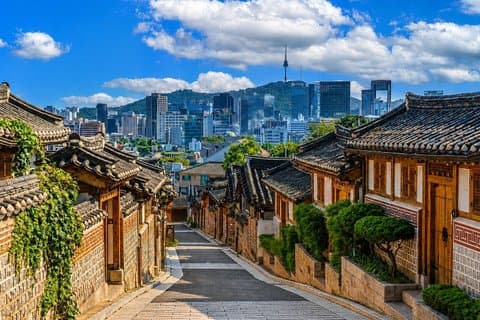
[Hanok Village] -Bukchon Hanok Village -Ikseon-dong Hanok Street
[Shopping] -Insadong(Antique shop alley) -Dongdaemun Design Plaza (DDP) -Starfield COEX Mall -The Hyundai Seoul -Myeongdong Shopping Street
[Art Gallery Museum] -Seoul Museum of Art(Monday x)
[Museum] -National Folk Museum -The War Memorial of Korea (Mon-Closed) -National Museum of Korea
[Korea Buddhist Temple] -Jogyesa
[Traditional Local Market] -Gwangjang Market
all mixure of all different cultures from the globe. The area became home to many international residents early on influenced by the nearby US Army base. Gyeongnidan-gil began to grow in popularity as one of Seoul’s representative tourist attractions with its unique and exotic atmosphere lined with restaurants, cafes and ateliers.
The street (also known as ‘artists' street’) has an eccentric flair thanks to its variety of charmingly decorated coffee shops, and designer stores.
It's must-see place if you visit Korea. Meet the Gyeongbok Royal Grand palace meaning "Palace Greatly Blessed by Heaven."
SCO World Cultural Heritage Committee in December of 1997. The palace was the second royal villa built following the construction of Gyeongbokgung Palace in 1405. It was the principal palace for many kings of the Joseon dynasty, and is the most well-preserved of the five remaining royal Joseon palaces.
r of the Joseon dynasty, King Sejong (r.1418-1450), for his retiring father, King Taejong. It often served as residential quarters for queens and concubines. During the reign of King Seongjong (r.1469-1494), the palace was renovated and renamed to Changgyeonggung Palace. It later became a park with a zoo and a botanical garden during Japanese colonial rule. The palace grounds remained this way until 1983 when restoration of its old grace was completed.
Situated in Yeouido, the heart of politics, media, banking and finance. The park hosts many exciting events, from the Yeouido Cherry Blossom Festival in spring
opened in 2005, is one of the most loved park by citizen. The park consists of four parts, Culture & Art Park, Educational Experience Park, Eco-forest Park, and Riverside Park along Hangang River.
nal garden with native plants, and Greenhouse exhibiting plants from 12 tropical and Mediterranean cities.
Created as part of an urban renewal project, Cheonggyecheon Stream is a restoration of the stream that was once there during the Joseon Dynasty (1392-1910).
chon Hanok Village is home to hundreds of traditional houses, called hanok, that date back to the Joseon dynasty. The name Bukchon, which literally translates to "northern village," came about as the neighborhood lies north of two significant Seoul landmarks, Cheonggyecheon Stream and Jongno.
Ikseon-dong Hanok Village, first established in the 1920s, offers a unique mix of modern and traditional elements. The narrow alleyways are lined with uniquely decorated shops and cafes as they twist and turn. It’s no surprise that these alleyways are referred to as “photo zones” as the colorful shops make the perfect backdrop for photogenic moments. The shop signs and one-of-a-kind murals can also help you find you way within Ikseon-dong Hanok Village.
The teahouses and restaurants are the perfect complement to the galleries. They are hidden deep within the twisting alleyways, making it feel like a treasure hunt. T
The building complex is divided into sections, which are named Allimteo, Beaumteo, Sallimteo, DDP Design Museum, Design Market & Eoullim Plaza, and Dongdaemun History & Culture Park. Designed by world-renowned architect Zaha Hadid, the building's exterior attracts the attention of many photographers with its delicate curves and bold shapes.
Combining fashion, food, culture and entertainment, the mall provides everything the visitors need. Also the Starfield Library is landmark in Seoul offering a space to rest and entertainment with books.
The first floor, named “Exclusive Label,” has 30 global designer brands such as Gucci, Prada, Balenciaga, and more. On “Creative Ground” located on B2, there is an H&M brand shop called Arket, the first store to open in Asia. In addition, “Tasty Seoul” on B1 has approximately 90 famous food & beverage brands. The Hyundai Seoul is based on the concept of an eco-friendly futuristic department store and has a larger resting area and path. “Sounds Forest” is an indoor rest area and is one-seventieth the size of Yeouido Park. Furthermore, there are multiple locations with natural sunlight gaining popularity as photo spots.
Many brand name shops and department stores line the streets and alleys. Common products for sale include clothes, shoes, and accessories.
onal programs, and a library where art-related books, magazines, and visual reference materials are available to the public. In one of the exhibition halls is a permanent collection titled "The Soul of Chun Kyung Ja," an exhibition of the works of the famous Korean artist Chun Kyung Ja.
commemorate the noble sacrifice of patriotic martyrs. The museum houses approximately 33,000 artifacts with about 10,000 on display at indoor and outdoor exhibitions. There are six separate indoor halls, including Expeditionary Forces Room, Patriotic Memorial Room, War History Room, 6·25 Korean War Room, Development Hall and Large Machinery Room.
from ancient times to the modern era in a wide range of topics, including art and culture. The museum houses a Children's Museum, where visitors can learn more about the nation's history through educational programs and experiences.
The temple was built in the late 14th century during the Goryeo period but was completely destroyed in a fire. It was rebuilt with the effort of many respectful monks.
It was constructed in the 10th year of Silla King Weongseong’s reign (794). In 1498, Queen Jeonghyeon refurbished Gyeonseongsa Temple and renamed it Bongeunsa Temple.
It's now over 100 years old existing market still many locals and foreigners visit with must list. The most popular section of the market is the food street
This is one of the most beloved traditional market by young locals with many fancy streets and delicious food alleys. This traditional market is home to many delicious restaurants and friendly vendors offering the freshest ingredients in a clean environment.
We pick up anywhere as long as it is in Seoul area. Please let us know your hotel name and address.
For a full refund, cancel at least 24 hours before the scheduled departure time.
Gennemse Seoul efter kategori - skip-the-line billetter, ture til fods, dagturnéer, madbeskrivelser og meget mere