Enjoy a guided tour of the Balkans and discover more than 15 Unesco World heritage sites in 9 contries: Romania, Bulgaria, Macedonia, Albania, Bosnia-Herzegovina, Croatia, Slovenia, Serbia and Hungary. You will have the comfort of a small group tour, modern transportation with a air-conditioned minivan and a professional driver/tourleader that will make this experience unforgettable.
from your hotel.
After crossing the bridge over the Danube River we will enter in Bulgaria and our first visit will be at a hidden 16th century Church of Nativity with beautiful and richly inside painted fresco
Tsarevets Fortress , Monument of the Asenevtsi kings , Samovodska charshia are the main attractions of the city.
The walking tour of city center will include the gold-domed Alexander Nevsky Cathedral, Saint (Sveta) Sofia Church , Banya Bashi Mosque, the Sofia Synagogue and the main shopping street Vitosha .
te ) and founded in the 10th century by Saint Ivan Rilsky (St John of Rila ) , a hermit canonized by the Orthodox Church . The monastery , one of the largest in the Balkans , was the center of Bulgarian culture and Orthodox belief for more than 1000 years . Our tour includes a visit to the Church, which is of particular artistic value, for it was adorned by the foremost 19-century masters of the Samokov, Bansko and Debar schools of painting and woodcarving
In the early evening we will arrive in Skopje , the capital of Macedonia . Orientation tour of Skopje before arriving to your hotel.
of Mother Teresa ) , with its most important landmarks : quay of the Macedonian river “Vardar”, the narrow streets in the Old Bazaar (is the biggest bazaar preserved in the Balkans today ), the Memorial house of Mother Teresa , the 1500 years old fortress Kale , Macedonia Square with the statue of Alexander The Great on horse
n exceptional archeological complex and a reconstruction of a part of the pile-dwelling settlement, dating back between 1200 and 700 BC.A Roman military fortification
a great view of the Ohrid Lake and experience a small rowing boat ride to the springs of Black Drimm river.
The walking tour of city center of Tirana will reveal the main tourist attractions : Tirana’s massive main square – Skanderbeg , National History Museum , Palace of Culture, National Bank, Et’hem Bey Mosque and Skanderbeg’s statue
The name and the importance of the city are attributed to the national hero of Albania, George Castriot Skanderbeg, who made Kruja a fortress of resistance against the Turkish Ottoman empire for more than 25 years in the 15th century . Orientation tour of Kruja before arriving to your hotel.
Enjoy a visit of the Kruja Castle Museum for a short lesson of Albanian history than discover the local souvenir market of the local traditional Old Bazaar
visit the Old Town and show you the most important spots: Ballerina and Mogren Beach, Land Gate, Ancient Necropolis, Square of Churches, Citadel, Njegoš’s street, marina, Mediternaska Street and Slovenska Plaza
ocks), Tivat & Porto Montenegro !! Please keep in mind that the boat trip to the Church of Our Lady of the Rocks depends on the weather and in case of bad weather (for ex: strong wind, storm, ecc) it is possible that we will see the Church only from the shore as a caution for your safety.
“The Pearl of Adriatic Sea" !! After check-in in Lapad-Dubrovnik you will take a 10 minutes ride with a local bus (own expenses) together with the tour manager to reach the old town of Dubrovnik
by local operators to admire better the surroundings like: Boat Trip to the beautiful Elafiti Islands or discover the natural beauty of the Blue Cave and the options don’t stop here. The tour manager will help you with indications regarding the tours. If you prefer to relax you can stroll on the promenade from Lapad or just lay down on the beach and enjoy the Adriatic sea.
border we will visit the beautiful city of Mostar with its Old Bridge Area and the old city, part of Unesco Heritage
ortant cities at the Adriatic Seat: Split. Visit the 4th century Diocletian’s Palace and city’s historical center also listed on Unesco’s heritage.
We will enjoy a walking tour in the nature and discover the amazing colours of the Natural Park that are ranging from azure to green, grey or blue depending on the sunlight. Overnight in a 3* hotel in Korenica close to Plitvice National Park. !! Please keep in mind that the visit of Plitvice Lakes is conditioned by the weather and in case of bad weather the National Park administration can take the decision to close it. We aren’t responsible in this case but we will do our best if possible to make some slight changes to the itinerary if the next day the weather will get better, respecting all the visits included in the itinerary. The tour manager will decide and choose the best solution for the group keeping in mind also your safety.
Explore the largest show-cave in Europe, the Postojna Cave with an electrical train, a touristic attraction that you can’t miss it , thanks to its natural beauty. In the late evening we will arrive in the capital of Slovenia, Ljubljana.
attractions of Ljubljana city center : Congress Square, the National University Library, the New Square, and Cobbler’s Bridge, main square with the Prešeren monument, Franciscan Church, and Three Bridges , Old Square, the river promenade, the Municipality Square, St. Nicholas Cathedral, the Open Air Market, Butcher’s Bridge, and Dragon Bridge.
Explore Zagreb’s Upper Town and Lower Town districts on this walking tour—enjoy fine city views from the Strossmayer Promenade. Discover top attractions including the Lotrščak Tower, St Catherine’s Church, the Stone Gate and the seat of the Croatian Parliament. Then, descend via Tkalčićeva Street to the Lower Town and head through Dolac Market to medieval Kaptol. Admire traditional architecture in Ban Jelačić Square.
Visit the Republic Square, the National theater and the National museum, Bohemian Quarter (Skadarlija), the oldest part of Belgrade with Ottoman heritage, the only mosque in the city, Kalemegdan park, Belgrade fortress, „Victor“ the most famous symbol of Belgrade and the confluence of the Sava and the Danube rivers.
sit Zmaj Jovina Street, the promenade of Novi Sad and obligatory sight for any tourists, not least for the ornamental Palace of the Orthodox Bishop. We will see also y – Dunavska, street with its long line of single-storied 19th century houses. The Danube embankment, the outside of Petrovaradin Fortress on the other bank.
see the iconic statues of Heroes’ Square, the Andrássy Avenue, a UNESCO World Heritage Site. Discover also St. Stephen’s Basilica, Dohány Street Synagogue and the beautiful Castle District in Buda.
ng wich we will see the impressive Neo-Gothic Palace of Culture, the City Hall Palace and the Red Church built in secessionist style, the great Catholic Cathedral and the State Theater in neoclassical style.
Serbian, Austrian and German elements, which will become the European Capital of Culture in 2021
e and one of the most beautiful and greatest of our continent, the famous Corvin Castle
Great United Romania was made here on December 1st, 1918, so immediately after the First World War
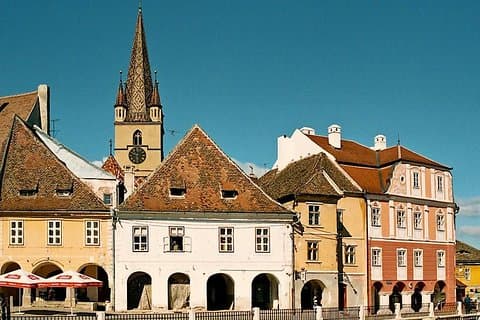
ng peacefully for centuries and where the various religious monuments (Catholics, Orthodox and Protestants) demonstrate this peaceful coexistence. Sibiu was named European Capital of Culture in 2007 and hosts an extraordinary theater festival every year. The city fascinates thanks to its three squares (Big Square, Small and Huet Square ) that transport tourists in a real medieval atmosphere. Its towers and its 15th century bastions, but also its beautiful museums and the famous “houses with the eyes” give the visitor lovely moments. Also in Sibiu you will see one of the largest gothic evangelical churches in Transylvania.
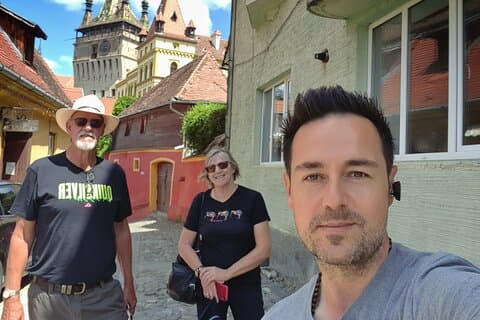
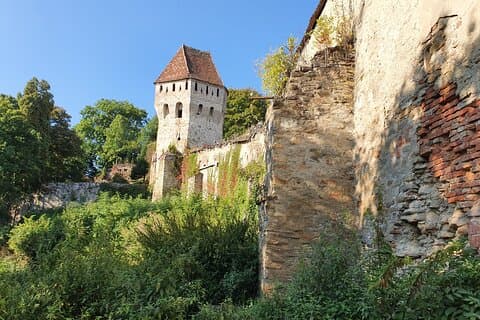
This citadel is the best preserved in Europe and, extraordinary, it is still inhabited. Since 1999 the historic center of Sighisoara is a UNESCO heritage site. Here we will admire the church on the hill, reachable after a wooden staircase called the schoolchildren’s ladder. We will also see the statue of the famous Hungarian national poet Petofi Sandor, testifying to the fact that in Sighisoara the Magyar community was in the past numerically important. Next to the statue is the beautiful Catholic church, reserved for the Hungarian community, and the tower of the shoemakers. You can have lunch at the house where Vlad the Impaler was born (not included)
ant cultural, tourist and commercial center. Brasov impresses with its typically German architecture, where the Gothic, the Baroque and the Renaissance intersect to give life to an interesting and culturally very lively city. Visit of the First Romanian School, which is located in the oldest district of the city, and which was inhabited exclusively by Romanians, the Schei district, interesting for the entrances into the city that were carried out in medieval times through the Caatherine’s and Schei Gate, quest last of the nineteenth century. In Brasov we will also visit the impressive Black Church, the largest evangelical Gothic church in Eastern Europe, with a 65 meter high bell tower and a length of 90 meters, the church houses the most beautiful nineteenth-century mechanical organ of Romania. We will then admire the palaces and houses of the historic center, recently restored, with the Council Square which now houses a beautiful museum, and the pedestrian Avenue of the Republic.
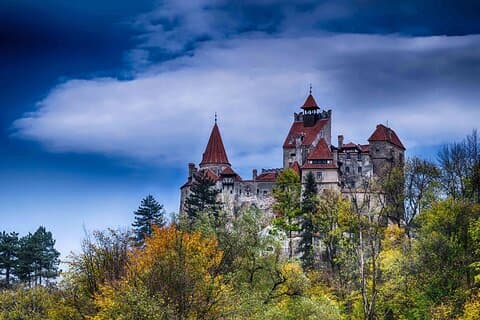
In the Middle Ages, Bran was exactly on the border between Wallachia and Transylvania, so it was essential for the inhabitants of Brasov to build and preserve a defensive stronghold
mania, the King Charles 1 of Hohenzollern, of German origins. The castle was beautifully designed by a Czech architect, and is famous for being one of the most modern castles in Europe at the time of its construction, between the 19th and 20th centuries. Each room is characterized by a unique style, different from the styles of the other rooms. We will also admire the Florentine room, where we will breathe a typically Italian and Renaissance atmosphere.
th the collaboration of construction experts, anthropologists, ethnographers and sociologists from all over Romania. This wonderful open-air museum offers the opportunity to learn about the lifestyle of the romanian farmers of the 19th century, their houses, their water mills and their churches entirely made of wood. Here everything is authentic. We will also admire a wooden Maramures church, which was dismantled and then taken to the museum. In this regard, remember that many wooden churches of Maramures are UNESCO heritage
entagon, built at the behest of the dictator in the 80s of the 900 and for whose creation an entire neighborhood was razed
ian area, with the remains of the princely fortress of Vlad the Impaler, the 16th century palatine church in Byzantine style, and the Stavropoleos church, an architectural jewel of the 18th century, in typical Wallachian style, with important oriental influences in external decoration.
Departure at 09.00 a.m. from your hotel or indicated address
If you cancel at least 6 full day(s) before the scheduled departure time, you will receive a full refund.<br>If you cancel between 2 and 6 day(s) before the scheduled departure time, you will receive a 50% refund.<br>If you cancel within 2 day(s) of the scheduled departure, you will receive a 0% refund.
Gennemse Bucharest efter kategori - skip-the-line billetter, ture til fods, dagturnéer, madbeskrivelser og meget mere